With the 2019 Rugby World Cup slowly edging nearer, RUCK.co.uk has had a look back at the 2003 team of the tournament.
We’ve remembered why they were in the team but also had a look at what this XV are doing now 15 year’s on.
15: Mils Muliaina (New Zealand)
Why he was on the team?
The All Black runner may have missed out on a place in the final but he was, without doubt, the full-back of the tournament.
He ended as the leading try scorer - topping the tables with seven alongside team-mate Doug Howlett - and looked dangerous wherever he found himself in possession.
He scored one of the tries of the tournament against Tonga, as well as running four in against Canada, and looks set to be New Zealand's long-term answer at number 15.
What is he doing now?
After winning 100 caps (three as captain) for the All Blacks, the fullback moved to Europe, playing for; Connacht and Zebre before ending his career in the USA with San Francisco Rush. He's now working as a pundit back in New Zealand.
14: Rupeni Caucaunibuca (Fiji)
Why he was on the team?
Seeing the Fijian flyer in action was strangely reminiscent of Jonah Lomu in his prime. The only caveat to Caucau's World Cup appearance was that it was all too brief, as Fiji failed to qualify from the pool stages.
He was on fire from the very outset, sprinting in a 70-metre solo spectacular against France before being banned for two games for a punch on Olivier Magne.
Thankfully, Caucau returned for the final game against Scotland and was at his prolific best once more with a further two tries.
What is he doing now?
Following a career in France he left Agen in November 2014 and took up a contract with Army SC to play in the Sri Lankan Rugby League.
13: Stirling Mortlock (Australia)
Why he was on the team?
He was not even on the bench in Australia's opening match of the tournament but finished the first semi-final as man of the match and was equally strong on the losing side in the final.
His return from shoulder surgery complete, he was in mesmeric form, constantly causing chaos in the All Blacks defence as well as running England ragged on occasions.
His try against New Zealand was just reward for his long road to fitness - and the victory over the All Blacks seemed apt following such a wonderful performance. Sadly for him, he couldn't quite repeat it in the final.
What is he doing now?
Mortlock, who amassed 80 Test caps between 2000 and 2009, hung up his boots at the end of the 2012 Super Rugby season. He is now a founding Partner at Unio Advisors who look after peoples money.
12: Tony Marsh (France)
Why he was on the team?
Marsh's return to form and fitness is even more impressive than Mortlock's, having won his battle with testicular cancer just in time to earn his player in France's World Cup squad.
It remained unclear whether he would be capable of the sort of form he had previously showed at international level but, if anything, he was better than ever.
Always looking to launch a fresh attack - even in the reasonably pointless third-place play-off - he ran his lines beautifully as well as putting in the big tackles when it really mattered.
What is he doing now?
Marsh played his last game for France in 2004 and his last game for Clermont came in the 2007 French Championship match against Stade Francais. He now works in strength and conditioning.
11: Lote Tuqiri (Australia)
Why he was on the team?
Tuqiri's selection on the left wing was deemed a gamble not worth taking according to many of Australia's critics.
But the former league star proved his doubters wrong and was in superb form, always looking exciting on the attack as well as enjoying a superb rapport with both Mat Rogers and Wendell Sailor.
His defence was also supreme and he saved a try when he forced Mils Muliaina to knock-on over the try line in the semi-final, before his try in the final when
he latched onto a Stephen Larkham up-and-under.
he latched onto a Stephen Larkham up-and-under.
What is he doing now?
The cross-code star eventually returned to rugby league in 2010 following spells with Leicester Tigers and Leinster.
Tuqiri was then part of the South Sydney side who defeated the Canterbury-Bankstown Bulldogs 30–6 in the 2014 NRL Grand Finalat ANZ Stadium.
He then hung up his boots and set up a marketing agency.
10: Jonny Wilkinson (England)
Why he was on the team?
It seemed fitting that it was Wilkinson who stole the headlines with his extra-time drop goal - virtually the final kick of the tournament.
He had been the talk of the town in both England and Australia - the World Cup hosts often criticising his game and England's reliance on him, while the English papers praised his unerring accuracy.
But when the pressure mounted, he did the job. And few could argue with his role as our playmaker.
What is he doing now?
After 2003 Wilkinson endured a succession of injury problems that interrupted his England career but he played in the 2007 World Cup final and won the Six Nations in 2011, retiring from international rugby in the December of the same year after England’s failed World Cup campaign.
In the 2015 Queen’s Birthday Honours, he was promoted to Commander of the Order of the British Empire (CBE) ‘for services to Rugby Union’. Has also set up the Jonny Wilkinson Foundation, seeking to offer life-changing support to members of his community who need it most.
He also works as a pundit for ITV and SKY.
9: Fabien Galthie (France)
Why he was on the team?
He was one of the few truly reliable ball distributors throughout the tournament, and his inspirational leadership and relationship with fly-half Frederic Michalak was the main reason for France's explosive displays.
What is he doing now?
Retired following the tourament and has since went into coaching. He currently leads the three-time European champions Toulon.
1: Bill Young (Australia)
Why he was on the team?
Young won his place at loose-head for his sterling efforts against the All Blacks and England.
He did not put a foot wrong in the scrum and terrorised the opposition front rows, leading to a host of penalties from his English rivals in the final.
But it was in open play where he was at his most prolific, and he never seemed to tire of running as the clock ticked on.
What is he doing now?
Young announced his retirement from rugby on 18 July 2006 to prevent further trouble with a chronic neck injury. In total he was capped 46 times for Australia and played 100 matches for the ACT Brumbies. He retired as the second most capped Wallaby prop of all time.
Young now operates the Concord Hotel, a suburban pub in Concord West, NSW. He also owns The Palace Hotel in Mortlake, NSW and Wisemans Ferry Inn Hotel, NSW.
2: Keith Wood (Ireland)
Why he was on the team?
Like Galthie, Wood has hung up his boots but certainly gave everyone something to think about.
As always, "the raging potato", as he became known by some commentators, was the very heart of everything that Ireland did.
His line-out throwing - in the past one of his weak points - was more accurate than a Tomahawk missile, while he ran his heart out and kicked like the best fly-halves at times.
What is he doing now?
Wood made his last appearance on the BBC as a regular pundit having worked for the Beeb for 21 years and The Daily Telegraph as a freelance journalist. In 2014, Wood was inducted into the IRB Hall of Fame.
He now works as a journalist back in Ireland for The Irish Times.
3: Phil Vickery (England)
Why he was on the team?
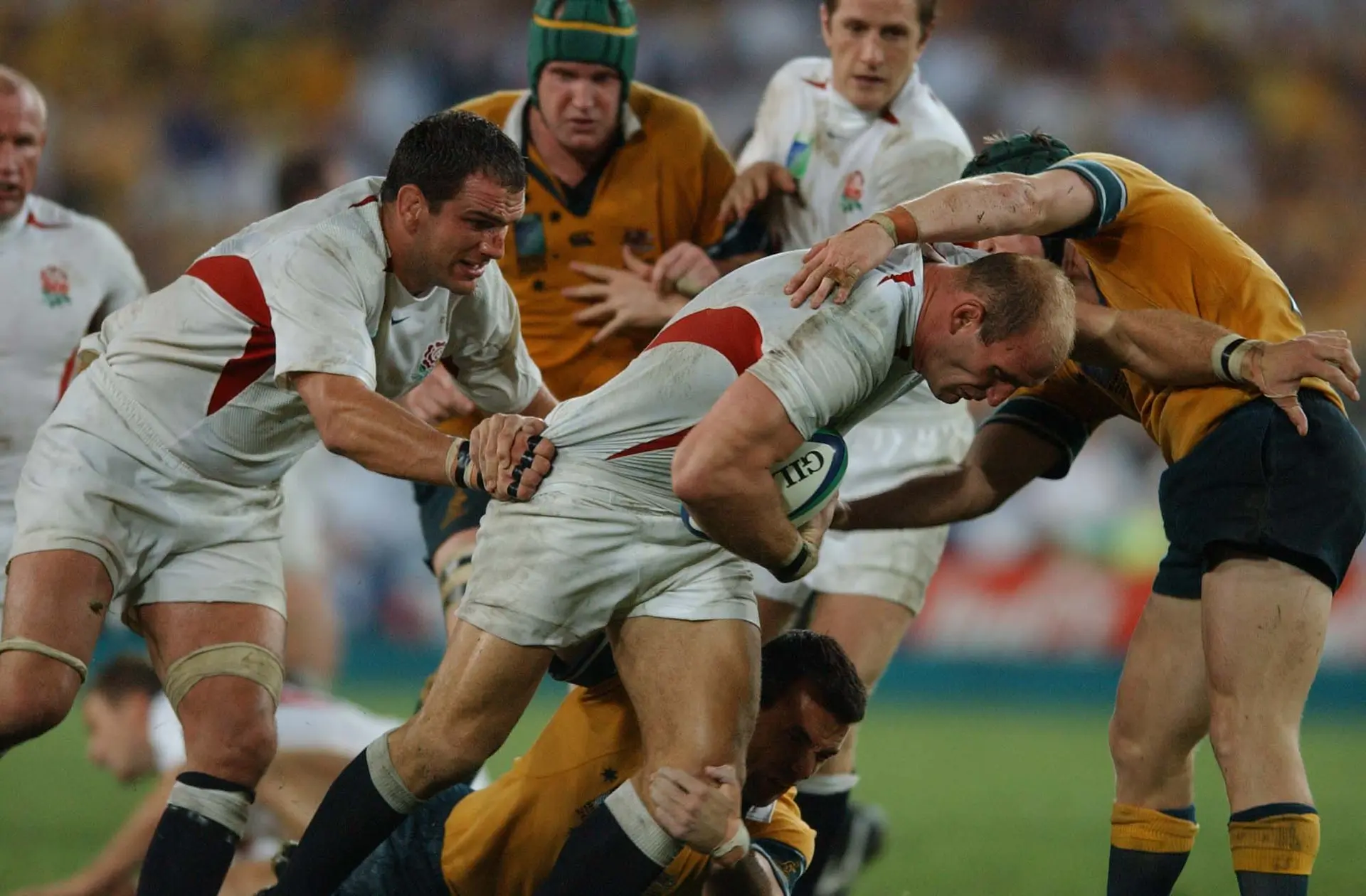
England's front five proved the strongest in the tournament but Vickery was the pick of the front-rowers in the second semi-final and the final, making all of his 18-stone bulk pay in a series of telling shoves.
He is never going to win any sprint plaudits but his game is much more about the weight he gives to England's scrums than anything.
However, he enjoyed the occasional burst against France and Australia, scuttling over the odd tackler, even though he had the occasional difference of opinion with final referee Andre Watson.
What is he doing now?
Captain of the (almost successful) 2007 World Cup squad. Retired in 2010 due to neck injuries. Won the 2011 series of Celebrity Masterchef before working as a co-commentator at the 2011 Rugby World Cup for ITV.
4: Martin Johnson (England)
Why he was on the team?
Johnson was the clear captain of the World Cup XV, having lifted the Webb Ellis Trophy aloft after England's 20-17 win against Australia.
But it was not just his leadership which gets him in the starting line-up. Simply as a second-rower he was truly outstanding.
He was always irritating the opposition in the line-out, driving at every opportunity and taking on attack after attack whenever he got the chance. The overwhelming star lock down under.
What is he doing now?
The World Cup winning captain retired from international rugby before the 2004 Six Nations, continuing to play at club level for Leicester until 2006. In 2007 he worked as an analyst for ITV in their coverage of the Superbowl before becoming a surprise choice as England chief in April 2008.
Still getting over the 2011 World Cup which brought to an end his stint as England supremo. Has taken up cycling and done some coaching sessions with younger players and was an ambassador for the 2015 World Cup.
5: Paul O'Connell (Ireland)
Why he was on the team?
Aside from Johnson, there were a lot of stars in the second row. Australia's main protagonists did not put a foot wrong until the final where their line-out didn't quite work.
South Africa's Victor Matfield was another impressive player as was Ireland's Malcolm O'Kelly, but it is O'Kelly's team-mate Paul O'Connell who makes it into the mix.
The Irish line-out was majestic, only showing cracks in the quarter-final defeat to France, while O'Connell was also a raging inferno in the loose.
What is he doing now?
After retiring following the 2015 Rugby World Cup, the Ireland legend joined BBC Sport as a pundit and commentator ahead of their coverage of the 2017 Six Nations Championship, but joined ITV for the 2019 World Cup. He's very good too!
6: George Smith (Australia)
Why he was on the team?
Critics said Australia would not beat the big boys of world rugby with two natural open-side flankers, but Smith, a man of perpetual motion, rammed that notion back down their throats.
He was afforded a standing ovation by the Telstra Stadium crowd when he came off in the semi-final win over New Zealand and made England's life a misery whenever the chance arose in the final.
What is he doing now?
The unit was still going! After spells all over Europe and in Japan, the Wallabies legend finally hung up his boots at the end of the 20178/19 season after playing for the Bristol Bears in the Gallagher Premiership.
7: Joe van Niekerk (South Africa)
Why he was on the team?
South Africa dipped out of the tournament after a quarter-final defeat to New Zealand - so it is easy to forget the sort of impact van Niekerk made.
The Springboks were a tad too fluctuating on the field, but not van Niekerk, who could not have been blamed for any of their misadventures.
Defensively, he is an irritation to any attackers, but it was with the ball in hand that he was at his finest.
What is he doing now?
In 2008 Van Niekerk packed his bags and headed for Toulon in France where he became an instant club legend, playing - and captaining the side - in 122 matches.
Then he disappeared off the radar.
Completely.
That was until Toulon's non-official fan club posted a picture of another former Toulon player Pierrick Gunther who caught up with Van Niekerk, who now manages his psychological fitness centre for burn victims in Costa Rica.
8: Lawrence Dallaglio (England)
Why he was on the team?
Some had said the England number eight was past it, but they were left eating their words after his displays against the French and All Blacks.
In both games he protected Matt Dawson superbly as well as always being willing and able to take the ball into contact throughout.
For all the criticism, his World Cup outcome must have been more satisfying than for most.
What is he doing now?
Retired in 2008 helping Wasps win the Guinness Premiership final at a sold-out Twickenham in his last professional game. He went on to work as an analyst for ITV during the 2011 Rugby World Cup and co-commentated on the semi-final match between Australia and New Zealand before setting up the Dallaglio Foundation which has raised millions of pounds for charity through gruelling cycling challenges. Now BT Sport’s lead rugby union expert.