Bundee Aki missed arrival of his daughter after wife gave birth in a CAR
Rugby NewsWednesday, 11 February 2026 at 18:11
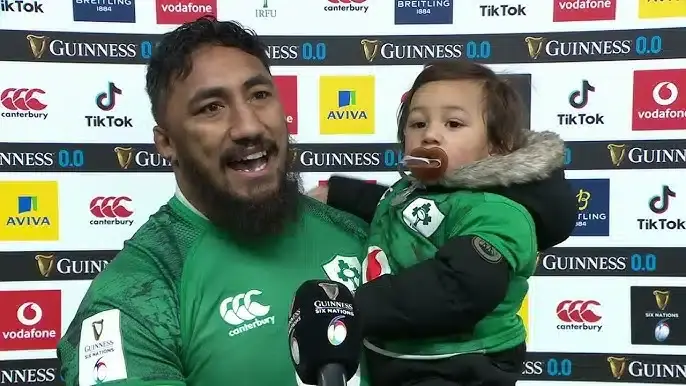

Bundee Aki’s Lions tour delivered drama on and off the pitch — with the Ireland centre revealing his wife gave birth in the back of a car just hours before a Test match.
The 35-year-old was in Brisbane preparing for the series opener when wife Kayla, back in New Zealand, called to say contractions had started.
Watch the Guinness Six Nations at your local Greene King sports pub.
Within minutes her waters had broken — and the hospital was still 40 minutes away.
Then came the moment he’ll never forget.
“She video-called me and I could see the baby,” Aki said. “She had delivered in the car. Credit to my wife — she’s a powerful woman.”
Daughter Aine arrived safely, with both mum and baby healthy.
Aki went on to help the Lions secure a 27-19 opening Test win — later admitting he took the chaotic scenes as “good juju”.
While the series ended without a whitewash following a 22-12 defeat in Sydney — a game where Aki conceded he underperformed — the bigger victory had already been secured.
And there was no long wait for a reunion.
Aki was able to meet baby Aine in August after the tour, bringing a remarkable chapter of his Lions adventure full circle.
From back-seat delivery drama to Test match intensity — it’s a campaign the powerhouse centre will never forget.
Law change reduces number of foreign-born players in Ireland and Scotland Six Nations squads
The Six Nations has always been rooted in tradition — but in the modern era, international squads are increasingly shaped by migration, ancestry, and residency eligibility.
In 2026, foreign-born players remain a major part of the championship picture, although the overall numbers have fallen sharply compared to recent years.
Scotland — 14 foreign-born players (35%)
- Homegrown: 26/40 (65%)
- Foreign-born: 14/40 (35%)
Scotland once again lead the Six Nations for overseas-born representation.
Full list (Scotland)
Nathan McBeth — South Africa (Grandparent)
Pierre Schoeman — South Africa (Residency, 2021)
Ewan Ashman — Canada (Parent)
Elliot Millar Mills — England (Parent)
Josh Bayliss — England (Grandparent)
Jack Dempsey — Australia (Grandparent)
Ben White — England (Grandparent)
Fergus Burke — New Zealand (Grandparent)
Tom Jordan — New Zealand (Residency, 2024)
Rory Hutchinson — England (Grandparent)
Sione Tuipulotu — Australia (Grandparent)
Kyle Rowe — England (Cumulative Residency)
Kyle Steyn — South Africa (Parent)
Duhan van der Merwe — South Africa (Residency, 2020)
Wales — 9 foreign-born players (23.6%)
- Homegrown: 29/38 (76.3%)
- Foreign-born: 9/38 (23.6%)
Wales sit mid-table, with most foreign-born players coming through English development pathways or overseas heritage.
Full list (Wales)
Tomas Francis — England (Grandparent)
Archie Griffin — Australia (Parent)
Ben Carter — England (Residency, 2004)
Freddie Thomas — England (Grandparent)
Olly Cracknell — England (Grandparent)
Josh MacLeod — Monaco (Residency, 2004)
Gabriel Hamer-Webb — England (Parent)
Ellis Mee — England (Parent)
Blair Murray — New Zealand (Parent)
Italy — 8 foreign-born players (24.2%)
- Homegrown: 24/33 (72.7%)
- Foreign-born: 8/33 (24.2%)
Italy continue to benefit from a diverse talent pool, drawing on Argentine heritage and residency-qualified backs.
Full list (Italy)
Pablo Dimcheff — Argentina (Grandparent)
Muhamad Hasa — Albania (Residency, 2014)
Martin Page-Relo — France (Grandparent)
Stephen Varney — Wales (Parent)
Juan Ignacio Brex — Argentina (Grandparent)
Paolo Odogwu — England (Parent)
Montana Ioane — Australia (Residency, 2020)
Matt Gallagher — England (Grandparent)
Ireland — 8 foreign-born players (20%)
- Homegrown: 34/40 (85%)
- Foreign-born: 8/40 (20%)
Ireland remain one of the most homegrown squads in the championship, but several key players — especially in the backline — were born abroad.
Full list (Ireland)
Jeremy Loughman — USA (Parent)
Finlay Bealham — Australia (Grandparent)
Cormac Izuchukwu — England (Parent)
Joe McCarthy — USA (Parent)
Jamison Gibson-Park — New Zealand (Residency, 2019)
Ciarán Frawley — Australia (Parent)
Bundee Aki — New Zealand (Residency, 2017)
James Lowe — New Zealand (Residency, 2020)
France — 7 foreign-born players (15.5%)
- Homegrown: 39/45 (86.6%)
- Foreign-born: 7/45 (15.5%)
France have one of the strongest domestic player bases, but still include a handful of residency-qualified forwards.
Full list (France)
Dany Priso — Cameroon (Residency, 2008)
Uini Atonio — New Zealand (Residency, 2014)
Tevita Tatafu — Tonga (Residency, 2024)
Joshua Brennan — Ireland (Residency, 2005)
Thibaud Flament — Belgium (Born in France)
Emmanuel Meafou — New Zealand (Residency, 2023)
Tom Staniforth — Australia (Residency, 2025)
England — 6 foreign-born players (16.6%)
- Homegrown: 34/36 (94.4%)
- Foreign-born: 6/36 (16.6%)
England have the most domestically produced squad in the tournament, with only a small group born outside the country.
Full list (England)
Bevan Rodd — Scotland (Parent)
Emmanuel Iyogun — Spain (Residency)
Sam Underhill — USA (Parent)
Marcus Smith — Philippines (Parent)
Henry Arundell — Dhekelia (Parent)
Immanuel Feyi-Waboso — Wales (Grandparent)
Ranking: Most foreign-born players (2026)
England — 6
Scotland — 14
Wales — 9
Italy — 8
Ireland — 8
France — 7
TRENDING



LATEST NEWS

LATEST COMMENTS
- Jordie Barrett over Damian de Allende is far from being correct. The hype around Dupont is also overreaching, he's probably 4th in the world and has been since the 2023 WC. He also avoids certain matchups which is strange. The rest of the list is pretty good apart from minor subjective biases.JasonMarlow16-09-2026
Loading