Fans confused after seeing picture of Six Nations balls being charged up
Rugby NewsThursday, 02 February 2023 at 12:45

The 2023 Six Nations is fast approaching,
so here’s a rundown of the little changes that are coming to the tournament this year.
Smart ball
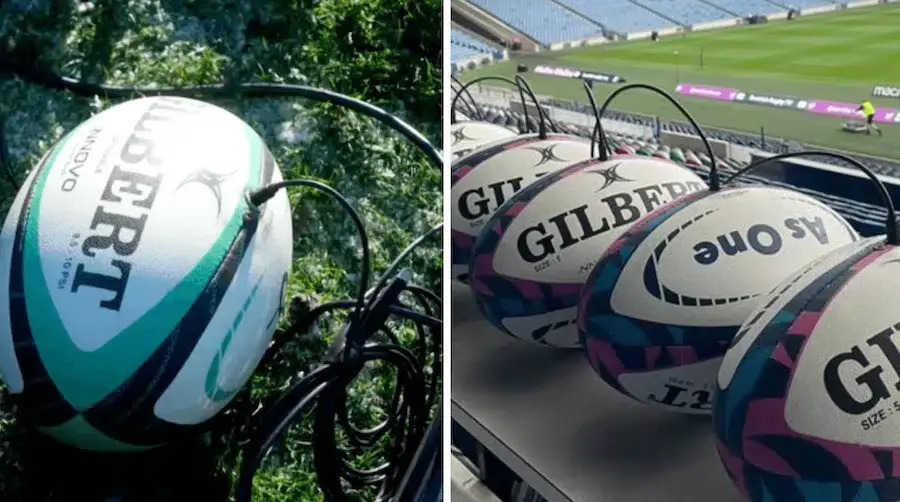
Fans have been left extremely confused after seeing an image of Six Nations balls being charged up before the opening game this weekend.
The Smartphone changed the landscape of the world forever and it now seems the introduction of the Smart Ball could have the same effect on rugby.
Each rechargeable ball, in a phenomenal feat of engineering, contains a micro-tracking chip within which does not affect performance or flight, and communicates up to 20 times per second via radio frequency technology with 10 beacons placed around the stadium.
The net result is that, after five years and thousands of hours of research, trialling and development, the artificially intelligent Smart Ball can instantly track, in real time and 3D, ball location and movement within centimetres, and is even able to instantly differentiate the type of kick made, be it a box-kick, tactical kick, kick to touch, kick for goal or grubber kick.
It can then provide information such as distance, hang-time, speed and spin within milliseconds, meaning the endpoint of a kick or the length of time it hung in the air is provided upon the ball's landing, wirelessly, with no delay.
Watching fans are thus afforded access to the distance, speed, gain and effectiveness of kicks or passes within seconds on broadcast. 'Reload time' can show which players have the quickest hands, for example.

Penalising negative player actions
Referees are expected to take action against negative player actions such as trapping players in the ruck, and players not attempting to play the ball in jackall situations.
A statement says: "Players are reminded about their responsibilities not to hold the ball or walk off with the ball at penalties – this reduces attacking options by the non-offending team and slows the game down unnecessarily and will be sanctioned."

Referee, Wayne Barnes during the Gallagher Premiership Rugby Match between Bristol Bears and Bath Rugby at Ashton Gate on 29 Jan. Photo: Phil Mingo/PPAUK
Speeding up the game
World Rugby encourages all levels of the sport to adopt guidelines aimed at speeding up the game. Elite competitions are encouraged to use a shot clock, similar to the one trialled in the LNR/FFR competitions, when feasible. A clock for kicks at goal is already being used in France's Top 14.

Owen Farrell of England takes a penalty kick during the Autumn International Series match between England and New Zealand at Twickenham, London on 19 November 2022 (Photo: Micah Crook/PPAUK)
World Rugby director of rugby Phil Davies said: “World Rugby, member unions and competitions will work with broadcasters and match hosts to implement on-screen (stadia and broadcast) shot clocks for penalties and conversions to ensure referees, players and fans can view the countdown, mirroring what happens in the LNR and Sevens."
Conversion. [The kicker] takes the kick within 90 seconds (playing time) from the time the try was awarded, even if the ball rolls over and has to be placed again. Sanction: Kick is disallowed.
Penalty Kick: The kick must be taken within 60 seconds (playing time) from the time the team indicated their intention to do so, even if the ball rolls over and has to be placed again. Sanction: Kick is disallowed and a scrum is awarded.
[ad_connatix
A player must not waste time. Sanction Free Kick
Lineout: Teams form the lineout without delay. Sanction: Free-kick.
Scrum: Teams must be ready to form the scrum within 30 seconds of the mark being made. Sanction: Free-kick.
Cutting reliance on TMO reviews
Officials are being reminded that the TMO protocol is meant to quickly identify and address clear and obvious infractions on the field, and that extended reviews suggest an infraction may not be clear.
Davies added: “There was excellent debate at the Shape of the Game conference on this topic, including leading match officials, coaches and player representatives.
"It was agreed that reviews can often take too long, suggesting the offence being reviewed is not clear and obvious.
"While we can always enhance the technology interaction to speed up the process, the match official teams – led by the referee - should attempt to make speedier decisions and limit replays where not necessary.”

Referee, Jaco Peyper watches the TMO for a potential shoulder charge during the Autumn Nations Match between England and Australia at Twickenham on 13 November 2021. Photo: Micah Crook/PPAUK
Fewer water carrier interventions
Water will be able to be taken onto the field when a try is scored.
While the global law trial on limiting the number of water carriers to two, and reducing the times they enter the field, has reduced unnecessary stoppages, World Rugby say creating set windows for water breaks has created the impression of disrupting the game, even if that water was taken during a natural stoppage (try/injury/TMO review).
Davies added: “Following discussions with stakeholders, an amendment to the current global law trial covering water carriers will allow water onto the field when a try is scored. Participating competitions and unions are reminded of the 60/90 second limits on kick times. Only in a game with no tries, should a natural stoppage be used."
[ad_connatix
TRENDING





LATEST NEWS




LATEST COMMENTS
- Jordie Barrett over Damian de Allende is far from being correct. The hype around Dupont is also overreaching, he's probably 4th in the world and has been since the 2023 WC. He also avoids certain matchups which is strange. The rest of the list is pretty good apart from minor subjective biases.JasonMarlow16-09-2026
Loading