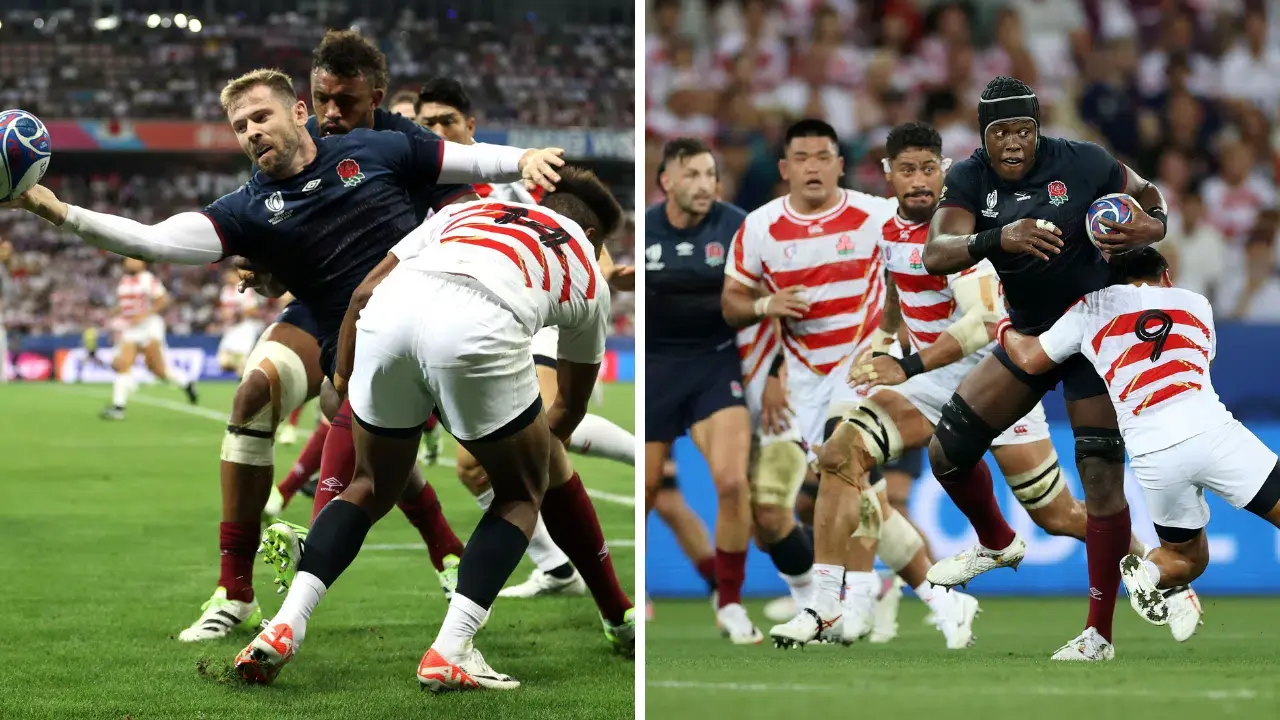

England have secured their second win at the Rugby World Cup, with a 34-12 bonus point victory over Japan in Pool D. England dropped down a gear from their impressive performance against Argentina, yet did enough to secure the win over the Brave Blossoms.
This Autumn, Ruck’s England content will be powered by Charles Tyrwhitt, as they introduce an exclusive assortment of England Rugby apparel and accessories within the Tyrwhitt Supporter Collection. Not only do they back the team, but they also elevate your wardrobe.
A kicking match broke out for the opening 20 minutes, before England scored the first try of the match. Flanker Lewis Ludlam came up with the plaudits, after a fumbled Japan line-out on their own 5m line gifted Steve Borthwick's men a try after 26 minutes. George Ford and Rikiya Matsuda kicked the difference for their sides, who departed at a 13-9 at the break.
Japan clawed their way to just one point behind, with Matsuda again adding three points from the tee. A tide-turning try soon followed with England captain Courtney Lawes scoring an important try before the hour mark. Freddie Steward's try took the match out of sight for Japan, with the pats on the back again going to George Ford, after the fly-half's pinpoint kick to the corner. Joe Marchant secured the bonus point try in the final play in the game, as England press on to round three against Chile.
Here are the five biggest talking points from England's win over Japan
1. England Take 40 Minutes to Attack with Malice
England attempted to 'turn the screw' with a kick to the corner for a penalty to close out the first half, however, the efficiency was not there. A move from the training ground failed to click into place, and Jamie George knocked the ball forward. England lacked any punch in their first half offensive, with 41 carries seeing the Japan line broken just once.
England were later awarded a penalty on the stroke of half-time, and after the failed line-out move, Ford took matters back into his own hands, and opted to take the points instead of working a set-piece into a try. An underwhelming first half lacked any fire in the midfield, with England's ball carriers seemingly accepting the contact, and not hurtling into the collisions as they did against Argentina. After leaving bruises on the Argentines, Manu Tuilagi had a slower run-out against Japan.
England's efforts drastically improved in the second half, with Courtney Lawes' try presenting a seismic shift in energy for Steve Borthwick's side. Ford and Freddie Steward all stepped up in the second half, with Ollie Lawrence adding the extra fire when Tuilagi run out of steam after just three carries. Marcus Smith electrified the tempo with his late introduction, as England saw out the match in style.

2. Over-Kicking Insistence is Self-Destructive
Both sides presented a modern criticism amongst modern day rugby, as England and Japan frequently preferred to kick the ball away instead of orchestrating an attack. Boos rang out around the stadium as Alex Mitchell insisted on putting boot to ball, with unambitious box kicks over the Japan defenders. Such kicks are often reserved as a 'get out of jail' option to clear the lines, however, England especially went to the boot far too many times, and even kicked the ball away when they are in the Japanese final third.
England seemed to rush whenever they were slightly out of position, and instead of running a few phases and re-gathering their composure, Mitchell or Ford would send the ball sailing down-field. The quality on display was far less than the aggressive go-forward approach of the side that took on Argentina. England's worst offence came in the 61st minute, with Jonny May desperately calling for the ball yet Joe Marchant decided to kick the ball away, without even a look at the heavy overlap on the wing.
George Ford did eventually utilise the boot well, as he did against Argentina. His best work was the cross-field-kick, that provided the assist for Freddie Steward's try. A pinpoint nudge to the fullback was one of the better open-play efforts from the boot, as the Sale Shark supplied the ammunition for the Leicester man's try.
3. Japan Adopt the Ford Philosophy
England fly-half George Ford began proceedings against Japan, in the same fashion that he closed out the match against Argentina. The tactic early in the contest was to tick the score-board over against the Brave Blossoms, with Ford getting the first points for Steve Borthwick's side after just three minutes. Ford nailed his first two attempts at the sticks, yet added an uncharacteristic miss to his record on the 29th minute.
Japan mirrored England's tactics, as they opted to take a shot at goal after winning a penalty. Despite England's discipline improving from over the Summer, Japan were more than within touching distance in the first half thanks to the sharpshooting of Rikiya Matsuda. Japan edged within one score after 54 minutes, with questions again asked about England's mindset and discipline in defence. 13-12 with 38% position just before the hour mark, Japan's clinical responses were rewarded whilst England waisted their time with ball in hand.
4. England Capitalise on Japan Errors
A key area where England prospered, was how quick they were to react to errors made by the Brave Blossoms. The humid conditions made it a greasy surface, with the ball spilled loose often to a dark blue jersey. Flanker Lewis Ludlam capitalised on a Japan mistake to gift England their first try of the contest. Ollie Chessum was fastest to react to a fumbled Japan line-out, with the ball spilled close to the Japanese try-line.
What followed was Ludlam being driven over from close range, as England established a four-point lead in the first half. George Ford started off the second half with a kick into the back field, as he identified the weak mis-management in the Japan back-three. Japan are amongst the emerging 'tier two' nations, yet presented their shortcomings in the second half against England. They lacked direction when England scored through Lawes, and relied on sporadic individual breaks from the likes of Matsushima and Nakamura.
5. Joe Marler Uses His Head
The Harlequin provided the all important header for Courtney Lawes' surprising try. The refereeing team was left scratching their heads for a brief moment, before the laws were clarified in how Marler's knock on was within the laws of the game, as the ball ricocheted off his iconic mohawk.
A try that seemingly changed the tune of the second half, England began to come into their own after Lawes' try. Japan too responded to ignite the contest, as Kotaro Matsushima broke away at pace shortly after, and was brilliantly coined as the 'bullet train' after his direct running style. When Marler departed the pitch, he received a strong ovation from the travelling England faithful. Selected this week ahead of Ellis Genge, Marler made good on his opportunity with an unorthodox assist.
ENGLAND: 34
TRIES: 4 (Ludlam 26', Lawes 58', Steward 65', Marchant 80')
CONVERSIONS: 4 (Ford 26', 58' , 65', 80)
PENALTIES: 2 (Ford 3', 40')
DROP GOALS: 0
YELLOW CARDS: 0
BUNKERS: 0
RED CARDS: 0
JAPAN: 12
TRIES: 0
CONVERSIONS: 0
PENALTIES: 3 (Matsuda 15', 23', 31, 55')
DROP GOALS: 0
YELLOW CARDS: 0
BUNKERS: 0
RED CARDS: 0