
5. Sudden tide
Date: 26 March 2012
Summary: Players get caught in tide
Location: Port Elizabeth
Six players from Motherwell Rugby Club went swimming following a beach practice session in Port Elizabeth.

One player immediately drowned while five of his team-mates were missing and feared dead after being swept out to sea off the south coast.
The five were never seen again.
4. IRA bombing
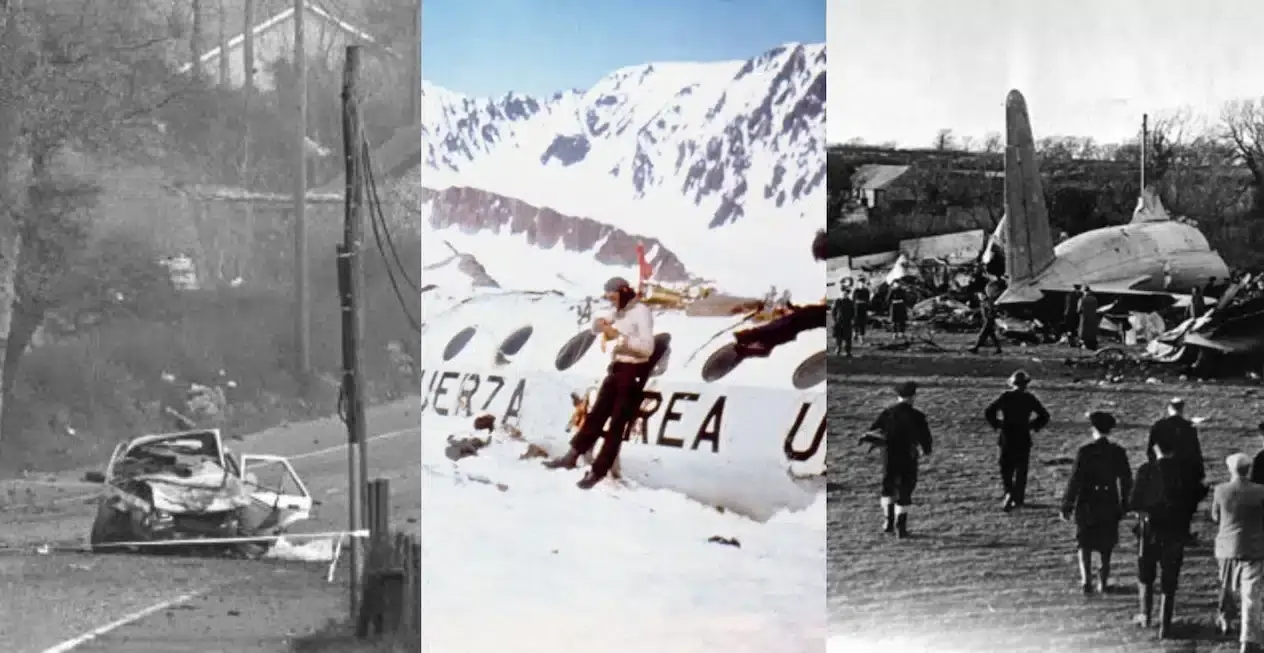
Nigel Carr was an Ireland rugby union international whose promising career was cut short due to injuries sustained in an IRA bomb explosion.
On 25 April 1987, Carr, David Irwin and Philip Rainey had set off for a training session in Dublin before the World Cup.
On that day the IRA had targeted Lord JusticeSir Maurice Gibson - Northern Ireland's second most senior judge - who was travelling back from holiday with his wife, Lady Cecily Gibson, and a 500 lb land mine was detonated at Killean, on the border, killing them both.

Heroically, Irwin, pictured left, then pulled Carr and Rainey from the car. That may have saved their lives.
The three Ireland internationals were on the same stretch of road when the bomb exploded and although miraculously, they all escaped serious injury, the explosion ended Carr's rugby career at just 27.
3. Paris air crash
Date: 3 March 1974
Summary: Cargo door failure due to aircraft design flaw leading to explosive decompression; loss of control
Location: Ermenonville Forest
Fontaine-Chaalis, Oise, France
Fontaine-Chaalis, Oise, France
18 Bury St Edmunds Rugby Club members and supporters killed in the 1974 Paris air crash.

The granite memorial, inspired by a larger one at Ermenonville near Paris, was unveiled by John Cousins, the last surviving member of a club party who had flown to France to see England play.
John had been one of a small group who decided to stay in France instead of catching the ill-fated Turkish Airlines DC10 from Orly on March 3, 1974.
The crash, in which 346 died, was the second attributed to a poorly designed cargo door latching system on the DC10 and resulted in a redesign of the locking system
2. Llandow air disaster
Date: 12th March 1950
Summary: Stall
Location: Sigingstone, Wales
Triumph turned to tragedy when 75 Welsh rugby supporters and five crew members were killed in a plane crash as they returned from an international match in Ireland.
The plane, an Avro 689 Tudor V named Star Girl, had been chartered privately to take supporters to see Wales take on Ireland in rugby union’s Five Nations Championship.

After an uneventful outbound flight, the 78 supporters travelled up to Belfast via Dublin to see Wales beat Ireland 6-3 to win the Triple Crown and were in high spirits when they boarded the plane in Dublin on Sunday afternoon.
However, almost home, the aircraft stalled and plummeted towards the ground, coming to rest in a field in the village of Sigingstone.
That there was no fire failed to reduce the death toll, as most of the passengers died on impact as their seats – not properly bolted to the plane’s floor – were flung around the fuselage.
Only three passengers staggered out of the wreckage and although another 10 were pulled out alive, they died in hospital later. The final casualty figure of 80 made the Llandow disaster the worst accident in aviation history at the time.
1. Uruguayan Air Force Flight 571
Date: 13 October 1972
Summary: Controlled flight into terrain due to pilot error, 72-day survival
Location: Remote Andes in Malargüe Department, Mendoza Province, Argentina, near the border with Chile
This has to go down as one of the greatest tragedies in aviation history, not for the scale of death, but for the hardships some of the survivors came to endure.

On 13 October 1972, in an incident known as the Andes flight disaster, flight 571 crash landed at an altitude of 3,600 metres (11,800 ft). Transporting the Old Christians Club rugby union team from Montevideo, Uruguay, to play a match in Santiago, Chile, the twin turboprop Fairchild FH-227D was forced to fly through atrocious weather.
Dipping under the thick cloud, the aircraft clipped a peak standing at 4,200 metres (13,800 ft), severing the right wing. The aircraft then clipped a second peak which severed the left wing and left just the fuselage flying through the air before crashing down a steep slope.
The survivors were, after running out of supplies, were forced to eat those who had been killed in the crash. The events were dramatised in the Hollywood film Alive.