
The 2015 All Blacks and 2023 Springboks produced two of the greatest Rugby World Cup winning teams of the professional era, packed with legendary talent across every position.
But which side would dominate in a combined dream XV?
Here, each starter from the two finals goes head to head, with selections based primarily on overall career achievements, legacy, and individual quality.
Performances in the finals themselves are only used as the deciding factor when the margins between players are too close to separate.
15 Ben Smith
Choosing between Smith and Damian Willemse was difficult, but Smith gets the nod for his reliability and composure. Willemse is an outstanding playmaker with a dangerous running game, though Smith always looked slightly more assured under pressure.
He earned Man of the Match honours for his performance in the semi final against South Africa, which New Zealand won 20-18.
In the final against Australia, Smith became the first player to be carded in a Rugby World Cup final after receiving a yellow for a tip tackle. He later returned to help the All Blacks secure a 34-17 victory, including setting up replacement back Beauden Barrett for a try.
14 Kurt-Lee Arendse
Although Nehe Milner-Skudder made an explosive impact and even scored in a World Cup final, Kurt-Lee Arendse takes the number 14 jersey.
The former sevens star, still in his prime at 29, has shown greater consistency across his career than Milner-Skudder.
At their very best, the New Zealand winger could have challenged for the spot, but overall Arendse stands out as the stronger choice.
He also produced a crucial try saving tackle in the 2023 final, dragging down Ardie Savea near the corner flag.
13 Conrad Smith
Jesse Kriel has been an important figure in South Africa’s success, but Conrad Smith was the superior individual player.
Smith captained the Hurricanes and represented New Zealand from 2004 to 2015. He played a major role in the All Blacks’ Rugby World Cup triumphs in 2011 and 2015 before retiring from international rugby.
An exceptionally intelligent player, he dominated the outside centre role with his positioning, decision making, and ability to outthink opponents.
12 Ma'a Nonu
A remarkable example of longevity, Nonu is still playing in France at 44. He played a key role against Australia, producing a brilliant run for the second try in the final. It capped off a performance full of pace, power, and precision.
Those qualities defined Nonu throughout his career. One of the greatest centres the game has seen, he earns his place ahead of Damian de Allende.
11 Cheslin Kolbe
Julian Savea was devastating at his peak, but Kolbe’s all around game gives him the edge here.
After returning to South Africa from Japan this year, Kolbe continues to impress with electric speed, incredible footwork, and surprising strength for his size.
He was nominated for the 2019 World Rugby Player of the Year award, eventually losing out to teammate Pieter-Steph du Toit.
10 Dan Carter
There was never any doubt about Carter’s inclusion. Widely considered one of the greatest players ever, he was central to New Zealand’s World Cup victories in 2011 and 2015.
In the 2015 final, his accurate goal kicking created breathing room for the All Blacks, while a crucial drop goal stopped Australia’s momentum. He finished with four penalties, two conversions, and a drop goal, earning Man of the Match.
Carter was named International Rugby Board Player of the Year in 2005, 2012, and 2015. As reliable as Handre Pollard has been under pressure, he does not match Carter’s overall influence.
9 Aaron Smith
Smith provided the platform that allowed Carter’s brilliance to flourish. Faf de Klerk came close, but Smith remains the standout choice.
He was instrumental throughout the 2015 campaign and is the second most capped All Black in history.
In the final, he delivered the pass for New Zealand’s opening try and consistently controlled the tempo, outperforming Will Genia.
1 Steven Kitshoff
Among the starting looseheads, Kitshoff delivered a stronger World Cup final performance than 2015 All Black Joe Moody.
He made key contributions around the breakdown, including a turnover that gave Pollard a shot at goal and several powerful clear outs at the ruck.
There was little separating the two overall, but Kitshoff’s longevity also worked in his favour. Had Ox Nche started the final, he may well have claimed this spot instead.
2 Dane Coles
Although Bongi Mbonambi was forced off early in the final, Coles would still have taken the hooker position.
At his peak, he was widely regarded as one of the best hookers in the world and was nominated for World Rugby Player of the Year in 2016.
One of the early modern hookers, Coles combined excellent throwing and scrummaging with genuine impact around the field.
3 Owen Franks
Franks made his New Zealand debut in 2009 and earned 108 Test caps across a decade, making him one of rugby’s most capped players.
He was part of the squads that won the 2011 and 2015 Rugby World Cups.
Remarkably, Franks never scored a point for New Zealand, holding the record for the most international appearances without scoring.
Frans Malherbe was also outstanding at tighthead, but Franks’ longevity gives him the advantage.
4 Brodie Retallick
Leaving Eben Etzebeth out is a huge call, but Retallick is one of the few players capable of edging out the South African enforcer.
Retallick offered more than physical presence alone. He won the World Rugby Player of the Year award in 2014 and remains the youngest winner in the award’s history.
As dominant physically as Etzebeth was, Retallick brought slightly more to his overall game.
5 Sam Whitelock
Franco Mostert narrowly misses out, especially after completing 16 tackles from 16 attempts in the 2023 final.
Whitelock played 153 Tests for New Zealand between 2010 and 2023. He became the youngest New Zealander to reach 100 Tests and the fastest player ever to achieve 100 international appearances.
Named New Zealand Rugby Player of the Year in 2017, he formed one of rugby’s great locking partnerships with Brodie Retallick, and that combination remains intact here.
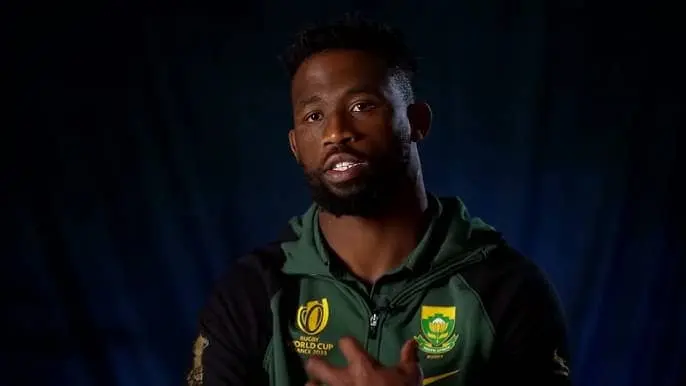
6 Siya Kolisi
This was perhaps the toughest selection, with Kolisi and Jerome Kaino both deserving consideration. Purely as players, Kaino may have had a slight edge, but Kolisi’s leadership elevates him into the side.
Kolisi captained South Africa to a historic fourth Rugby World Cup title in Paris and became only the second captain to win the tournament back to back.
Since becoming captain in 2018, his impact as the Springboks’ first black captain has made him a hugely significant figure in rugby history.
7 Richie McCaw
Despite strong competition from Pieter-Steph du Toit, McCaw was impossible to overlook as the greatest flanker of all time.
For the forwards, McCaw was what Carter was to the backs. He consistently delivered on the biggest stage. In the 2015 final, he produced a vintage display and seemed to be everywhere on the field.
That match marked his 13th Rugby World Cup appearance as captain, which remains a world record.
McCaw earned 148 caps and was rugby union’s most capped player until Alun Wyn Jones surpassed him in 2020. He also shares the record for the most Rugby World Cup appearances with Jason Leonard.
8 Kieran Read
Duane Vermeulen was a formidable enforcer, but Read was the superior all around player across his career.
He won IRB Player of the Year in 2013 and was a vital part of New Zealand’s World Cup winning teams in 2011 and 2015.
His athleticism, leadership, and intelligence made him one of the defining forwards of his generation.
LATEST RUGBY NEWS
- Champions Cup: 2025/26 Team of the Tournament
- Transfer News: Saracens sign South African prop following collapse of another deal
- Toulouse face record fine, could be forced to sell Antoine Dupont
- England scrum-half Alex Mitchell stood down with immediate effect
- Two All Blacks legends set to buy and save Moana Pasifika
TRENDING


LATEST NEWS
LATEST COMMENTS
- Jordie Barrett over Damian de Allende is far from being correct. The hype around Dupont is also overreaching, he's probably 4th in the world and has been since the 2023 WC. He also avoids certain matchups which is strange. The rest of the list is pretty good apart from minor subjective biases.JasonMarlow16-09-2026
Loading