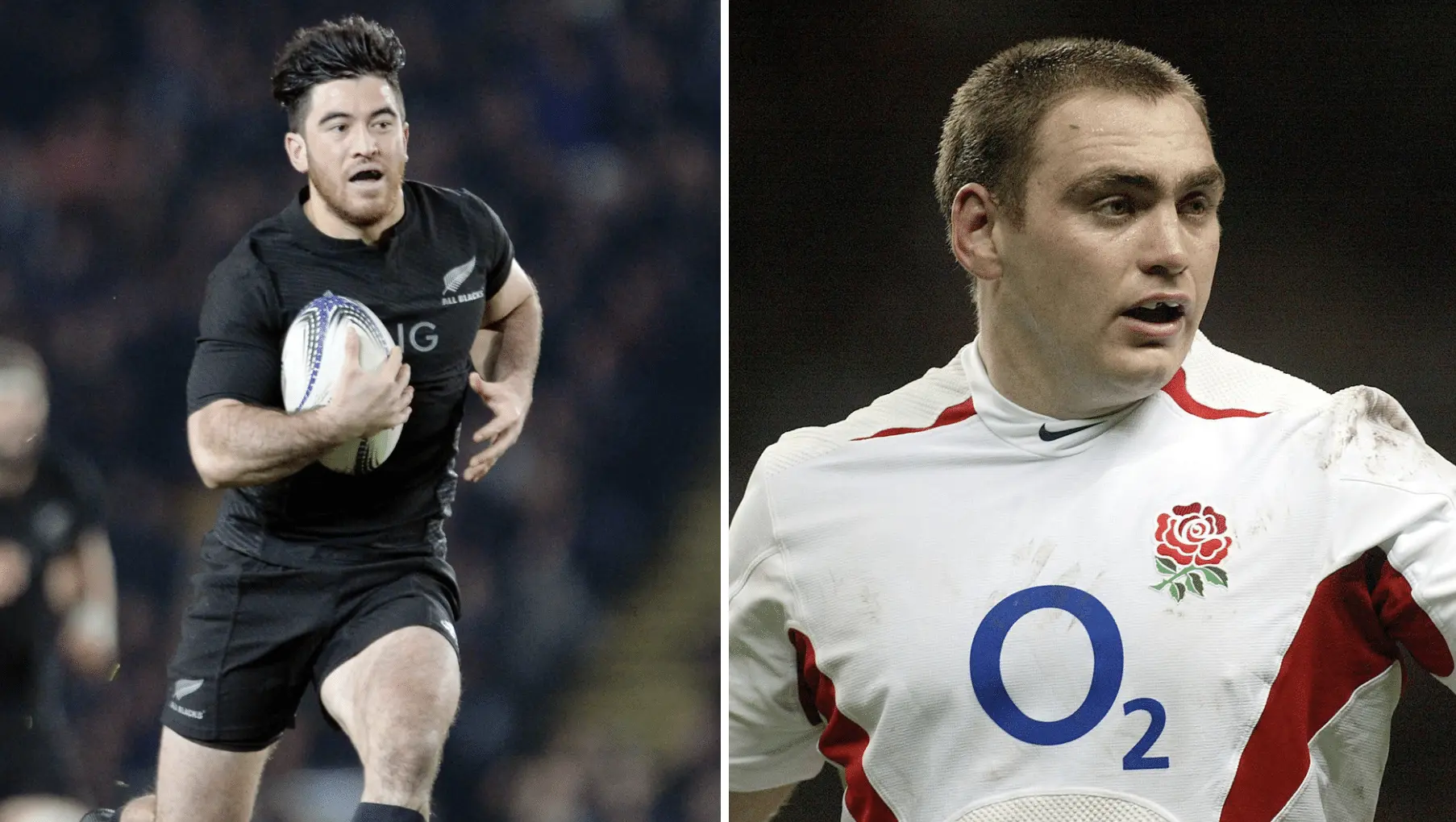

Some players don’t fade slowly—they arrive at the top, look like they’re about to dominate for years, and then injuries or circumstance cut the story short.
These are five of the clearest examples of rugby careers where the absolute elite peak lasted barely a season or two.
1. Nehe Milner-Skudder
Milner-Skudder’s rise felt like a bolt from nowhere. During the 2015 Rugby World Cup, he lit up the tournament with outrageous footwork, sharp angles, and a finishing ability that made him one of the standout backs in the world. He wasn’t just effective—he looked like a long-term All Blacks fixture in the making.
But rugby can be brutal. Shoulder injuries soon after the tournament derailed his momentum almost immediately. Despite returning to professional rugby later, he never quite recaptured that same explosive, world-class edge. His true peak at the very top level remains essentially tied to that single, unforgettable year.
2. Tom Croft
Croft was a rare prototype: a blindside flanker with genuine pace, lineout dominance, and try-scoring instinct. Around 2009–2012, he looked like one of the most modern back-row forwards in world rugby, earning selection for the British & Irish Lions and becoming a key part of England’s pack.
His athletic profile made him uniquely valuable, but his body couldn’t sustain it. Neck and knee injuries repeatedly interrupted his career, preventing any long-term run at peak performance. In hindsight, his time at the very top was brief—but undeniably high-level when it lasted.
3. Joe van Niekerk
Van Niekerk entered international rugby with enormous expectations. In the early 2000s, he looked like the complete modern loose forward: powerful, mobile, skilled, and physically dominant. There were stretches where he appeared capable of anchoring the Springbok back row for years.
Instead, injuries and inconsistency prevented that trajectory from fully materialising. While he remained a respected professional across club rugby, his brief spell at true world-class Test level never developed into a sustained peak. He remains one of the more intriguing “what if” forwards of his generation.
4. Israel Folau
Between roughly 2014 and 2016, Folau was among the most dangerous fullbacks in the world. His aerial dominance, positional sense, and finishing ability made him a constant threat and a reliable source of tries for Australia.
At his best, he was a game-breaking presence in international rugby. However, his Test career ended abruptly due to off-field controversy, bringing an unexpected halt to what could have been a longer elite run. His top-level peak was sharp, dominant, and relatively short-lived.
5. Trevor Woodman
Woodman’s peak is one of the clearest examples of a compressed elite career. He played a crucial role in England’s 2003 Rugby World Cup winning squad, and during that period was regarded as one of the best loosehead props in the world—technically solid in the scrum and effective around the field.
Unfortunately, serious injuries—particularly after 2003—cut short what should have been his prime years. He never returned to sustained international prominence, and his time at the very top level effectively spans only a brief but significant window around England’s World Cup triumph.
LATEST EUROPEAN CUP NEWS
- Team of the Week: Champions Cup & Challenge Cup Semi-Finals
- Bath player ratings vs Bordeaux-Begles: Champions Cup semi-finals
- “Not too concerned about underdogs or favourites.”– Hugo Keenan previews Bordeaux challenge.
- Leinster player ratings vs Toulon: Champions Cup semi-finals
- Where Are They Now? – RC Toulon’s Last ‘Galacticos’ who won the 2015 Champions Cup
TRENDING



LATEST NEWS

LATEST COMMENTS
- Jordie Barrett over Damian de Allende is far from being correct. The hype around Dupont is also overreaching, he's probably 4th in the world and has been since the 2023 WC. He also avoids certain matchups which is strange. The rest of the list is pretty good apart from minor subjective biases.JasonMarlow16-09-2026
Loading