"All Blacks v Springboks" - Top 5 New Zealand vs South Africa Rugby World Cup Matches Ahead of 2023 RWC Final
Rugby NewsTuesday, 24 October 2023 at 14:00
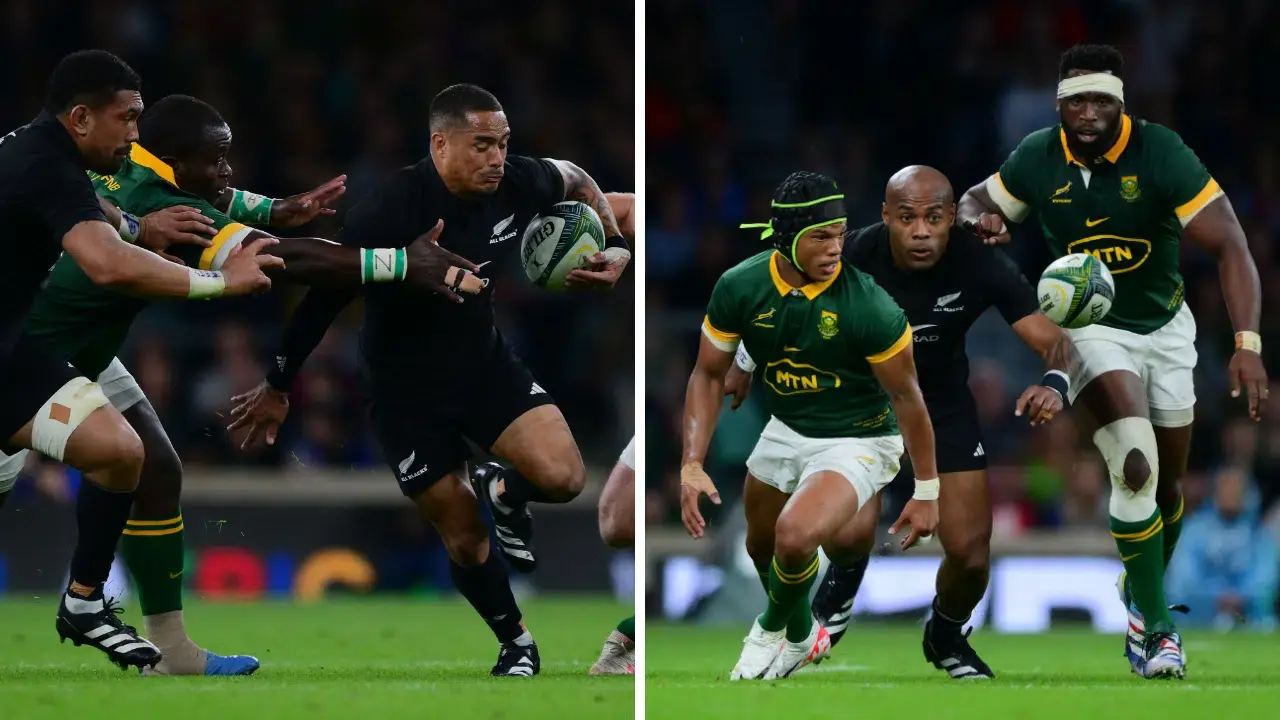

It all comes down to this Saturday. We are fast approaching the biggest match of the international rugby calendar, with New Zealand and South Africa set to battle it out in the 2023 Rugby World Cup Final.
These two sides have a storied rivalry on the grandest stage, with this weekend set to etch the newest chapter into the history books. Since the Rugby World Cup’s first iteration in 1987, the Springboks and All Blacks have collided five times at the competition. Each match has been an unforgettable contest, between these two titans of international rugby.

Cam Roigard of New Zealand hands off Manie Libbok of South Africa during the Test Match between New Zealand and South Africa at Twickenham Stadium, Twickenham, London on August 25th 2023. - PHOTO: Phil Mingo/PPAUK
The stakes have never been higher for the two sides, with plenty of records on the line heading into this Saturday’s Rugby World Cup Final. The winner of the showpiece event will become the first side ever to win a record fourth Rugby World Cup title, with the All Blacks and Springboks both currently boasting a trio of tournament victories.
South Africa are also looking to become the first side to emulate New Zealand’s back-to-back Rugby World Cup retentions, when Richie McCaw led his men to glory in 2011 and 2015. There is plenty on the line for New Zealand second row Sam Whitelock as well, as the most capped All Black is looking to become the first player in history, to win and unbelievable three Rugby World Cups.
So, as this match with unparalleled grandeur and sporting significance draws ever closer, let’s take a look back through the annuals of history. Here is a full re-count of the five previous Rugby World Cup meetings between New Zealand and South Africa, ahead of this weekend’s seismic Rugby World Cup Final.
1. South Africa 15 - 12 New Zealand: 1995 Rugby World Cup Final
June 24th 1995, Ellis Park, Johannesburg
‘The Original and Best’, the stakes could not have been higher for the first Rugby World Cup run-in between the All Blacks and the Springboks. Considered to be amongst the greatest of the competition's finals, this storied fixture played out like a Hollywood blockbuster. The match has since found its way to the silver screen as the film ‘Invictus’, and is a rugby match that has certainly transcended the sport.
The pay-off to an epic tournament, the 1995 Rugby World Cup is best remembered for the iconic image of Nelson Mandela, handing Springboks captain Francois Pienaar the Web Ellis trophy. This symbol of solidarity meant so much to the nation of South Africa, as the country worked towards a future away from the hostile grip of Apartheid.
The on-field story was a classic one. New Zealand had unleashed the rampaging Jonah Lomu onto the rugby world, with no-one able to find a way to halt the rampaging winger. Lomu had bulldozed his way through the opposition, with an unforgettable semi-final seeing him run riot over England with four tries, leaving the likes of Mike Catt flattened in his path. However, South Africa seemingly found the answer, and nullified the powerhouse with relentless defence, in their home soil triumph.
It is not often that a try-less match goes down in the history of iconic rugby fixtures, yet this one achieved just that. A 9-9 draw at 80 minutes saw all of the points come from the boots of Springboks’ Joel Stransky, and the All Blacks’ Andrew Mehrtens. This classic went to extra time, with New Zealand edging in front via another Mehrtens penalty.
South Africa fired back, as Stransky drew his side level once again, for a 12-12 stalemate after an exhausting hour and a half of play. The decisive moment came two minutes later, with Stransky slotting the title-winning drop goal to claim South Africa their first Rugby World Cup. Ellis Park shook to its core, with the rafters just about holding for the frenzied capacity crowd.
2. New Zealand 18 - 22 South Africa: 1999 Rugby World Cup Third Place Play-Off
November 4th 1999, Principality Stadium, Cardiff
Four years removed from the unforgettable scenes of Johannesburg, New Zealand and South Africa once again collided on the final weekend of the Rugby World Cup. However, the All Blacks and Springboks met in the match that no-side wanted to be in, as they clashed in the 1999 Third Place Play-Off.
South Africa fell to the semi-final sharpshooting of Australia’s Matthew Burke, as the Wallabies edged past the Springboks on route to win their first Rugby World Cup title. New Zealand’s final four defeat came at the hands of France, despite the best efforts of Jonah Lomu’s two tries. Les Bleus were resilient, and found retribution for their 1987 Rugby World Cup Final loss to the All Blacks.
So, the stage was set for the Springbok-All Blacks reunion, yet it was not quite in the match that their armies of fans had hoped for. Despite that, the Bronze Medals were on the line, and both sides emptied their tanks which were already deep into the reserves. Four years on from kick-starting the contest in Johannesburg, Andrew Mehrtens got the first points on the board, with a well-struck eleventh minute penalty.
The All Blacks lead lasted less than 60 seconds, as Percy Montgomery slotted a drop goal, to bring the Springboks back onto level terms. Henry Honiball then took over Springbok kicking duties with a penalty of his own, to take South Africa in front. Mehrtens retaliated with his second effort at the posts, before the opening try of the contest was scored by South Africa.
Jonah Lomu got his hands on the ball for the first time, which caused an eruption from the crowd. However, it was the talents of Lomu’s opposite man that shone in the opening Springboks score, with the ball stolen from the titanic winger. Breyton Paulse sent a neat chip kick over the All Blacks defence, and hacked the ball through towards the try-line. He dived on the ball amongst a pile of black jerseys, and got his hands on it first with Christian Cullen in pursuit.
This stood as the only try of the 1999 Bronze Medal Match, with Honiball nailing the conversion before he traded penalties with Mehrtens for much of the nail-biting second half. The metronomic place kicking was interrupted by the final effort at the posts, which saw Montgomery pop up on the 75th minute, to slot his second drop goal through the up-rights. South Africa saw out the match for the remaining few minutes, and left the Welsh capital with bronze draped around their necks.
New Zealand 29 - 9 South Africa: 2003 Rugby World Cup Quarter-Final
November 8th 2003, Docklands Stadium, Melbourne
Once again, we fast-forward four years in time, when New Zealand and South Africa met to complete their trilogy of Rugby World Cup matches. The Southern Hemisphere giants locked horns in the 2003 Quarter-Finals, with the All Blacks getting their first victory against the Springboks at the tournament. Springboks fans can blame England for bringing this fixture about, as the soon-to-be World Champions finished at the top of Pool C, with South Africa second as the runners-up.
This put South Africa in the unfavourable position of taking on the winners of Pool D, which so happened to include their old foes of New Zealand. Low and behold, the All Blacks made light work of Wales, Italy, Canada and Tonga, and topped the group for a third consecutive Rugby World Cup meeting with the 'Boks. This 20-point margin of victory stands as the most one-sided win between the two sides at the Rugby World Cup, as their four other meetings have all finished within a maximum of two scores.
The star man for the All Blacks on this day was Fly Half Carlos Spencer, who produced an inspired performance against the ill-disciplined Springboks. South Africa gave away repeated penalty offences and unforced errors, that Spencer was more than happy to capitalise upon. Spencer created two out of the three All Blacks tries, starting with a brilliant first half break to assist Leon MacDonald’s opener.
A brief hiatus from the Carlos Spencer show saw the All Blacks score through hooker Kevin Mealamu. Spencer followed this up with the moment of the match, as he performed an audacious through-the-legs pass to find Joe Rokocoko, who was able to dot the ball down over the Springboks line. The All Blacks maintained their dominance by building an unobtainable points tally. MacDonald added eleven points off the tee, with Aaron Mauger later slotting a drop goal to boot.
This win came amongst an era of All Blacks superiority over the Springboks, for their record setting seventh consecutive win. New Zealand dominated every aspect of the game in Melbourne, with All Blacks fans more eager for a repeat of such a one-sided win this weekend. South Africa returned the favour ahead of the 2023 Rugby World Cup, as they handed New Zealand their record defeat (35-7), in front of a sold-out Twickenham crowd to finalise their tournament preparations.
South Africa 18 - 20 New Zealand: 2015 Rugby World Cup Semi-Final
October 24th 2015, Twickenham Stadium, London
There was a 12-year wait before the Springboks and All Blacks would next meet at the Rugby World Cup, with their fourth encounter coming in the 2015 Semi-Finals. This match was the final stop on New Zealand’s road to immortality, as the All Blacks followed up this victory with a Final win over Australia, to become the first team to retain the title as World Champions.
New Zealand also wrote themselves into the history books, by becoming the first side to reach four Rugby World Cup Finals, in 2015. However, South Africa did all that they could to make it as tough as possible for the All Blacks. Handre Pollard presented his now all too familiar skillset from the tee, with a well taken penalty from far and wide for an early Springboks lead.
However, this 3rd minute lead lasted as long as it took to build, with New Zealand powering over for a sixth minute try. Legendary All Blacks blindside flanker Jermone Kaino made the initial break, and battled his way back into the attacking line. He was found by Richie McCaw’s looping pass, to dive over in the corner for the try. A well struck conversion from Dan Carter built a 7-3 lead, with the flow of this match constantly shifting in momentum.
Two more consecutive Pollard penalties regathered the South African advantage, with the match balanced on a knife’s edge for the most part. A fourth successful shot at goal sent the Springboks off at the break with a 12-7 lead, all courtesy of their resident place-kicker Pollard, and the poor defensive discipline of the All Blacks.
The iconic image of Dan Carter’s 35m drop goal followed shortly after the re-start. New Zealand’s halfback maestro dug deep into his back of tricks for a sensational effort that narrowed down the deficit. This turned the tied once more, with the tournament’s break-through star Beauden Barrett crashing over for a key try. Carter converted once again, with the match then following suit of previous iterations, with penalties traded for the closing moments.
Carter, Pollard, and replacement halfback Pat Lambie kept the match in the balance for the full 80 minutes. However, unlike previous kicking contests, this one was won by New Zealand, thanks to the unmatchable talents of arguably the greatest rugby player of all time, Dan Carter. The Twickenham faithful marvelled at ‘DC’, as he nailed a vital penalty from the touchline to edge the All Blacks far enough in front to reach the 2015 World Cup final.
New Zealand 23 - 13 South Africa: 2019 Rugby World Cup Pool B
September 21st 2019, International Stadium, Yokohama
Now we come to the latest Rugby World Cup meeting between the two sides, in what was the only occurrence to take place during a Rugby World Cup Pool Stage. South Africa had a long road to go before they would eventually lift the Web Ellis Trophy in Yokohama, with this opening weekend defeat in the International Stadium setting them onto the back-foot, in their eventual run to glory.
This match began in the same pattern as previous encounters, with Handre Pollard now trading penalties Richie Mo’unga, for an early 3-3 stand-off. However, what came next surprised even the most ambitious All Blacks fan, as New Zealand turned on the afterburners with two tries in four minutes.
New Zealand stunned the Springboks, as a superb Beauden Barrett offload found George Bridge, who was able to finish off an outstanding team move after 24 minutes. The Springboks looked dis-jointed, and were caught off-guard by another wave of All Blacks attack just moments after the re-start. Anton Lienert-Brown stepped his way through a gap, before popping the ball off to the supporting Scott Barrett, with the lock striding away on a clear line to score.
The try under the posts made for a simple conversion for Mo’unga, as the staggered Springboks re-grouped in a heated team huddle. The ‘Boks fired out fastest in the second half, with the ever-reliable Pieter-Steph du Toit’s try keeping his team within the contest. Pollard channelled his inner Joel Stransky with a drop goal against the All Blacks, and narrowed the gap to just four points with 20 minutes left to play.
Yet it was the Springboks’ own mistakes that cost them dearly, as Mo’unga and Barrett were more than happy to slot away two unanswered penalties, and build momentum with a memorable win. The gong sounded in Yokohama, and the sea of black jerseys rejoiced in victory, after what had been a gruelling first test for both sides in Japan.
TRENDING


LATEST NEWS

LATEST COMMENTS
- Jordie Barrett over Damian de Allende is far from being correct. The hype around Dupont is also overreaching, he's probably 4th in the world and has been since the 2023 WC. He also avoids certain matchups which is strange. The rest of the list is pretty good apart from minor subjective biases.JasonMarlow16-09-2026
Loading