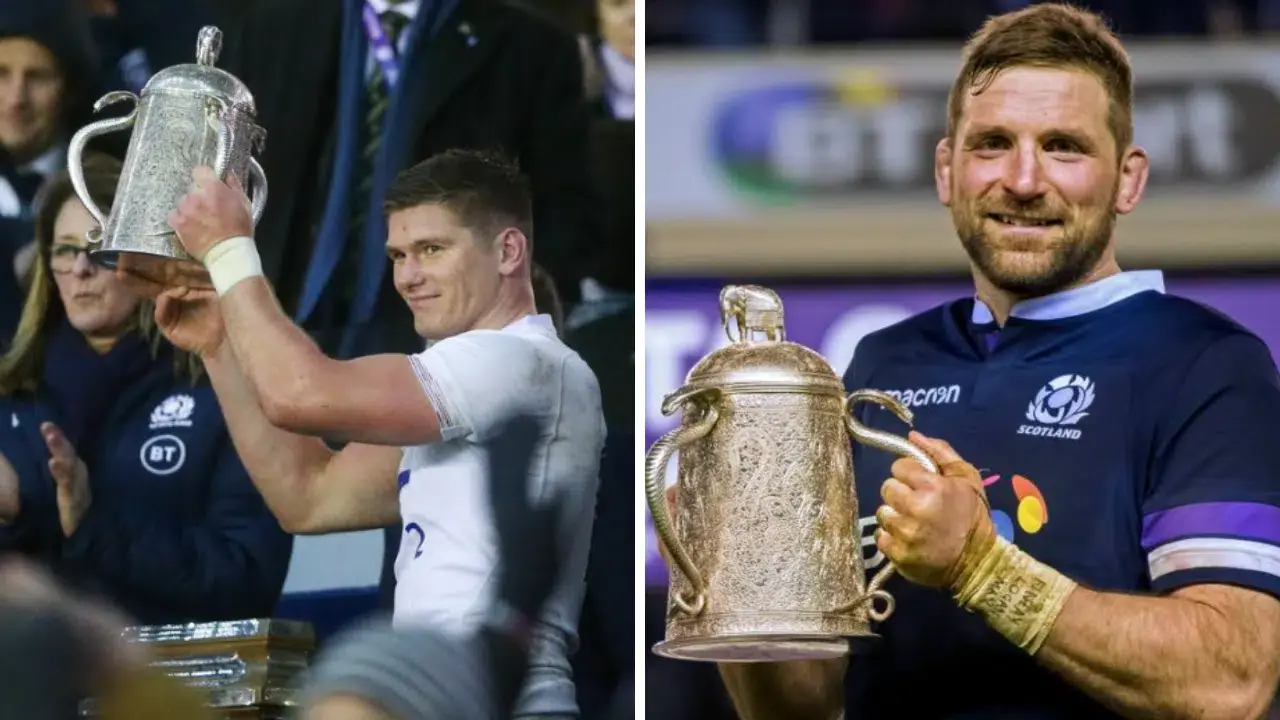

The iconic symbol of an age-old rivalry, the Calcutta Cup is contested between England and Scotland every time the two Home Nations sides meet on the test match stage. Be it the Six Nations, Rugby World Cup or an exhibition encounter, the stakes are raised when the fabled trophy is put on the line.
Tracing it's origins back to 1879, the trophy has been an heirloom of rugby union history since close to when records began. No two rugby nations on the planet boast a longer lineage of rivalry than England and Scotland, with the trophy being contested since the ninth meeting of the two nations. This Saturday, Scotland host England at Murrayfield, with the Calcutta Cup on the line for the 131st time. The Scots currently hold the trophy, and have had possession of the relic since 2021.
Should Gregor Townsend's men once again get the better of England, they will equalise their Scottish record for Calcutta Cup retains. This record dates as far back as 1896, as the Calcutta Cup stayed North of Hadrian's Wall throughout four consecutive encounters with the English. Steve Borthwick is eyeing up redemption this Saturday, as Scotland handed England a 29-23 defeat at Twickenham, in what was Borthwick's first match as England head coach.
So, with this iconic trophy back on the line on Saturday, let's delve into the history and heritage of the Calcutta Cup. Here are five interesting and unique facts about the Calcutta Cup, ahead of Scotland vs England in the 2024 Six Nations.
1. Forged from Indian Rupees - The Calcutta Cup's Origins
The iconic trophy was first minted in 1879, yet the origins behind its inception date back some seven years prior to 1872. In the year which saw Wanderers FC win the first ever F.A Cup in football, an amateur match of rugby union took place in Calcutta (today Kolkata), a formerly British Empire ruled city in Bengal, India. The match of course was between representatives of England and Scotland, with the unorthodox rulings of each side having 20 players on the pitch at one time.
Due to the rules and unrecognised representitives, the match has not been recorded in the official test match fixtures, and the outcome of the 40-man chaos has been lost to history. However, following the match, the Calcutta Rugby Football Club was established in January 1873, as an increase of British immigrants to India increased the growth of the sport. Former students of Rugby School; the institution that witnessed William Web Ellis run with the football to create rugby as we know it, came together with soldiers stationed in West Bengal to form the club.
In 1874, Calcutta RFC joined the RFU, yet just four years later, diminishing membership saw the final funds withdrawn to the club, and 270 rupees were put forward to piece together the iconic silverware as a commemorative symbol for the RFU. The rupees were melted down and forged into the iconic trophy, with the original said to be handmade by Indian craftsmen. The famous elephant that stands atop of the mantle, is said to have been modelled on the herd owned by the ruling British viceroy of the time, in India.
2. The Naming Anomaly - Previous Winners Wrongly Engraved on the Trophy
There is an interesting yet incorrect inclusion engraved upon the Calcutta Cup. Despite first being contested as a recognised trophy in 1879, the trophy incorrectly lists the 'winners', back to the first meeting between the nations in 1871. So, despite the winning teams of the matches from 1871-1878 being honoured upon the trophy, these nations did not actually win the trophy ahed of it's creation.
The trophy has been remade multiple times throughout history, yet the winners of these fixtures incorrectly remain upon every single iteration. There is no denying how striking the trio of cobras are which hold up the trophies' ornate centrepiece, yet the historical blunder remains to be seen by those eagle-eyed viewers that venture round the RFU or SRU museum's at Twickenham or Murrayfield.
3. Damaged in Celebrations - Player's Banned for Breaking the Trophy
Two players have received on-field match bans for breaking the Calcutta Cup, with both incidents taking place during the post-match celebrations in 1988. England had just beaten Scotland 9-6 at Murrayfield, to retain the trophy in a toughly contested Five Nations fixture. This was England's 57th time of winning the trophy, yet what followed was a first time occurrence for both the RFU and the SRU.
The Calcutta Cup was damaged by supposed 'drunken antics', involving both England and Scotland rugby players. Former England number eight Dean Richards and ex-Scotland flanker John Jeffrey, are said to have played football with the Calcutta Cup along the famous Princes Street in Edinburgh. Due to their actions in breaking the trophy, Jeffrey received a staggering six month ban by the SRU, whilst Richards was let off a lot lighter. The former Leicester Tigers man was only issued a one-match ban by the RFU.
4. The Original Plan for the Calcutta Cup - 'Rugby's F.A Cup'
Embed
Despite the Calcutta Cup now being synonymous with the rivalry between Scotland and England, the trophy was first issued to be rugby's answer to the FA Cup in football. The Calcutta Club's initial plan was to create the trophy, to be the most sought-after prize in England's domestic club rugby. The tournament would mimic the knock-out format popularised by the F.A Cup, with unexpected match-ups between teams across the divisions being a real selling point of the competition.
However, the RFU refused the Calcutta Club's ambitions, and did not give the 'Calcutta Cup Tournament' the go ahead. It is said that back in 1879, the Governing body believed that there was plenty of 'competitiveness' within the amateur sport of rugby union, and that there was no need for such a tournament to drum up the spirit the game. The RFU then decided to utilise the trophy on the test match stage, and have competed for the famous piece of silverware against Scotland ever since.
5. Calcutta Cup Records - Jonny Wilkinson Leads In the Fixture's History
The Calcutta Cup's history books are decorated by some of the greatest players, throughout the age-old heritages of England and Scotland. Iconic England fly half Jonny Wilkinson holds the record for the most points scored in a single Calcutta Cup match, when he racked up a stunning 27 point total in the 2007 Six Nations. Wilkinson's efforts saw him score a try, slot two conversions, nail five penalties and also a drop goal, as England accrued a strong 42-20 win at Twickenham.
The previous record of 24 points was held by former England fly half Rob Andrew, yet Wilkinson admitted how he was unaware of the accomplishment until after the fixture. Speaking after the match in 2007, Wilkinson said; “Someone said I’d scored a few points and that’s good, but my job in the team is to kick goals.
“To be honest at 7-3 down I would have taken a win at any cost. But fortunately for me the ball went over today and I came through it fine. It has been a great team day. I’m a big believer in what you get out is what you put in and I have prepared well. I prefer to go into games tired but heavily prepared and today was the reward for all the preparation I’ve done.”