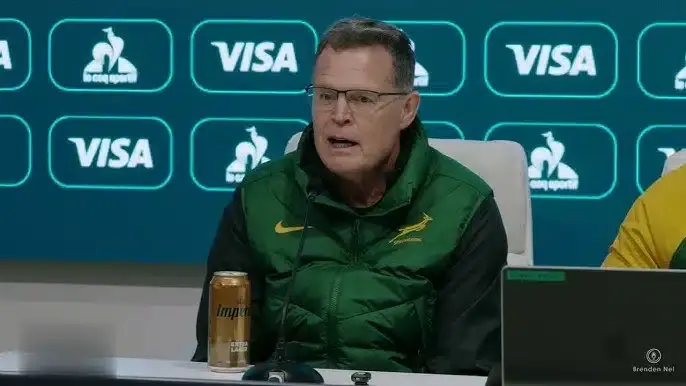

Five years on from one of the biggest refereeing controversies in rugby history, Rassie Erasmus finds himself operating in a very different world when it comes to discussing match officials.
The Springboks boss was famously banned from all rugby activity for two months following his criticism of referee Nic Berry during the 2021 British & Irish Lions series.
Now, in 2026, World Rugby has introduced an entirely new process designed to protect match officials from public criticism and the online abuse that can follow.
Join RUCK’s Instagram broadcast channel and get the latest rugby news straight to your phone.
At the same time, coaches have been given stricter limits on how they can communicate concerns directly with referees.
Erasmus has already questioned whether the changes are improving the game – even referencing his infamous Lions video while explaining just how different things are now.
So, five years on, did Rassie learn his lesson – or has rugby changed around him?
Why was Rassie Erasmus banned?
The controversy dates back to the British & Irish Lions tour of South Africa in 2021.
Following the Springboks' 22-17 defeat in the opening Test, an extraordinary 62-minute video emerged in which Erasmus analysed the performance of Australian referee Nic Berry.
Erasmus highlighted numerous incidents and questioned the consistency of Berry's decision-making, including how he believed Springbok captain Siya Kolisi had been treated compared with Lions skipper Alun Wyn Jones.
World Rugby subsequently charged Erasmus with misconduct.
An independent committee found all six charges against him proved.
His punishment was substantial.
Erasmus was suspended from all rugby activities for two months, while he was separately banned from all match-day activities – including coaching, contact with match officials and media engagement – until September 30, 2022.
He was also issued with a warning over his future conduct and ordered to apologise to the relevant match officials.
SA Rugby was fined £20,000.
Rugby has changed since Rassie's ban
Five years later, the debate surrounding how coaches talk about referees has moved on significantly.
In July 2026, World Rugby introduced its new Match Official Abuse Sanction Process across international fixtures involving World Rugby-appointed officials.
The governing body says the process is designed to tackle comments which can contribute to the "unacceptable increase" in abuse and threats directed towards match officials.
Crucially, World Rugby says its social media protection programme has found since 2023 that a large proportion of online abuse begins with inaccurate comments about refereeing performances from people in positions of authority.
Under the new system, an independent panel can examine comments or conduct which allege that an official acted with bias, prejudice, an improper motive or deliberately attempted to influence the outcome of a match.
It can also act when comments could reasonably undermine public confidence in officials.
Punishments range from no further action and guidance letters to formal warnings and automatic suspensions.
Coaches are already being banned
World Rugby has wasted little time using the new system.
Italy head coach Gonzalo Quesada was initially handed an automatic two-match suspension following comments about the officiating of his side's Nations Championship defeat against New Zealand.
After referring the case to an independent committee, that punishment was reduced to a one-match suspension alongside a formal warning and public apology.
Argentina international Tomás Albornoz was also charged following his interactions with match officials after their Nations Championship clash with England and was subsequently suspended for four matches.
It demonstrates just how seriously World Rugby is now treating criticism and abuse of its officials.
Rassie has noticed the changes
Erasmus has already spoken publicly about the new landscape.
Discussing Quesada's case earlier this year, the double World Cup-winning coach admitted he was unsure whether the new protocols were improving rugby.
He also pointed directly towards his own past.
"A while back I sent a very long video," Erasmus said, referring to the 2021 Lions controversy.
Things are rather different now.
Teams can submit a maximum of six clips and accompanying notes when raising issues with officials.
There has also been a major change to the traditional pre-match meeting between coaches and referees.
A meeting can only take place if both coaches agree – and both must attend together.
Erasmus has questioned the logic.
Rassie and the All Blacks skip referee meeting
The issue has become particularly relevant during South Africa's current series against New Zealand.
Erasmus and All Blacks coach Dave Rennie have opted against holding a joint meeting with the referee ahead of the second Test in Cape Town.
For Erasmus, discussing potential concerns in front of the opposition risks revealing exactly what his team intends to target.
"In my opinion, it's impossible to discuss something with the referee with the other coach present," he explained this week.
His argument is that raising a concern about the scrum or breakdown would immediately alert the opposition to an area South Africa intended to scrutinise.
"So what do you discuss with the referee?" Erasmus questioned.
Did Rassie Erasmus learn his lesson?
There has unquestionably been a change since 2021.
Erasmus has never repeated anything resembling the extraordinary hour-long analysis of Berry's performance that ultimately earned him his suspension.
But the South African remains willing to publicly discuss refereeing structures and question whether World Rugby's processes are working.
The difference is significant.
Rather than publicly dissecting the performance of an individual referee, Erasmus is increasingly discussing the system around them.
And that system has changed considerably.
World Rugby now has a specific process for dealing with public comments which could undermine officials, while coaches have fewer opportunities to privately raise concerns before and after matches.
The governing body's reasoning is clear: referees need greater protection at a time when criticism can quickly turn into personal abuse and threats online.
For Erasmus, however, there is a balance to be found between protecting officials and allowing coaches to legitimately discuss areas of concern.
Five years after his infamous ban, Rassie hasn't stopped talking about referees.
But both he – and the rules governing what coaches can say – have changed considerably.
LATEST RUGBY NEWS
TRENDING





LATEST NEWS




LATEST COMMENTS
- Jordie Barrett over Damian de Allende is far from being correct. The hype around Dupont is also overreaching, he's probably 4th in the world and has been since the 2023 WC. He also avoids certain matchups which is strange. The rest of the list is pretty good apart from minor subjective biases.JasonMarlow16-09-2026
Loading

