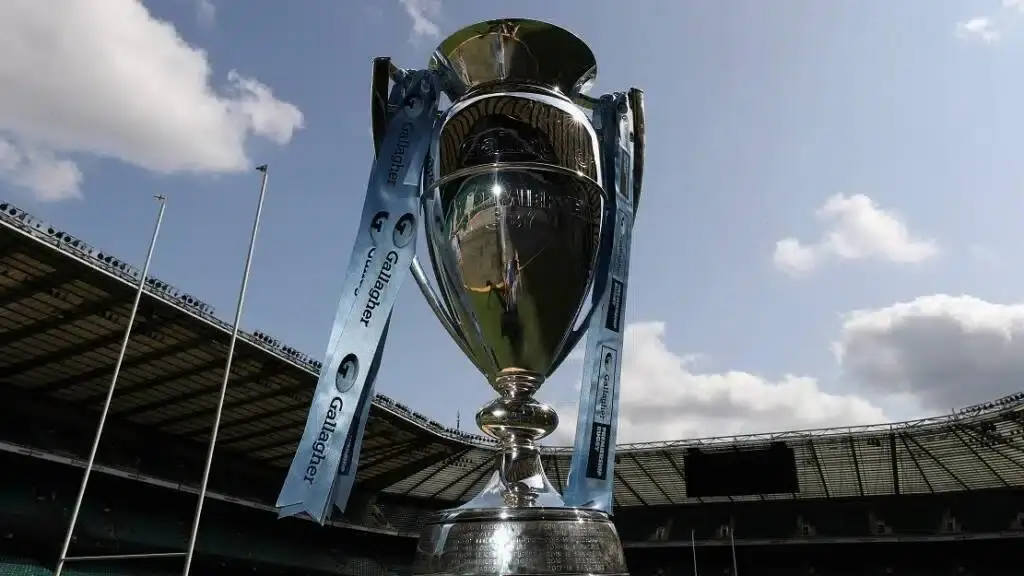

The Rugby Players' Association says it is a "sad day in the history of rugby" as the civil war between players and Premiership clubs over pay rages on.
In a statement released to The Times, the clubs accused the RPA of not giving its members "appropriate advice".
Most top-flight players took a 25% pay cut in March because of coronavirus.
Now the Union have responded with a statement of their own, accusing the clubs of "personally attacking" players and their representatives.
They've also said the suggestion there was an agreement to make pay cuts permanent is "pure fabrication.
Read the full statement below.
RPA STATEMENT
In relation to the statement released by the Premiership clubs earlier today, the RPA is compelled to address the factually incorrect comments contained within and ensure that our members and all the game’s stakeholders, including supporters, are clear on the facts.
Our response to the specific issues are below:
1. It is a sad day in the history of rugby that the game finds itself in this position. PRL and the clubs have decided to publicly criticise the RPA and, by doing so, personally attack players and their representatives. Throughout this crisis both the RPA and players have been open to a collaborative and positive solution to address the long-term financial viability of the game.
2. Our Players Board met on the 26th May to receive a formal proposal from PRL regarding the future of the game. In reality, the proposal was singularly for immediate and permanent pay cuts. Our Board voted unanimously against that proposal. To suggest there have been any other agreements in relation to permanent pay cuts is complete fabrication.
3. On the 22nd April, a non-disclosure agreement was sent to the RPA but categorically did not include any financial information and no deadline for response. To reiterate, at no point has the RPA been provided with any detailed financial information from PRL or the clubs. This NDA was not signed and could never be without RPA Players Board approval. As already stated above, our Board voted unanimously against immediate and permanent pay cuts.
4. PRL and their member clubs are fully aware that, at the same meeting, the Players Board unanimously voted for a counter proposal of independent mediation, chaired by a leading QC through Sports Resolutions. This counter proposal remains unanswered and is a resounding example of the players being open to a professional, collaborative and constructive dialogue to help address the future of the game. The offer remains on the table.
5. The changes to the Salary Cap as announced on Wednesday and the arbitrary June 18th deadline for contracts to be “existing” were passed with no consultation of players. That has led to a significant number of our members faced with immediate contractual decisions to make about their long-term futures in order to facilitate this change for the clubs. This approach exposes the lack of governance within the Premiership, as recently highlighted by Lord Myners’ independent review.
6. The RPA have never threatened strike action and would not recommend this as an appropriate course of action.
7. Regarding the welfare of players; PRL states that there is no intention to reduce Academy salaries of those players at the low end of the spectrum, however there is evidence that this has already happened at some clubs.
8. The RPA has acted, and will continue to act, in the best interests of our player membership and support their legal rights.
9. The players are a vital part of the game and deserve to be treated with respect, which is a key value of rugby. The current unreasonable approach that the clubs are taking will continue to cause substantial long-term damage to player and club relations going forward. The clubs statement ends with a call for mutual understanding and respect, both require reciprocation. Our offer of mediation remains open.
SUBSCRIBE:
The Team Voted The Greatest England XV
With the 2019 Rugby World Cup now under a year away in Japan, Sky Sports wanted to know what you think the best-ever England XV from the World Cup era is.
And after 30,000 votes, here is the team fans selected. There are one or two surprise inclusions.
Fullback: JASON ROBINSON (94% of the vote)
The speedster was a menace whatever number was on his back, a bewildering opponent, a man seemingly able to sidestep in mid-air, with pace and nerve and vision, tough in the tackle, intelligent in his use of angles and selfless when it came to creating openings for teammates.Embed from Getty Images
Winger: JOSH LEWSEY (56%)
A player reborn after joining the armed forces and playing for Wasps simultaneously; his physical prowess was matched with a determination to constantly improve and a wonderful ability to read the game in front of him.Embed from Getty Images
Centre: JEREMY GUSCOTT (69%)
The Prince of Centres,’ was how Guscott was described by Clive Woodward. And he wasn’t wrong.Embed from Getty Images
Centre: WILL GREENWOOD (66%)
At 6ft 4ins, Greenwood had a physical presence himself but it was the judgement he brought to the field of play that marks him out. Everything you could want in a modern day inside centre and more. He is sorely missed.Embed from Getty Images
Winger: RORY UNDERWOOD (55%)
England’s highest try scorer, with 49, and a player of undeniable attacking class. Many of his tries for England are classics of the game. Give him the ball, point him in the direction of the try-line, sit back and applaud.Embed from Getty Images
Fly-half: JONNY WILKINSON (97%)
Who else could it have been? There’s little to say about this man that hasn’t already been written. One of the greatest defensive fly halves to have ever played the game, and a physical embodiment of rugby as a professional sport. One of a kind.Embed from Getty Images
Scrum-half: MATT DAWSON (83%)
A sniper and an absolute pain for defences, Dawson caused havoc on the 1997 Lions tour when he dummied half of South Africa’s pack and headed for the corner to help seal the first test. Although never the greatest of distributors, Dawson’s competitive edge and ability to spot the gap puts him in ahead of many other contenders.Embed from Getty Images
Prop: JASON LEONARD (69%)
The most enduring, the most accomplished and, as his ‘Fun Bus’ nickname would suggest, one of the most faithful and inspirational team-mates to have alongside you.Embed from Getty Images
Hooker: BRIAN MOORE (43%)
‘To be or not to be’ was a question answered by this William Shakespeare fan. He played in three World Cups for England and won three Grand Slams, earning World Rugby’s Player of the Year award in 1991.Embed from Getty Images
CONTINUES ON PAGE FOUR
Prop: PHIL VICKERY (82%)
As one of the hardest hitters in rugby, “Raging Bull” is never far from a Dream XV list. The former captain played every game of the 2003 campaign, coming back from a series of injuries.Embed from Getty Images
Lock: MARTIN JOHNSON (98%)
The stats themselves – 84 caps for England across a decade, 39 of them as captain, culminating in that World Cup victory, three tours for the British and Irish Lions as well.Embed from Getty Images
Lock: MARO ITOJE (59%)
The 25-year-old would have excelled no matter the time or style of game, be it tight and relentless, a bare-knuckle exchange as often used to be the case, or, as he does now, as an all-purpose player, as at ease in the open spaces as he is doing the grunt work at the coal-face.Embed from Getty Images
Flanker: RICHARD HILL (85%)
The flanker was “first on the team-sheet,” according to Johnson and Sir Clive Woodward. Praised by Jeremy Guscott for his “work rate”, it is no wonder the forward scored so many points.Embed from Getty Images
Flanker: NEIL BACK (56%)
A genuine openside and a genius at the breakdown, Back added an extra dimension to the England side that is so sorely lacking from them now. Notably small in a pack full of giants, Back made up for his lack of size through his cunning and forethought on the pitch.Embed from Getty Images
Number 8: LAWRENCE DALLAGLIO (70%)
Dallaglio has always been a singular figure, one never daunted by any situation which is why he was such a long-standing captain with Wasps.Embed from Getty Images
TRENDING

LATEST NEWS
LATEST COMMENTS
- Jordie Barrett over Damian de Allende is far from being correct. The hype around Dupont is also overreaching, he's probably 4th in the world and has been since the 2023 WC. He also avoids certain matchups which is strange. The rest of the list is pretty good apart from minor subjective biases.JasonMarlow16-09-2026
Loading