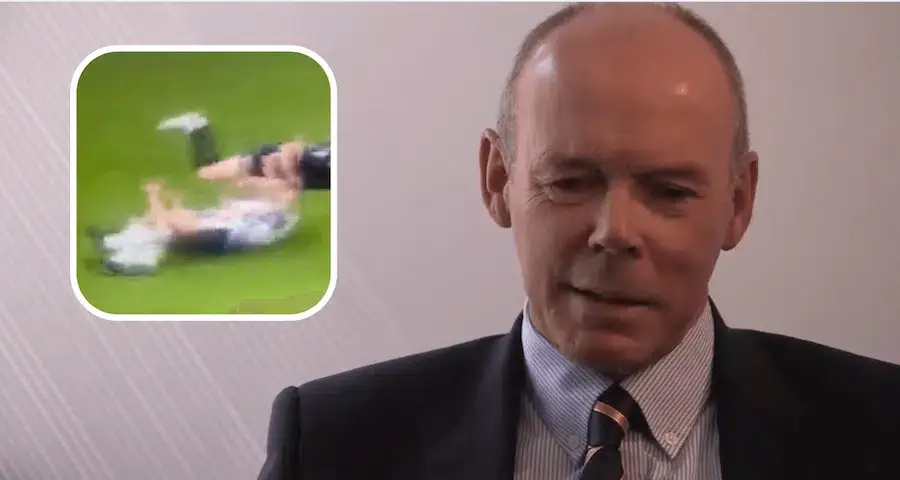
Sir Clive Woodward has been left perplexed by England's decisions to select Owen Farrell two weeks after the Saracens playmaker was knocked out cold in the Premiership.
Given the games current issues around head injuries, which includes an impending lawsuit against World Rugby, rushing back the skipper did seem a strange one for a game Eddie Jones' men would have likely won with or without him.
"I’ve been championing Farrell to be both No 10 and captain but if he comes off concussed then rugby, and especially English rugby, will be left looking really poor," wrote Woodward.
"Talking about concussion and player welfare is one thing. Taking tangible actions to show you are serious is another — and this was a high-profile opportunity to do just that.
"As a coach, I would have taken this into my own hands. The final decision is not down to the player nor doctor. No one would have any qualms if Farrell had been given another week’s rest.
"I think England can win the World Cup with Farrell or Marcus Smith in the No 10 position and this was the perfect opportunity to allow Smith to run the team from start to finish."
Owen Farrell Concussion:
Wide Angle:
Close-up:
Owen Farrell Facts:
- The Saracens star went to school with England teammate George Ford
- His education began in rugby league – he joined Wigan St Patricks at the age of eight
- He became the youngest ever player to appear in English professional rugby, making his debut aged 17 and 11 days. This record was later beaten by schoolmate Ford
- It’s well known that Owen is the son of Ireland head coach Andy Farrell. However, it’s less commonly know that his uncle Sean O’Loughlin is also a rugby league legend, winning 34 caps for Great Britain between 1993 and 2009
- He was not at first registered as a Farrell, but took mum Colleen’s family name of O’Loughlin. The couple married in 1995, changing Owen’s surname to Farrell the following year.
Sir Clive Woodward’s FOUR most talented players he’s ever seen
#4. Brian O'Driscoll (Ireland)
The former Ireland and British and Irish Lions Skipper Brian O’Driscoll was one of the most consistent performers in the world for over a decade.
He hung up his boots in 2014 after accumulating 133 caps for Ireland with a fantastic return of 245 points. In the emerald green, he triumphed in the Six Nations in 2009 (Grand Slam) and 2014 as well as being chosen as Player of the Tournament in 2006, 2007 and 2009.
The Dublin-born is also the highest all-time Irish record try scorer with an incredible 46 scores, and also led his country more times than any other player.

Woodward wrote: "In the Grand Slam game in 2003, we worked on a plan to man-mark him with three players, so the tackler was not exposed by O'Driscoll's footwork and pace in a one-on-one situation.
"That's how big a threat we believed he was - he needed three men to handle him. Ireland were going for a Grand Slam, but none of the players around Brian were in the same league.
"Whenever he had the ball we wanted one player opposite him and one man either side - it would usually be Wilkinson, Will Greenwood and Mike Tindall."
Brian O'Driscoll facts:
- He is devoted to Manchester United and his boyhood hero was Mark Hughes
- O'Driscoll's father, Frank, played two games for Ireland and an uncle, Barry, won four caps
- His final appearance for Leinster, and for any team, was in the 2014 Pro12 Grand Final on 31 May in Leinster's home ground, the RDS in Dublin, in which Leinster defeated the Glasgow Warriors 34-12
- His most oft-quoted line was delivered at a press conference at Croke Park before an England match in 2009: "Knowledge is knowing that a tomato is a fruit; wisdom is knowing not to put it in a fruit salad."
- O'Driscoll was chosen as Player of the Tournament in the 2006, 2007 and 2009 RBS Six Nations Championships.
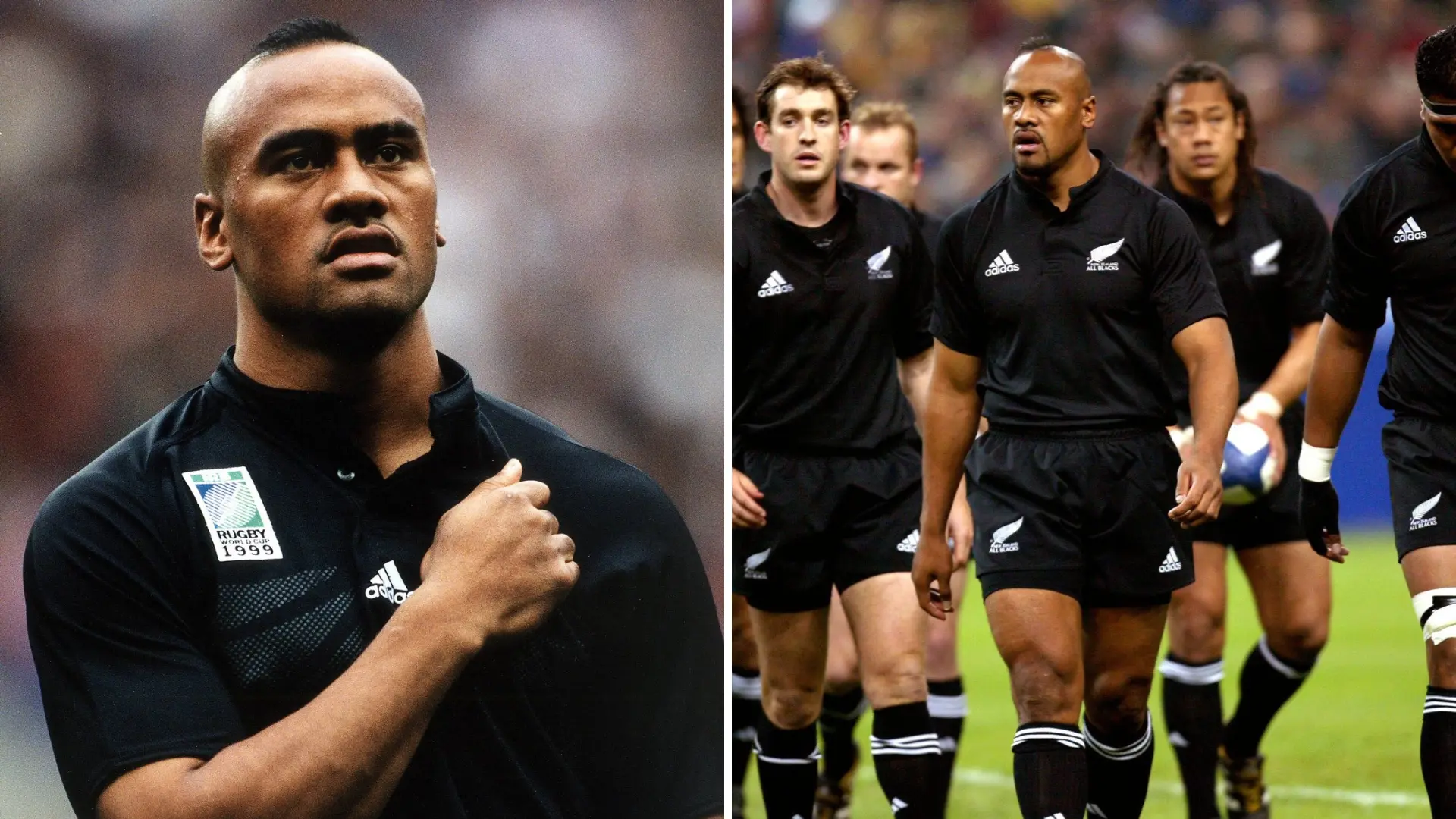
#3. Jonah Lomu (New Zealand)
The New Zealander remains the joint all-time top try scorer at the Rugby World Cup along with Bryan Habana, crossing the whitewash on 15 different occasions across the 1995 and 1999 tournaments.
Originally of Tongan descent, it was Lomu who made it glamorous to be a big, bruising winger, even though his stature could have easily seen him fill in at centre or somewhere in the pack.
Much like the Juggernaut of the Marvel Universe, there wasn’t much that could stop Lomu once he’d gotten into a stride.

"He took rugby to a whole new level," said Woodward.
"There's very rarely one player who dominates a whole World Cup and he certainly did."
Jonah Lomu facts:
- Playing on the wing Lomu finished his international career with 63 caps and 37 tries
- He became the youngest ever All Black when he played his first international in 1994 at the age of 19 years and 45 days
- Lomu was inducted into the International Rugby Hall of Fame on 9 October 2007, and the IRB Hall of Fame on 24 October 2011
- In 1996, McDonald’s New Zealand named a burger after Lomu, temporarily rebranding the McFeast burger line (called “Mega Feast” in New Zealand) as the “Jonah Burger”
- On 9 April 2007, Lomu appeared on New Zealand’s version of
This Is Your Life, in which he was reunited with long time friend Grant Kereama, who had donated a kidney to Lomu when he underwent a kidney transplant in July 2004
- Lomu lent his name to various video games including Jonah Lomu Rugby
#2. Jonny Wilkinson (England)
Forever remembered as the man whose last-gasp drop-goal won England the Rugby World Cup by edging past the hosts in Australia in 2003.
That moment is just one highlight of a record-breaking career that has seen Wilkinson rise to one of the sport’s all-time greats.
England won 67 of the 91 games Wilkinson played in with him scoring an outstanding total of 1,179 points. He also holds the Rugby World Cup points record with 277.

Woodward said: "Jonny was special and he scared the opposition. Everyone has to pat him on the back."
"The way he defended and attacked, he was a very special player," added Woodward, who handed Wilkinson his England debut in 1998.
"All of us involved in that team [in 2003] just felt very lucky and privileged to have had him around at that time.
"He would have taken the decision to retire very seriously but he will still be playing for Toulon, and he has been playing very well for Toulon.
"I'd just like to say well done to him. He has done so much for not just English rugby but also world rugby on the field, and especially off the field."
Jonny Wilkinson facts:
- Wilkinson’s brother, Mark, was also a Newcastle player who made 16 appearances in the Premiership for the side between 2002 and 2005
- When former England centre Jeremy Guscott walked into the dressing room on the day of Wilkinson’s international debut, he thought the 18-year-old had won a competition to spend the day with the national team
- Wilkinson followed Buddhist principles and teachings to help control his perfectionist tendencies, according to an interview he gave with The Times newspaper in 2009
- He is currently a studio pundit for ITV Sport, working on their coverage of the Six Nations Championship, Rugby World Cup and other rugby events.
- He was the 2003 International Rugby Board (IRB) International Player of the Year.
#1. Gareth Edwards (Wales)
The former Wales and British and Irish Lions scrum-half is simply the greatest player in his position in history. Edwards is also considered by many to be one of the greatest rugby players of all time.
He was notorious for his pace but also had an unexpected strength for a leaner player. He made 53 caps for Wales as well as making ten appearances for the British & Irish Lions, featuring on tours in 1968, 1971 and 1974.
The second tour, to New Zealand, is still the only victorious Lions tour to the Land of the Long White Cloud. During the third, to South Africa in 1974, was the greatest ever Lions jaunt, in which the tourists played 22 matches and remained unbeaten.
Woodward said: "The greatest talent I played against was Gareth Edwards. He was in his last season and I was in my first.
"His talent was undiminished and he had a great aura. His banter with his old Lions mate Bob Hiller was also priceless. As a coach, it is Jason Robinson.
"He was a sponge and soaked up every single rugby union skill. By the end he was probably the best kicker out of hand we had, he laid the ball back at rucks perfectly and his tackle technique was perfect. What a player."
Gareth Edwards facts:
- He won a scholarship to the elite Millfield Public School in Somerset. Apart from rugby, Edwards showed promise in a wide range of sports, playing for West Wales Youth soccer team, and signing for Swansea Town at the age of 16. He also showed prowess in gymnastics and athletics.
- In 2003, in a poll of international rugby players conducted by Rugby World magazine, Edwards was declared the greatest player of all time
- He is one of a small group of Welsh players to have won three Grand Slams including Gerald Davies, JPR Williams, Ryan Jones, Adam Jones, Gethin Jenkins and Alun Wyn Jones
- In 2007, former England captain Will Carling published his list of the '50 Greatest Rugby players' in The Daily Telegraph, and ranked Edwards the greatest player ever, stating; "He was a supreme athlete with supreme skills, the complete package. He played in the 1970s, but, if he played now, he would still be the best. He was outstanding at running, passing, kicking and reading the game. He sits astride the whole of rugby as the ultimate athlete on the pitch"
- In the 2007 New Year Honours, Edwards became a CBE for services to sport. He was knighted in the Queen's Birthday Honours of 2015, for services to sport and for charitable services