Springboks and All Blacks legends reveal trophy for Rugby's Greatest Rivalry
Rugby NewsThursday, 20 August 2026 at 07:56
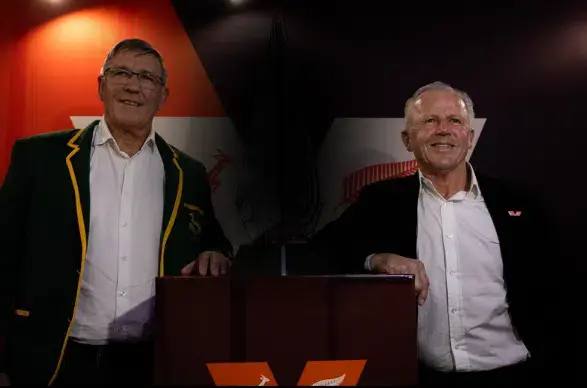

The Springboks and All Blacks will battle for a trophy unlike anything previously seen in international rugby when their historic four-Test series gets underway this weekend.
Join the RUCK’s WhatsApp community here and get the latest news sent straight to your messages.
Rugby’s Greatest Rivalry has unveiled a unique trophy made from two separate halves that are drawn together by hidden magnets, representing the enduring bond between South Africa and New Zealand.
The trophy was unveiled in Johannesburg by the captains of the 1996 series, former Springboks skipper Gary Teichmann and All Blacks legend Sean Fitzpatrick. The winning nation will claim both halves of the trophy after the final Test in Baltimore on September 12.
However, should the four-Test series finish level at 2-2, each country will retain one half.
That possibility was a key part of the thinking behind the design, with the two unions keen to create a trophy that reflected the unique nature of the rivalry.
‘A trophy like no other’

All Images Credit: New Zealand Rugby
SA Rugby CEO Rian Oberholzer explained the thinking behind the striking design.
“The brief to the agencies was to create a trophy that was really like no other, and one to capture the essence of the rivalry,” said Rian Oberholzer, CEO of SA Rugby.
“The thinking included the idea that the trophy could be split in two to represent the two halves of the rivalry or that each nation could keep one half if the series was shared.
“This is the eighth time in 12 tours that the series has included four Tests, and if each team has won two tests at the end of 320 minutes of intense rugby, it seemed inappropriate to decide a winner on an arbitrary metric.”
New Zealand Rugby CEO Steve Lancaster believes the trophy captures exactly what has made the rivalry so special for more than a century.
“The trophy is a really fitting way to recognise what this rivalry is about. It’s something different and unique, and importantly, it tells the story of two teams and two countries that have been competing against each other for more than 100 years.

“Every Test adds to that history. There’s a real respect between the two sides, but also that desire to get one over each other and find a way to win.
“And if the Series is drawn, the fact the trophy can be shared is something special to this tour and this concept. It’s a fitting reflection of just how closely matched these teams have been over the years, and the intensity of a rivalry that has endured for more than a century.”
The first two tours between South Africa and New Zealand, in 1921 and 1928, were both shared.
Two halves, one trophy

The trophy's design is inspired by a blade of grass, something common to every player who has ever taken part in the rivalry. Developed by Strategy Creative in New Zealand in collaboration with both rugby unions, the trophy consists of two individual blades – one representing South Africa and the other New Zealand.
Each blade can stand independently, representing the individual identity, culture and history of its nation. But when brought together, the two pieces form the complete trophy. Hidden magnets pull the blades towards one another, deliberately mirroring the way the rivalry continues to bring the two nations together generation after generation.
Each blade has been precision-machined from solid aluminium and features artwork from artists representing each country. The South African half features artwork by Bonolo Chepape, whose work explores the idea that greatness is never achieved alone, using layered patterns inspired by community, culture and shared experience.
The New Zealand blade features artwork by Kereama Taepa, drawing inspiration from the Māori creation story of Tāne and Whiro – two brothers who pursue the same goal through different paths. The contrasting artwork reflects the tension, respect and connection that define one of rugby's greatest rivalries.
Even the base follows the same theme. It is made from two different stones: black Pakohe stone from Aotearoa New Zealand and green Verdite from South Africa. The complete trophy stands 65cm tall, with each aluminium blade weighing 7kg and the base weighing 9.5kg. The project took a year to develop and build. And now, after more than 100 years of history, the trophy will finally go on the line.
It will be publicly displayed for the first time on Saturday when the Springboks face the All Blacks at 10bet Ellis Park in Johannesburg in the opening Test of Rugby's Greatest Rivalry.
LATEST RUGBY NEWS
- Richie McCaw heads to South Africa with All Blacks role revealed
- Five All Blacks Dave Rennie must pick for the 1st Springboks Test: Rugby’s Greatest Rivalry
- Steve Hansen launches war of words with Rassie Erasmus
- Springboks report All Blacks to World Rugby ahead of first Test
- Ruby Tui set for fresh start in England with new club confirmed
- Springboks make surprise Haka request ahead of huge All Blacks clash
TRENDING




LATEST NEWS


LATEST COMMENTS
- Jordie Barrett over Damian de Allende is far from being correct. The hype around Dupont is also overreaching, he's probably 4th in the world and has been since the 2023 WC. He also avoids certain matchups which is strange. The rest of the list is pretty good apart from minor subjective biases.JasonMarlow16-09-2026
Loading