Viral clip shows why Bundee Aki has been sent home from Ireland squad
Rugby NewsWednesday, 28 January 2026 at 19:17
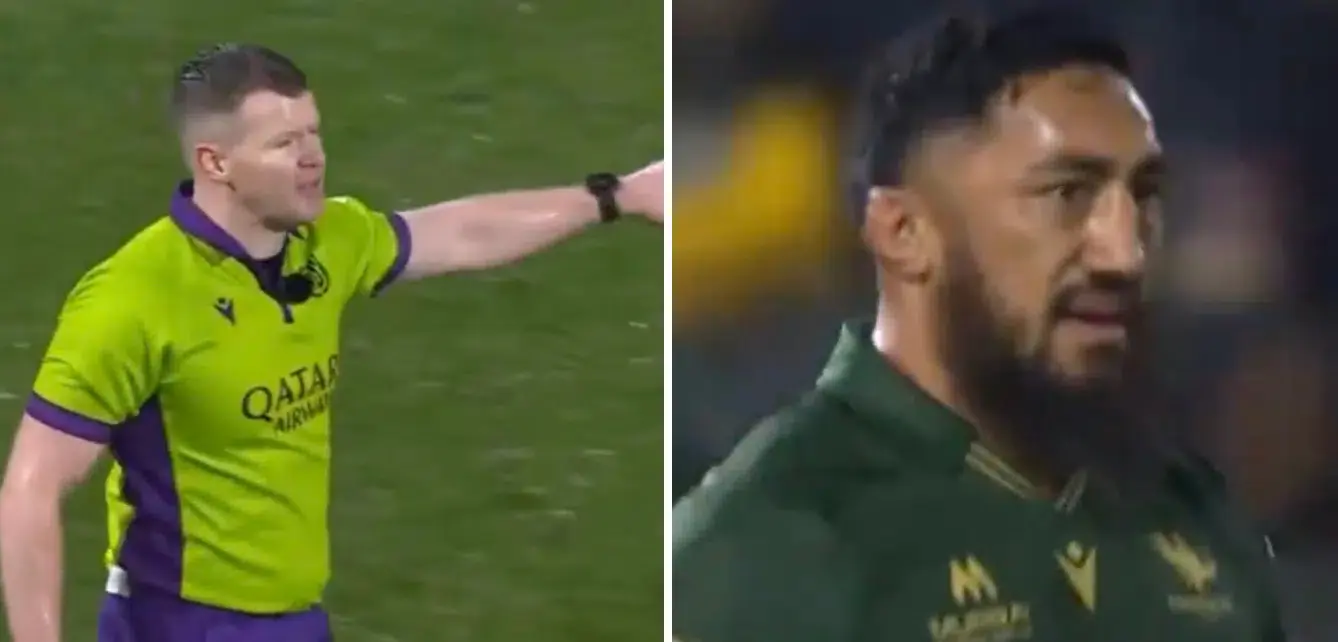

Fans believe a video of Bundee Aki from the weekend may explain why he was sent home from the Ireland squad today.
The 35-year-old, who was nominated for World Rugby Player of the Year in 2023, is accused of speaking to match officials several times during the United Rugby Championship (URC) defeat in a way that could breach the league’s disciplinary regulations.
Watch the Guinness Six Nations at your local Greene King sports pub.
Aki is due to appear before an independent disciplinary panel on Wednesday.
Ireland begin their Six Nations campaign against France in Paris on 5 February, and Aki has been replaced in the squad by Ulster’s uncapped centre Jude Postlethwaite.
In a statement, the Irish Rugby Football Union (IRFU) said: “The IRFU does not tolerate any form of disrespect towards match officials and does not condone behaviour that falls below the standards expected of players representing Irish rugby.
“The IRFU is investigating the matter internally and will make no further comment at this time.”
WATCH THE INCIDENT:
SOCIAL REACTION:
One supporter wrote: “Surely this can’t be why he’s been dropped by Ireland?”
Another said: “Mack Hansen received a three-match ban for telling the truth, and now Bundee Aki could face the same for doing the same. Referees demand respect — it’s time they started giving it too.”
Another fan commented: “Yet another referee acting like a drama queen who wants all the attention.”
Someone else added: “The softest sport in the world. But hey, #rugbyvalues.”
Another wrote: “Will there be any consequences for officials who can’t see there’s clearly no wrap in that tackle? I’m fed up with Irish refs handling the interpros.”
Who has the most foreign-born players? 2026 Six Nations
The Six Nations has always been rooted in tradition — but in the modern era, international squads are increasingly shaped by migration, ancestry, and residency eligibility.
In 2026, foreign-born players remain a major part of the championship picture, although the overall numbers have fallen sharply compared to recent years.
Scotland — 14 foreign-born players (35%)
- Homegrown: 26/40 (65%)
- Foreign-born: 14/40 (35%)
Scotland once again lead the Six Nations for overseas-born representation.
Full list (Scotland)
Nathan McBeth — South Africa (Grandparent)
Pierre Schoeman — South Africa (Residency, 2021)
Ewan Ashman — Canada (Parent)
Elliot Millar Mills — England (Parent)
Josh Bayliss — England (Grandparent)
Jack Dempsey — Australia (Grandparent)
Ben White — England (Grandparent)
Fergus Burke — New Zealand (Grandparent)
Tom Jordan — New Zealand (Residency, 2024)
Rory Hutchinson — England (Grandparent)
Sione Tuipulotu — Australia (Grandparent)
Kyle Rowe — England (Cumulative Residency)
Kyle Steyn — South Africa (Parent)
Duhan van der Merwe — South Africa (Residency, 2020)
Wales — 9 foreign-born players (23.6%)
- Homegrown: 29/38 (76.3%)
- Foreign-born: 9/38 (23.6%)
Wales sit mid-table, with most foreign-born players coming through English development pathways or overseas heritage.
Full list (Wales)
Tomas Francis — England (Grandparent)
Archie Griffin — Australia (Parent)
Ben Carter — England (Residency, 2004)
Freddie Thomas — England (Grandparent)
Olly Cracknell — England (Grandparent)
Josh MacLeod — Monaco (Residency, 2004)
Gabriel Hamer-Webb — England (Parent)
Ellis Mee — England (Parent)
Blair Murray — New Zealand (Parent)
Italy — 8 foreign-born players (24.2%)
- Homegrown: 24/33 (72.7%)
- Foreign-born: 8/33 (24.2%)
Italy continue to benefit from a diverse talent pool, drawing on Argentine heritage and residency-qualified backs.
Full list (Italy)
Pablo Dimcheff — Argentina (Grandparent)
Muhamad Hasa — Albania (Residency, 2014)
Martin Page-Relo — France (Grandparent)
Stephen Varney — Wales (Parent)
Juan Ignacio Brex — Argentina (Grandparent)
Paolo Odogwu — England (Parent)
Montana Ioane — Australia (Residency, 2020)
Matt Gallagher — England (Grandparent)
Ireland — 8 foreign-born players (20%)
- Homegrown: 34/40 (85%)
- Foreign-born: 8/40 (20%)
Ireland remain one of the most homegrown squads in the championship, but several key players — especially in the backline — were born abroad.
Full list (Ireland)
Jeremy Loughman — USA (Parent)
Finlay Bealham — Australia (Grandparent)
Cormac Izuchukwu — England (Parent)
Joe McCarthy — USA (Parent)
Jamison Gibson-Park — New Zealand (Residency, 2019)
Ciarán Frawley — Australia (Parent)
Bundee Aki — New Zealand (Residency, 2017)
James Lowe — New Zealand (Residency, 2020)
France — 7 foreign-born players (15.5%)
- Homegrown: 39/45 (86.6%)
- Foreign-born: 7/45 (15.5%)
France have one of the strongest domestic player bases, but still include a handful of residency-qualified forwards.
Full list (France)
Dany Priso — Cameroon (Residency, 2008)
Uini Atonio — New Zealand (Residency, 2014)
Tevita Tatafu — Tonga (Residency, 2024)
Joshua Brennan — Ireland (Residency, 2005)
Thibaud Flament — Belgium (Born in France)
Emmanuel Meafou — New Zealand (Residency, 2023)
Tom Staniforth — Australia (Residency, 2025)
England — 6 foreign-born players (16.6%)
- Homegrown: 34/36 (94.4%)
- Foreign-born: 6/36 (16.6%)
England have the most domestically produced squad in the tournament, with only a small group born outside the country.
Full list (England)
Bevan Rodd — Scotland (Parent)
Emmanuel Iyogun — Spain (Residency)
Sam Underhill — USA (Parent)
Marcus Smith — Philippines (Parent)
Henry Arundell — Dhekelia (Parent)
Immanuel Feyi-Waboso — Wales (Grandparent)
Ranking: Most foreign-born players (2026)
- Scotland — 14
- Wales — 9
- Italy — 8
- Ireland — 8
- France — 7
- England — 6
TRENDING


LATEST NEWS
LATEST COMMENTS
- Jordie Barrett over Damian de Allende is far from being correct. The hype around Dupont is also overreaching, he's probably 4th in the world and has been since the 2023 WC. He also avoids certain matchups which is strange. The rest of the list is pretty good apart from minor subjective biases.JasonMarlow16-09-2026
Loading
