Holly Wood - the elite official empowering others to pick the whistle back up after childbirth
The WhistleWednesday, 12 August 2026 at 10:36
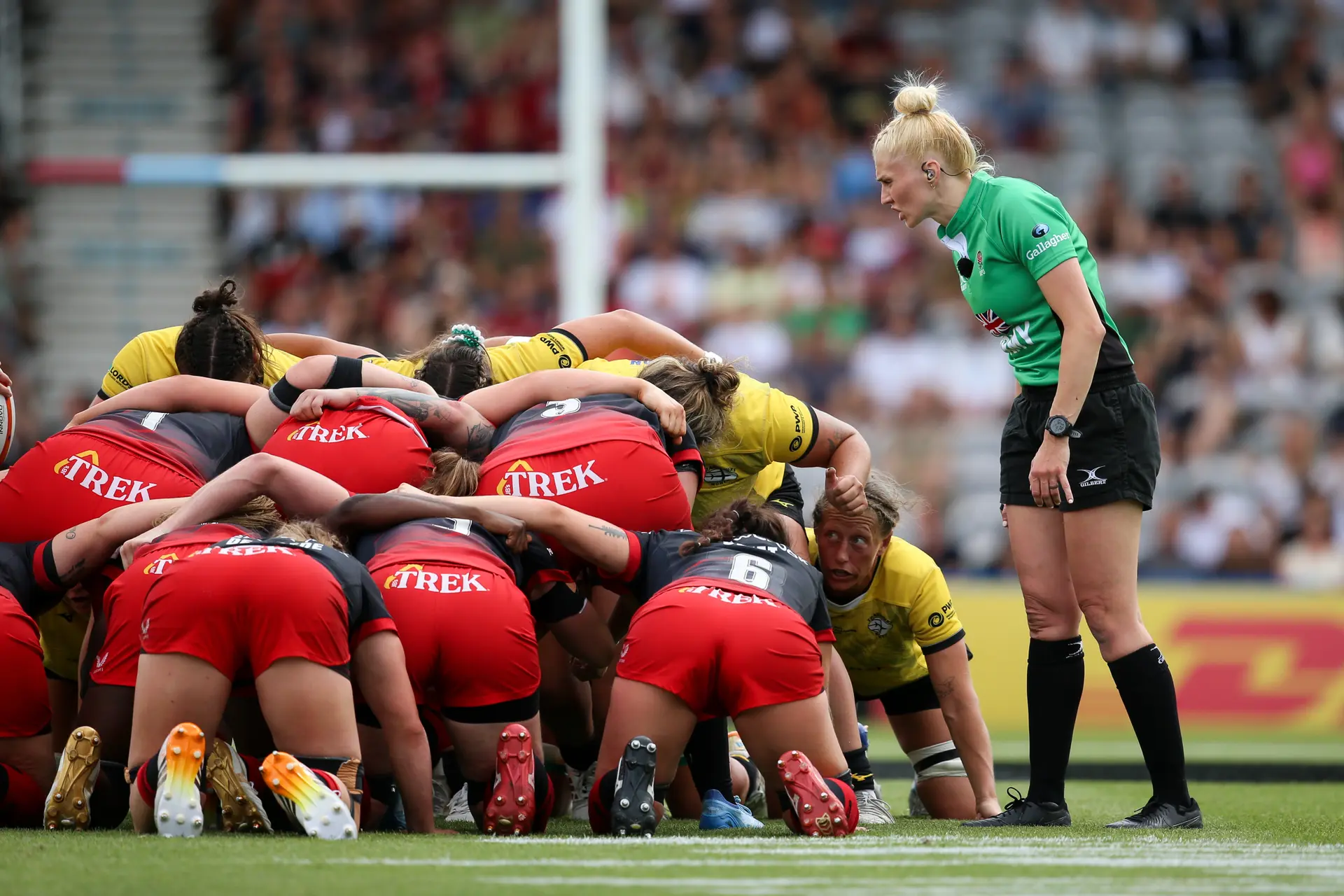

There has been a lot of noise recently around international match official, Holly Wood, and how quickly she picked the whistle back up after giving birth to both of her children. While her rapid comeback has brought attention; it’s the career she has built and changes she’s made within the world of rugby union that are making a lasting impact on the game.
From returning to elite refereeing just seven weeks after giving birth to using her experience to shape the RFU’s maternity policy and encouraging more women into refereeing, Holly discusses her remarkable journey and the future for women in rugby officiating, as well as the challenges and progress that still needs to be made.
Along with our partners, ACME Whistles, we sat down with the former Richmond and Harlequins player turned international referee to chat about how her life behind the whistle has evolved over the years, the impact she’s had on women officials and the highlights of her career.
Holly recently refereed the JAECOO Premiership Women’s Rugby (PWR) final between Saracens and Trailfinders Women, saying: “It was always in the back of my mind that I wanted to do that match to finish the season. When I found out I was pregnant the summer before, I thought that if I give birth on time, then I can get back in eight weeks and I can do the last couple of rounds of PWR and I have to referee to be in contention to do the final.
“It's not a given that you get the final. It's all on performance but baby came on due date, so it felt like perfect timing. Then I needed to get another game under my belt to go back into PWR so my timeline then became seven weeks which we managed to do by bumping up my rehab.
“Coming out of round 17 of the PWR they were like, okay, you're good, you're back, you're fit, you're going to do the final. The round 18 officiating team for Gloucester v Bristol is going to be the same team for the final. So, we knew going into the last round that we would be doing the final together.”
The last time the Premiership final was played at Twickenham Stoop was 10 years ago between Richmond and Saracens. Holly was playing for Richmond at the time.
“It was the year before it became Tyrrell's Premier 15s and was still women's Premiership rugby,” she recalls.
“We got changed in a broom cupboard, warmed up on the back pitch. It was so cold in January - a late kick off after Harlequins men's game and maybe like 150 people watching, if that.
“So, to get this years’ final and go back to The Stoop meant a lot to me. And the person who refereed that match 10 years ago was Sara Cox who had just been awarded her full-time contract as well. Sara’s a good friend of mine and is godmother to our daughter. So, it meant a lot to get the whistle for that final.”
Holly prepped mentally for the final like she would any other game, but there were moments where she admits to feeling like she might not make it physically.
“I've been seeing a chiropractor called Iain Crombie in Exeter,” she said.
“He has experience with athletes after spending six years with Somerset Cricket. He’s been supporting me and now fixed a minor ongoing hip problem I had before pregnancy, and started running again at 4 and half postpartum, which was just a steady 3km run with our dog and had treatment with Iain the next day.
“Typical me, I decided to do a high speed field session the day after, and my back went into spasm. It was the only time across both of my postpartum journeys, that I’ve had to stop and think okay maybe I need to calm down a little. I was just 5 weeks postpartum, back gymming and running but I still need to take care and not overdo it.
“I knew I had my first game back at seven weeks post birth and I thought I’ve got two weeks to be okay. So, I decided not to run for a week and just do gym work and was rehabbing my pelvic floor and stretching multiple times a day, had more treatment and the next running session at 6 weeks post birth, everything felt okay again.

Holly with husband Emmerson and their two children
Holly expresses appreciation for her coach Dean Richards who is the referee manager for PWR.
“He's been my coach for the last three seasons and has been fully supportive the whole way,” she adds.
“He’s always said that I’ve got to be honest if I’m not feeling right.
“While there was never a doubt in my mind that I wasn't going to get back, I know that I was lucky to have a plain sailing birth and that isn’t always a guarantee and after I had the baby, Dean said to take a month and then we'll look at the last two rounds of the PWR and what matches we give you so he was fully backing me.
“The Head of Professional Match Officials, Paul Hull fully backed me as well but it wasn’t until I got back for my first game in the PWR that reality hit me with players and commentators saying they couldn’t believe how I was back so quickly. I started to doubt myself a bit as to whether it was too quick. But when you're in that seven, eight-week block just doing your own thing and living life, you don't really think about it or what other post-partum mums are doing.”
Despite being able to get back behind the whistle in less than two months, Holly advocates for women to listen to their own bodies and come back to rugby when they’re ready and fit enough and has spearheaded the RFU’s maternity policy.
“The policy covers grassroots community referees up to those who get a contract and it's all about your own time scale. Obviously, we've got fitness tests to pass so that’s in there, but there's nothing on set timelines and everything is focused on how you feel,” she explains.
“I think for community grassroots, where there isn't fitness monitoring and they don't go into a gym and do a full range of fitness testing, you must listen to your own body. And that's the only way of doing it because there's nobody monitoring or benchmarking against what you were pre-pregnancy.
“I think it's just important for a community sport to be fully inclusive and have something in place to show women that they can have children and come back and that there is a guideline there for them but no set timeline.
“A great thing about the policy is that if you come back within that year, you go straight back to refereeing the level that you were previously. I think the fear for me was always that they would put me in a lower-level game to see how I got on which I just didn't want at all, because then it's like you're having to earn your stripes again. But this policy now ensures that won’t happen. Childbirth shouldn’t hinder progression in refereeing.”
Whilst already on her path towards international officiating, Holly took part in a campaign by the RFU in November 2022 in partnership with ACME Whistles to encourage more women to take up refereeing. The campaign, named Inspire, culminated in all 50 female referees coming together on the pitch at Twickenham ahead of an Autmn International between England and Japan.
“The Inspire campaign opened your eyes to how many other women are out there refereeing and wanting to get to different places,” she said.
“I’d only ever refereed on the male pathway until I got to the women's premiership. I didn't really come across that many women refereeing, in my teams or across the community game. However, over the few years, the PWR has been adding 4ths and 5ths to the league and that's where a lot of women now take part in the officiating teams in the PWR.
“I'm now coming across the women that I read about, which is really cool. So yeah, I think for me, Inspire was more eye opening that there are more than a small handful of women out there refereeing, which is nice. And you feel like you already know where they are, their society, and their journey as well, which I think is great.”
Despite several female elite officials leading the way for others, Holly believes there’s still work to be done to encourage more to join them.
“Unions have to be the driver to get more women in,” she explains.
“It's all good seeing a woman on TV, the likes of Hollie Davidson and Aimee Barrettt-Theron, but I think there's a lot of barriers in place that actually stop a female wanting to go and do a referee course and then pursue refereeing, whether it's because they've got a family and they're too busy, they don't know how to fit it in, or there's that fear factor of thinking that to progress they have to go through the male pathway like you do at the RFU.
“When I first started refereeing, there was number of times I’d rock up at games and would get asked if I was the physio - it happened all the time. And that's very off putting for women, because it gives the wider perception that you don’t belong. So, unless pathways change in unions like in cricket and football where you can choose to go up the female side or the male side and you earn your badges that way, you don't have that in rugby and that's a massive barrier for women accessing officiating.
For more information on refereeing and to get started, visit www.acmewhistles.co.uk
TRENDING




LATEST NEWS



LATEST COMMENTS
- Jordie Barrett over Damian de Allende is far from being correct. The hype around Dupont is also overreaching, he's probably 4th in the world and has been since the 2023 WC. He also avoids certain matchups which is strange. The rest of the list is pretty good apart from minor subjective biases.JasonMarlow16-09-2026
Loading