The ultimate one-club rugby XV, featuring Brian O'Driscoll, Martin Johnson and Lawrence Dallaglio
Top 10s/ListsWednesday, 29 August 2018 at 15:52
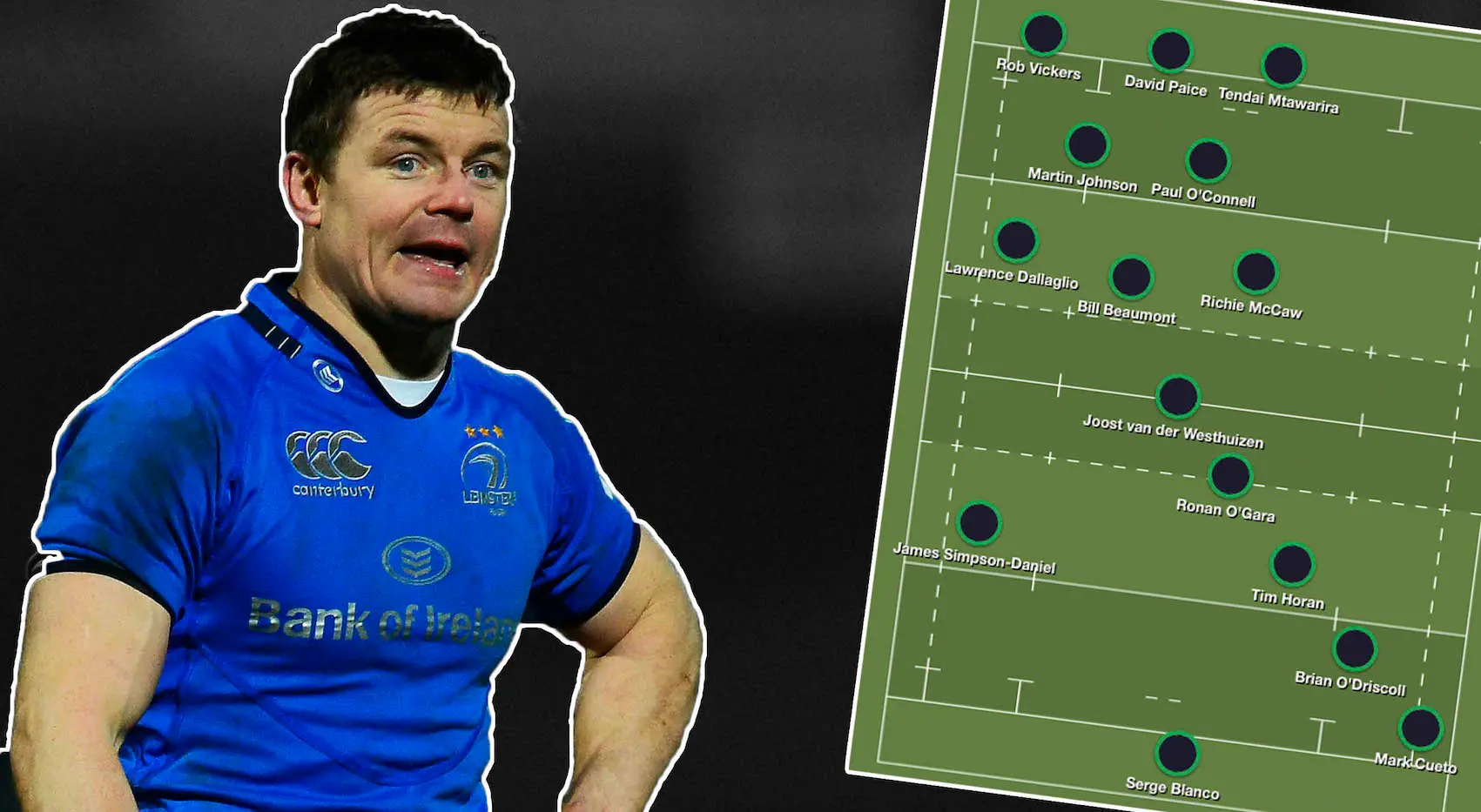
So here is a team made entirely of men who spent their whole career playing for one club and for that very reason, we salute them.
Fullback: Serge Blanco (Biarritz)
Blanco spent his entire career with Biarritz Olympique and the French national side, gaining 93 caps, 81 of them at fullback. After retiring as a player, he continued serving Biarritz Olympique as their president. In this role he saw his club become French champions in 2002 and 2006.
Winger: Mark Cueto (Sale Sharks)
At club level, Cueto made 303 appearances for Sale and scored 118 tries. Cueto made his England debut in 2004, claiming 20 tries in 55 international games and came within inches of scoring a try in England's 2007 World Cup final defeat by South Africa. He also played once for the British & Irish Lions against New Zealand in 2005.
Centre: Brian O'Driscoll (Leinster)
After 186 appearances, his final game for Leinster, and for any team, was in the 2014 Pro12 Grand Final on 31 May in Leinster's home ground, the RDS in Dublin, in which Leinster defeated the Glasgow Warriors 34-12.
He left the field injured early in the first half to be replaced by Ian Madigan. His final act as a rugby player was assisting club captain Leo Cullen - who also finished his career on this day - in lifting the Pro12 trophy.
He is regarded by critics as one of the greatest rugby players of all time.
Centre: Tim Horan (Queensland Reds)
Horan spent his entire professional career with the Queensland Reds. He was one of the best centres in the world throughout the 1990s due to his attacking prowess, formidable defence and playmaking ability. He became one of only twenty dual Rugby Union World Cup winners.
Winger: James Simpson-Daniel (Gloucester)
He played wing or centre for Gloucester Rugby from 2001 to 2013, making 274 appearances and scoring 120 tries.
His low centre of gravity, beautiful balance and keen rugby brain made him one of the all-time great wingers, the scorer or instigator of spectacular tries, but his career was sadly blighted by illness and injury and he only gained ten caps for England.
Fly-half: Ronan O'Gara (Munster)
Spending his entire professional career with Munster, he hung up his boots as the clubs all-time leading scorer following 16 seasons, and holds the Heineken Cup record for points. He is currently Assistant Backs Coach for the Crusaders in Super Rugby.
Scrum-half: Joost van der Westhuizen (Bulls)
Legendary playmaker Van der Westhuizen spent his entire provincial career with South African side the Blue Bulls, from 1993 until 2003, whereupon he retired from playing rugby.
He made 89 appearances in test matches for the Springboks, scoring 38 tries. He mostly played as a scrum-halfand participated in three Rugby World Cups, most notably in the 1995 tournament which was won by South Africa.
Prop: Rob Vickers (Newcastle Falcons)
n May 2018, after more than 250 appearances for the club, it was announced that Vickers would retire at the conclusion of the 2018 Aviva Premiership season.
Hooker: David Paice (London Irish)
The Australia-born hooker, who won the first of eight England international caps in 2008, bowed out at the end of last season, 15 years on from joining the Irish Academy. After making his Exiles debut in 2003, he has since made 288 appearances for the club - more than any other Irish player in the professional era.
Prop: Tendai Mtawarira (Sharks)
The 33-year-old has been at the Sharks his entire career and the Springbok powerhouse is likely to hang up his boots there.
Lock: Martin Johnson (Leicester Tigers)
A giant of the game in more ways than one, Johnson is widely regarded as one of the greatest locks to have ever played the game.
As a player he famously led England to glory at the 2003 Rugby World Cup and also captained the British & Irish Lions in 1997 and 2001 – the first player to lead the elite tourists on two occasions.
On the domestic stage he played all his club rugby for Leicester Tigers, making his debut in 1989 before going on to make a total of 307 appearances before hanging up his boots in 2005. During his 16-year career at Welford Road he led them to back-to-back Heineken Cup titles in 2001 and 2002 and also five Premiership titles including four in-a-row between 1998-99 and 2001-02.
Lock: Paul O'Connell (Munster)
Second-row Paul O’Connell is Munster through and through and holds the honour of having skippered the British & Irish Lions during their Test series with South Africa in 2009.
He steered Munster to Heineken Cup glory in 2008 but greater success would follow in 2009 when he played a key role in Ireland’s historic Six Nations Grand Slam triumph.
Despite signing for French giants Toulon, he never played a game due to injury meaning we’ve decided we can still count him on this list.
Flanker: Lawrence Dallaglio (Wasps)
The back-rower became one of the most decorated and successful English players of all time.
Emerging as a raw talent in the back row during England’s victory at the 1993 Sevens World Cup at Murrayfield, Dallaglio went on to secure 85 England caps and cement his place as a hero of English rugby.
Dallaglio was a one-club man, playing every first-class game of his career for Wasps. He took the reins as club captain in 1995 when Rob Andrew departed for Newcastle and made his England Test debut in November that year against South Africa.
Flanker: Richie McCaw (Crusaders)
Richie McCaw is a great of the modern game having led the All Blacks to Rugby World Cup glory in 2011 and 2015 as well as claiming the International Rugby Board’s Player of the Year award on a record three occasions.
He carved out a formidable reputation as arguably the best openside flanker in the world since emerging onto the international stage at only 20 years of age, but unlike a lot of other All Blacks never left New Zealand shores, choosing to stick with the Crusaders his whole career.
Number 8: Bill Beaumont (Fylde)
A former England and British & Irish Lions international, Beaumont is currently chairman of World Rugby having previously served as chairman of the RFU, vice-chairman of the International Rugby Board and a member of the IRB Council and IRB Executive Committee.
Beaumont rose to prominence as a lock for Lancashire-based side Fylde, where he spent his whole club career 1969-1982, and made his international debut for England as a replacement against Ireland in 1975 – aged just 22.
His sons, Josh and Sam, have both since represented Fylde in the National Leagues.
TRENDING


LATEST NEWS
LATEST COMMENTS
- Jordie Barrett over Damian de Allende is far from being correct. The hype around Dupont is also overreaching, he's probably 4th in the world and has been since the 2023 WC. He also avoids certain matchups which is strange. The rest of the list is pretty good apart from minor subjective biases.JasonMarlow16-09-2026
Loading