REVEALED | Jeremy Guscott’s all-time XV includes five England internationals
Top 10s/ListsMonday, 07 January 2019 at 17:19
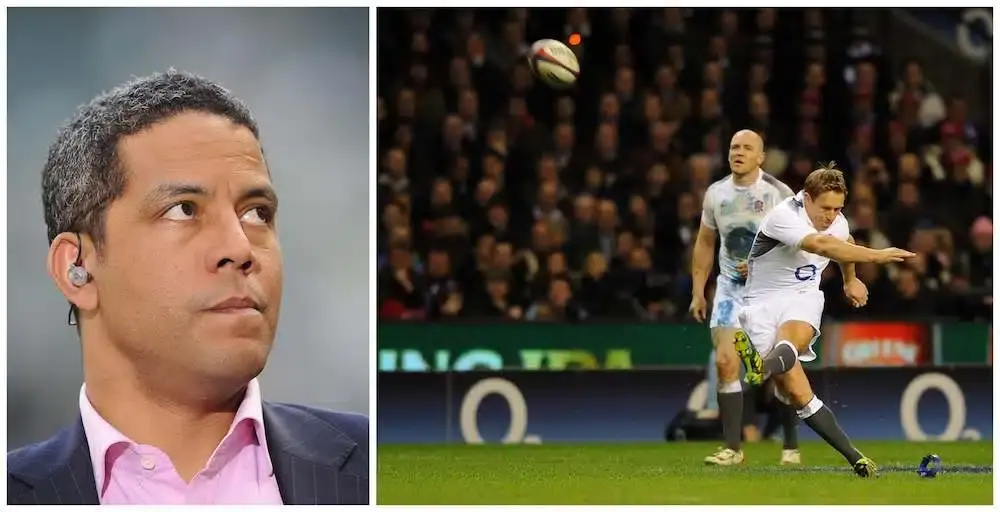

England legend Jeremy Guscott picks a dream team of Rugby World Cup winners (1987-2011 in The Rugby Paper.
15. John Gallagher (New Zealand 1987)
In terms of a traditional full-back hitting the line, Gallagher did it as well as any No.15 I have seen. He was elusive, and very quick, and the way the All Blacks brought him into the line was not just a joy to watch, but it must have been a fantastic feeling for Gallagher because it was making the most of a great talent.
He was not the greatest defender, but in that 1987 New Zealand side he did not have to defend much anyway.
14. Jason Robinson (England 2003)
Robinson was a superstar in Rugby Union and Rugby League, but it took him half the time to become a household name when he came over to the fifteen-a-side code. He left as one of the true greats, and as the biggest cross-code success in professional Rugby Union.
His speed over anything from 0 to 35 metres was quicker than anything I’ve seen, and his ability to work a 5-metre channel and leave defenders on their backsides with his changes of direction was incredible.
13. Conrad Smith (New Zealand 2011)
Arguably one of the best outside centres there has been who provides the foil for the New Zealand stars to shine. Smith quietly goes about his business, is deceptively quick and strong and shows that you don’t have to be a 15stone plus centre to have an impact these days.
12.Tim Horan (Australia 1991 and 1999, right)
Winning two World Cups tells it all. He was a pocket battleship with electric pace, and very tough. He tackled extremely hard for a small man, and in terms of pound-for-pound strength was like Scott Gibbs. One of the best, and in 1999 came back from a knee reconstruction to be the player of the tournament.
11.David Campese (Australia 1991)
You cannot say more about him than he’s already said about himself, but Campese is one of the most gifted players every to pull on a pair of rugby boots. For pure talent and instinct he is up there with Gareth Edwards and Jonah Lomu – that is how much impact he had on the game. Campo did not have exceptional pace, but his timing, running lines and skill, in terms of passing and kicking, were extraordinary.
10. Jonny Wilkinson (England 2003)
In his prime he was a phenomenon, especially in his ability to handle pressure and kick goals and drop-goals. The best backrowers in the world would love to have his tackling ability, and although he is not known for his line-breaks his passing is as good as any fly-half in the world.
9. Joost van der Westhuizen (South Africa 1995)
When you looked into Joost’s eyes they were those of a winner – there was such intensity and determination that you felt he would never be on the losing side. He was a big man for a scrum-half, and was strong and fast. He was also tenacious and scored an amazing number of tries for a No.9. A real Test match animal.
8. Buck Shelford (New Zealand 1987)
A true warrior, and one of those players you would have loved to play with. He did the basics incredibly well, and was a very fit, powerful unit. He was not the tallest No. 8 but he had huge presence and will-to-win, and it is why he became a great All Black captain.
7. Michael Jones (New Zealand 1987)
He was one of those remarkable athletes who did everything supremely well and made it look easy. He is one of the all time great openside flankers, and it was fitting when he scored the first ever try in a Rugby World Cup in the opening game of the 1987 tournament against Italy. He is also a man of great integrity, who gained admiration for sticking to his religious beliefs and not playing on Sundays.
6. Richard Hill (England 2003, far left)
He did not get the plaudits because he was not in one of the glamour positions, but he deserves to be there because he was the best in his position in his era. His work-rate was phenomenal, and it is why you hear the likes of Sir Clive Woodward and Martin Johnson saying he was one of the first names on the team sheet. He was that good.
5. John Eales (Australia 1991 and 1999)
No-one thought that such a lanky string-bean of a bloke could become one of the world’s best, and he was famously called “the arty farty student” by Wade Dooley. What he lacked in weight, he made up for by being a great athlete with a huge appetite for hard work – and, if that wasn’t enough, he also took over the goal kicking.
4. Martin Johnson (England 2003)
An amazing leader who consistently performed well. Johnson pushed the boundaries to the limit, not just in terms of the laws of the game, but also in terms of what was expected from second row forwards. He got better and better at lock as his career went on, and there was never a game when he did not play with total commitment.
3.Phil Vickery (England 2003)
Big and mobile, he helped to re-write the script for modern props. He always did his job in the scrum, but he was at his best around the field as a ball-carrier and tackler. He made a big impact as part of a great England front row trio alongside Steve Thompson and Trevor Woodman.
2. Sean Fitzpatrick (New Zealand 1987)
Showed his ability and his confidence when, as a young man, he kept Andy Dalton, a former All Black captain, out of the New Zealand side. A truly gritty competitor who never seemed to have a poor game, or get injured. He always found a way to stay at the top and get an edge.
1. Steve McDowell (New Zealand 1987)
McDowell was the super-fit prototype for the modern prop, and others followed where he blazed the trail. His trademark was scrummaging opponents into the ground and then getting around the pitch like a back row forward.
TRENDING


LATEST NEWS


LATEST COMMENTS
- Jordie Barrett over Damian de Allende is far from being correct. The hype around Dupont is also overreaching, he's probably 4th in the world and has been since the 2023 WC. He also avoids certain matchups which is strange. The rest of the list is pretty good apart from minor subjective biases.JasonMarlow16-09-2026
Loading