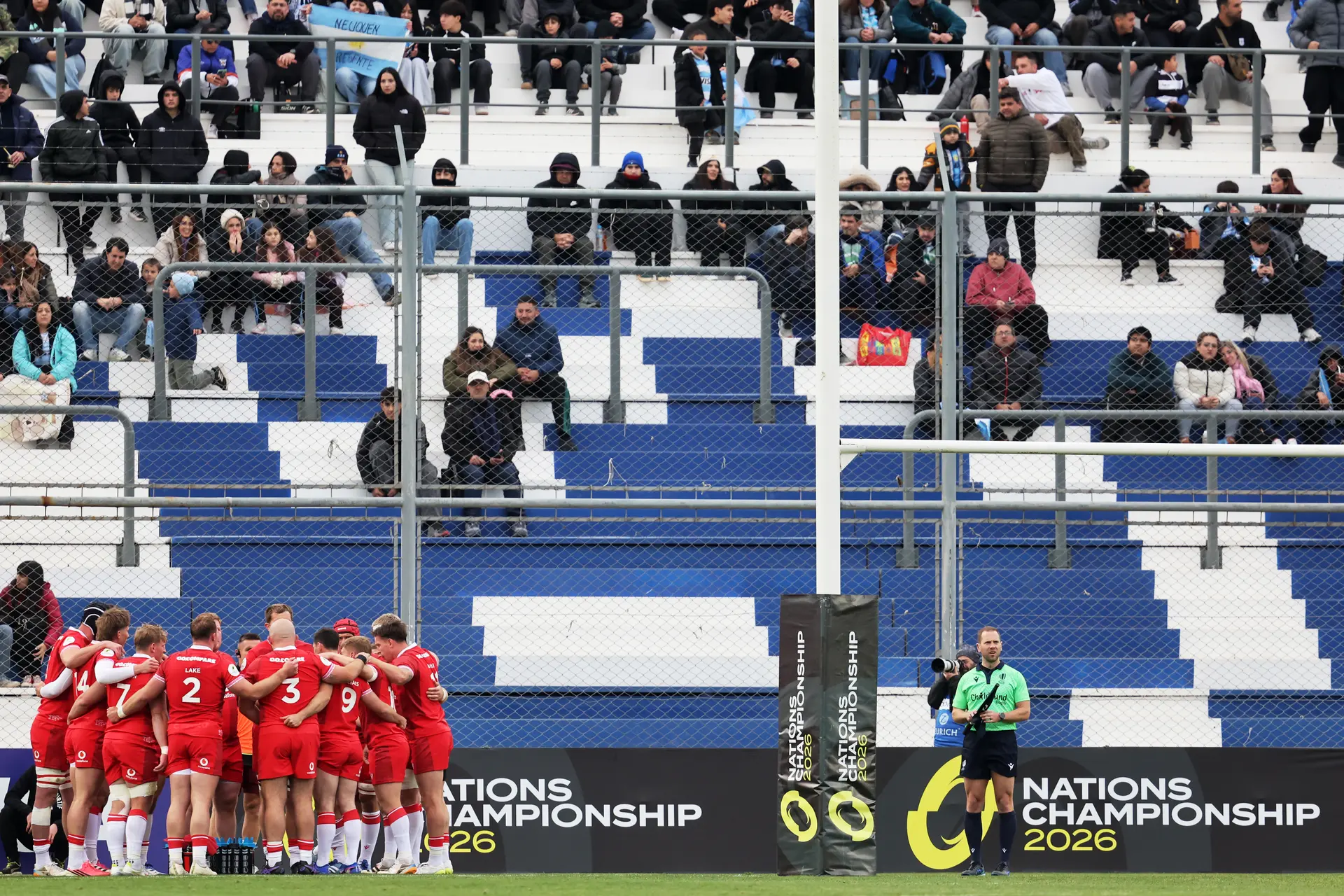

With everything looking rosy for Wales after recording two consecutive Test match wins against Italy and Fiji, Steve Tandy’s side were handed a harsh reality check at the Estadio San Juan del Bicentenario.
Facing Argentina, who are now ranked five positions higher than Wales in the world rankings, it was always going to be a tougher test, but the 35-21 loss still shows how far Wales have to go.
Join the RUCK’s WhatsApp community here and get the latest news sent straight to your messages.
They remain outside the world’s top 10 after missing the chance to return for the first time since July 2024, with victory over Los Pumas all that was required after Italy’s 47-17 defeat against New Zealand.
Although it’s a setback for Wales after three consecutive outings where they have recorded victories, Tandy’s side showed great spirit and were unfortunate not to leave western Argentina with at least a bonus point.

SAN JUAN, ARGENTINA - JULY 11: Dewi Lake of Wales celebrates scoring his team's first try with teammate Jac Morgan during the 2026 Nations Championship match between Argentina and Wales at Estadio San Juan del Bicentenario on July 11, 2026 in San Juan, Argentina. (Photo by Marcos Brindicci - Nations Championship/Getty Images)
It turned into a pointless visit to South America, but unlike the pair's previous outing in Cardiff last November, the deficit was significantly less, showing improvements are being made.
But the manner in which Wales went about their business, being clearly overpowered, saw them fall short of securing any sort of upset.
“We did well in the first third, and probably the last third,” admitted scrum-half Tomos Williams, who was stepping in for media duties with captain Dewi Lake absent from the post-match press conference.
“It’s that middle third that we probably struggled with. We struggled to get out of our 22.

SAN JUAN, ARGENTINA - JULY 11: Tomos Williams of Wales kicks the ball clear during the 2026 Nations Championship match between Argentina and Wales at Estadio San Juan del Bicentenario on July 11, 2026 in San Juan, Argentina. (Photo by Hernan Cortez - Nations Championship/Getty Images)
“Within 20-40 minutes, that’s probably where the game got away from us.
“I thought we started well. When we got in their red zone, I thought we were good and effective.
“We just did not get there often enough.”
Problems in Defence
Welsh supporters believed heading to Argentina that they could be victorious, following victory against Fiji and Scotland recording a thrilling 47-38 away win in Córdoba against Los Pumas.
However, earlier in the marathon day of Test match rugby, England brushed aside Fiji with ease to claim a thumping 73-8 victory in Liverpool.
Wales struggled in their outing against the Pacific Islanders seven days earlier, with their defence, particularly in the first half, a main talking point.

SAN JUAN, ARGENTINA - JULY 11: Joaquin Oviedo of Argentina celebrates scoring his team's first try during the 2026 Nations Championship match between Argentina and Wales at Estadio San Juan del Bicentenario on July 11, 2026 in San Juan, Argentina. (Photo by Hernan Cortez - Nations Championship/Getty Images)
Once again, albeit it was only his third game as Wales’ defence coach, Peter Murchie has got a lot of work to do to improve Wales’ rugged defence.
It was a sobering afternoon in San Juan, but it wasn’t a complete car crash of a result, though he’ll have the journey across to Durban, trying to implement a better strategy to improve his side’s defence.
“They’re a good team, and they’ve had more time together off the back of the Scotland game as well,” added head coach Tandy.
“We felt in a good place coming here, and it’s disappointing the way the game finished for us.”

SAN JUAN, ARGENTINA - JULY 11: Steve Tandy, Head Coach of Wales, looks on during warm ups prior to the 2026 Nations Championship match between Argentina and Wales at Estadio San Juan del Bicentenario on July 11, 2026 in San Juan, Argentina. (Photo by Marcos Brindicci - Nations Championship/Getty Images)
His side missed 32 tackles in total, compared to Argentina’s 11 misses, as Wales had a tackle completion rate of 86%. It’s Murchie’s first campaign, but they are nowhere near the standards expected.
Wales needed drastic improvements in the contest against Fiji; instead, the overall performance against Los Pumas took an unwanted backward step.
It’s an area that, on Saturday against the back-to-back world champions, South Africa, will need to improve; otherwise, a repeat of the harrowing 73-0 suffered last autumn may occur, and more records might be broken.
Wales’ Halfbacks

SAN JUAN, ARGENTINA - JULY 11: Sam Costelow of Wales kicks a conversion during the 2026 Nations Championship match between Argentina and Wales at Estadio San Juan del Bicentenario on July 11, 2026 in San Juan, Argentina. (Photo by Marcos Brindicci - Nations Championship/Getty Images)
Wales’ backline still remains a major talking point, and when it felt like there were improvements showing, they all have seemingly failed to grasp at their opportunities- expect changes ahead of the Springboks encounter.
Without doubt, Sam Costelow is a terrific player, and against Los Pumas, he was busier in defence than in attack.
He was given an opportunity to build on his performance against Scotland, but, like many, he did not grasp it to reclaim the 10 jersey.
That performance against Scotland at Principality Stadium now feels like a distant memory for the outside-half who left Argentina with a shiner.

SAN JUAN, ARGENTINA - JULY 11: Players of Wales warm up prior to the 2026 Nations Championship match between Argentina and Wales at Estadio San Juan del Bicentenario on July 11, 2026 in San Juan, Argentina. (Photo by Marcos Brindicci - Nations Championship/Getty Images)
But Tandy has to think hard now about whether to stick with starting Costelow or bring Dan Edwards back in for the clash against South Africa. This is key, as this is an area where, if continuous changes are made, it’s unhealthy for the rest of the backline.
Costelow kicked out on the full and fumbled possession, which led to Justo Piccardo scoring Los Pumas’ second try of the contest.
It was not just the 25-year-old who had an underwhelming performance; the whole of Wales’ backline didn’t cause the hosts many problems when attacking. Worrying signs were definitely shown, but were expected in a contest dominated by Argentina.
With the Springboks up next, Tandy should make changes but will likely keep his key personnel in the mix.
It’s a bold call, but scrum-half Williams has not been shining of late and hasn’t brought his impressive club form onto the international stage.
Talking about changes, Tandy may opt for a complete Ospreys half-back pairing of Kieran Hardy and Edwards against the Springboks. Hardy made his Nations Championship debut in San Juan and was one of Wales’ standouts against the Barbarians.
He started in all of Wales’ last three Tests in South Africa, which did include a first-ever victory on South African soil in 2022. The World Cup is looming, so why not employ Hardy from the off?
If it wasn’t the Springboks up next, like there was an intrigue with what Louis Rees-Zammit could do off the bench, which Tandy labelled as ‘exciting’, this could also apply if Williams comes on as a replacement.
Eddie James at 12?

SAN JUAN, ARGENTINA - JULY 11: Eddie James of Wales warms up ahead of the 2026 Nations Championship match between Argentina and Wales at Estadio San Juan del Bicentenario on July 11, 2026 in San Juan, Argentina. (Photo by Marcos Brindicci - Nations Championship/Getty Images)
Scarlets' Eddie James, at some point in his international career, will be selected at inside centre; it’s now just a matter of time.
Against Argentina, being paired alongside Joe Hawkins was not threatening enough. There’s the odd carry and metres gained, but Wales need it more consistently from their centres.
If anything, the senior centres may benefit from taking a leaf out of the book of Steffan Emanuel and Osian Darwin-Lewis, who shone in the U20s' fifth-place semi-final victory against Australia in Tbilisi on Sunday evening. Like the senior duo, they also play their club rugby together.
Against Los Pumas, neither flourished, and there seems to be a disconnect in these positions.
We have seen already this summer- Tom Rogers and Ellis Mee v Barbarians, Josh Adams and Rees-Zammit v Fiji, and Adams and Mee v Argentina- that Wales’ wingers aren’t receiving enough ball in hand in the wide channels.

SAN JUAN, ARGENTINA - JULY 11: Ellis Mee of Wales is tackled by Gonzalo Garcia of Argentina during the 2026 Nations Championship match between Argentina and Wales at Estadio San Juan del Bicentenario on July 11, 2026 in San Juan, Argentina. (Photo by Marcos Brindicci - Nations Championship/Getty Images)
Undoubtedly, Wales’ attack is currently lacking in creativity, and their performance against Los Pumas showed a dramatic shift in the wrong direction.
James has been called by several pundits and supporters to play at 12, and his big ball-carrying abilities are being wasted in the 13 jersey. It’s hard to disagree here.
Under attack coach Matt Sherratt who loves his inside centre to be a second playmaker, Hawkins and Ben Thomas are best suited in that regard. But as time goes on, this ploy seems to have passed its sell-by date. It’s time for change.
Wales in San Juan made a mere three line-breaks throughout the contest compared to Argentina’s 12, and that leaves one obvious question: is James better suited at getting his side over the gain line when employed at 12?
We are in a World Cup cycle after all, and normally these summer Tests were used for experimenting in the past, so why not start him at inside centre against the Springboks?
That may show a statement of intent from Tandy and Sherratt as Wales aim to improve from their dismal display in attack against Argentina.
Forwards Showing Positives
In recent years, finding positives in a Welsh performance has proven tricky, and at times almost impossible.
Despite the defeat, several individuals showed their skills despite being outplayed by Argentina. It was Tandy’s side's sternest examination to see how much they had improved.

SAN JUAN, ARGENTINA - JULY 11: Joaquin Oviedo of Argentina is tackled by Ellis Mee and Jac Morgan of Wales during the 2026 Nations Championship match between Argentina and Wales at Estadio San Juan del Bicentenario on July 11, 2026 in San Juan, Argentina. (Photo by Marcos Brindicci - Nations Championship/Getty Images)
Even in the gloom that Wales has endured on the international stage since the 2023 Rugby World Cup, Jac Morgan has been consistently his side’s best player. In San Juan, that was no different, after claiming the Player of the Match award seven days earlier, too.
The Gloucester-bound player was Wales’ top tackler with 23, and had Dewi Lake (21), Ben Carter (20), and James Botham (18) with him as company in the top four defenders of the match. All four were outstanding for Wales once again.
In fact, Botham, in his first start for Wales since the final Six Nations game against Italy, stated his case after replacing Cardiff teammate Alex Mann at blind-side.
He got through a lot of work on Saturday, and he was Wales’ main carrier with 15 made. After also producing a try-saving tackle, Botham has now provided Tandy with selection headaches ahead of facing South Africa.
Under a new scrum coach and former Wales international, Paul James, Wales’ scrum is now one of its greatest strengths.
Another area that drew a great deal of attention, for the right reasons, was surrounding Wales’ scrum.

SAN JUAN, ARGENTINA - JULY 11: Rhys Carre of Wales celebrates scoring his team's second try with teammate Jac Morgan during the 2026 Nations Championship match between Argentina and Wales at Estadio San Juan del Bicentenario on July 11, 2026 in San Juan, Argentina. (Photo by Marcos Brindicci - Nations Championship/Getty Images)
Rhys Carré and Dillon Lewis, before being replaced at the break, were solid, and replacements Nicky Smith and Ben Warren made Wales even stronger here in the final 40 minutes.
It’s a strenuous and long journey to Durban for Wales as they face the daunting challenge of back-to-back world champions South Africa, where the test is even greater than last time out.
Wales must continue to improve and show greater attacking ability, but cannot afford to lose their dominance at the set-piece.
It is rugby’s greatest challenge facing the Springboks in South Africa, but what does a positive display look like for Wales?