Who deserves a place in the greatest men's rugby team of their respective decade?
Join RUCK’s Instagram broadcast channel and get the latest rugby news straight to your phone.
From Wales' Golden Era stars of the 1970s to the modern-day record breakers, rugby has evolved exponentially across the past 66 years. Styles have changed, professionalism has transformed the game, and the demands placed on players are greater than ever.
Yet every decade has produced a collection of players who stood above the rest and left an enduring mark on the sport.
In this article, we have selected the best XV from each rugby decade, from the 1970s, all the way through to the fist six years of the ongoing 2020s.
The selections are based on a combination of individual brilliance, longevity, influence, major international titles and the impact each player had on their era. And yes, there are, inevitably, some huge names left out, with some of the greatest players ever sitting amongst the honourable mentions.
Choosing just one players per position from each decade filled with legendary talent is almost impossible. However, some positions will be more hotly contested than others.
But overall, that is what makes this debate so fascinating - so lets get cracking on with our picks.
So, from Gareth Edwards to Antoine Dupont, here are RUCK's picks for the greatest XV of every rugby decade.
1970s: The Golden Era of Our Sport
We begin our look through the decades with the 1970s, in a time fondly remembered as the golden era of amateur rugby union.
This generation produced players of extraordinary toughness, stunning flair and unbridled imagination, with this unveiled XV compiling a definitive roll call of legends.
At the back is the phenomenal JPR Williams, who sports 55 Wales caps, three Grand Slams, six Triple Crowns and a remarkable 11 wins in 11 Tests against England.
On the wings, Gerald Davies supplies the Welsh finishing touch, scoring 20 tries in 46 Tests. Legendary All Black Bryan Williams was too a devastating athlete, who scored 14 tries in just 13 matches on the 1970 South Africa tour.
In midfield, the most complete centre of the amateur era brings in Ireland’s Mike Gibson, who amassed 69 caps and five Lions tours.
He starts alongside legendary Lions coach and former Scotland captain Ian McGeechan, whose eight Lions Test caps included the undefeated 1974 South Africa tour.
Then there was Phil Bennett, whose audacious brilliance helped define Wales’ golden era. Whilst Barry John is another stellar shout, The King's early abdication in 1972 saw Bennett lead the Welsh line for the majority of the 70s.
Then at scrum-half, Gareth Edwards needs little introduction. Three Grand Slams, 53 consecutive Wales caps and that unforgettable 1973 Barbarians try against the All Blacks, in a moment still regarded as one of rugby’s greatest ever scores puts him on our team.
Up front, this side has everything: Ian McLauchlan’s “Mighty Mouse” scrummaging, Peter Wheeler’s pioneering all-round game and the versatile Graham Price across both the loose and tight heads. Price's 70-metre gallop against France, is another highlight reel moment from this decade.
In the row we pair formidable All Black Colin Meads’ legendary toughness, to Willie John McBride’s legendary leadership of the undefeated 1974 Lions tour and his record 17 Lions caps.
Mervyn Davies, Ian Kirkpatrick and Fergus Slattery complete a back row packed with intelligence, power and pace. This is 1970s rugby at its most compelling: brutal, brilliant and packed with players who revolutionised exactly what their positions could be.
HONOURABLE MENTIONS
BARRY JOHN (WALES) DAVID DUCKHAM (ENGLAND), ANDY IRVINE (SCOTLAND), JEAN-PIERRE RIVES (FRANCE)
1970S GREATEST MEN'S XV
15. JPR WILLIAMS (WALES)
14. GERALD DAVIES (WALES)
13. MIKE GIBSON (IRELAND)
12. IAN MCGEECHAN (SCOTLAND)
11. BRYAN WILLIAMS (NEW ZEALAND)
10. PHIL BENNETT (WALES)
9. GARETH EDWARDS (WALES)
1. IAN MCLAUCHLAN (SCOTLAND)
2. PETER WHEELER (ENGLAND)
3. GRAHAM PRICE (WALES)
4. COLIN MEADS (NEW ZEALAND)
5. WILLIE JOHN MCBRIDE (IRELAND)
6. IAN KIRKPATRICK (NEW ZEALAND)
7. FERGUS SLATTERY (IRELAND)
8. MERVYN DAVIES (WALES)
1980s: A New Generation, Old School Grit
We continue our journey through the decades with the 1980s, a period where rugby began to evolve rapidly from its amateur traditions into the modern game.
This generation combined the brutal physicality of old-school rugby with a renewed emphasis on athleticism, tactical sophistication and attacking invention, to produce another ungodly XV packed with genuine legends.
At the back is France’s magnificent maestro Serge Blanco, the ultimate embodiment of 'Jouer' flair, and a man regarded as the greatest full-back of all time.
He helped redefine the full-back as an attacking weapon and took the role into a new era.
He won Grand Slams in 1981 and 1987, before producing one of the decade’s defining moments with his famous diving corner try against Australia in the 1987 World Cup semi-final.
On the wing, 'The Great Entertainer' David Campese brought the chaos, as the Australian's trademark goose-step made him one of the most dangerous attackers in world rugby.
Alongside him is New Zealand powerhouse John Kirwan, whose 75-metre demolition job against Italy at the inaugural 1987 World Cup remains one of the tournament’s iconic tries.
In midfield, Danie Gerber’s staggering 19 tries in just 24 Tests tells only part of the Springboks story from the dark Apartheid Era days, which brought reduced international fixtures.
His hat-trick against England in Johannesburg in 1984 is a reminder of his devastating ability.
Gerber partners France’s Philippe Sella, arguably this decade's most complete centre whose strength, pace and sublime handling made him one of the finest in the midfield.
Then there is Hugo Porta, Argentina’s undisputed rugby king who takes the reins at fly half. Porta's greatest achievement came in the famous 21-21 draw with the All Blacks in 1985, when he scored all 21 points for Los Pumas.
Nick Farr-Jones then provides the tactical intelligence at scrum-half, having formed a legendary partnership with Michael Lynagh during Australia’s 1984 Grand Slam tour of the Home Nations.
Up front, Ireland’s Phill Orr provides the scrummaging stability and the stats to back up his inclusion, while New Zealand’s Sean Fitzpatrick brings with him the beginnings of the modern hooker, playing every minute of the All Blacks’ 1987 World Cup triumph and skippering the side later in his career.
France’s Jean-Pierre Garuet supplies the front-row steel at tight-head, with decorated former England captain Bill Beaumont and Australia’s 6ft 8in lineout giant Steve Cutler complete a formidable second row pairing that could challenge any duo.
The back row is pure confrontation, with bite, work rate and results the order of the day.
England’s Mike Teague was the 1989 Lions’ Player of the Series, Scotland’s Finlay Calder captained his men to new heights, along with a remarkable comeback victory in Australia.
New Zealand's Wayne ‘Buck’ Shelford opitimised grit, as he brought revered physicality and leadership to the No.8 jersey.
Shelford's stories are the stuff of legend, with incomparable toughness showcased best at the infamous 1986 'Battle of Nantes.
HONOURABLE MENTIONS
DAVID SOLE (ENGLAND), GAVIN HASTINGS (SCOTLAND), OLLIE CAMPBELL (IRELAND)
1980S GREATEST MEN'S XV
15. SERGE BLANCO (FRANCE)
14. DAVID CAMPESE (AUSTRALIA)
13. DANIE GERBER (SOUTH AFRICA)
12. PHILIPPE SELLA (FRANCE)
11. JOHN KIRWAN (NEW ZEALAND)
10. HUGO PORTA (ARGENTINA)
9. NICK FARR-JONES (AUSTRALIA)
1. PHILL ORR (IRELAND)
2. SEAN FITZPATRICK (NEW ZEALAND)
3. JEAN-PIERRE GARUET (FRANCE)
4. BILL BEAUMONT (ENGLAND)
5. STEVE CUTLER (AUSTRALIA)
6. MIKE TEAGUE (ENGLAND)
7. FINLAY CALDER (SCOTLAND)
8. WAYNE 'BUCK' SHELFORD (NEW ZEALAND)
1990s: The Professional Era Dawns
We now move into the 1990s, perhaps the most fascinating decade in rugby’s evolution.
The 90s began in the dying days of the amateur era and concluded with rugby firmly established as a professional, global sport.
This generation combined the last great traditions of amateur rugby with explosive athleticism, tactical innovation and a new level of physicality, producing another XV packed with transformational players.
At the back is New Zealand’s Christian Cullen, the “Paekakariki Express”, whose extraordinary acceleration and counter-attacking instinct has him take the mantle as this era's definite number 15.
Alongside him in the back-three, his fellow All Black Jeff Wilson brought elite finishing and intelligence, including a hat-trick on his Test debut against Scotland in 1993.
Then there is the late, great Jonah Lomu. Rounding off the back-field trio At 6ft 5in and 120kg. Lomu's backed up his freight-train build with frightening pace, as the All Black shattered every convention with traditional wingers.
His four-try demolition of England at the 1995 World Cup transformed him into rugby’s first global superstar, with his legend carried on by those in the black jersey.
In the midfield, England’s Jeremy Guscott brought effortless class, including the series-winning drop goal for the Lions against South Africa in 1997.
Australia’s Tim Horan joins him, after bookending the decade with two remarkable World Cup victories.
Horan's comeback from career-threatening knee surgery in 1994, followed by being named Player of the Tournament at the 1999 World Cup, is one of the era’s great stories.
Michael Lynagh provided the cool head at fly-half, while another late, great legend in Joost van der Westhuizen brought unprecedented aggression to scrum-half.
The Springbok's bone-rattling tackle on Lomu in the 1995 Rugby World Cup final remains one of the tournament’s defining moments that optimised his unbreakable spirit.
In the forward pack, South Africa’s Os du Randt combined immense scrummaging power with remarkable mobility and a tenured career that has never been replicated.
Phil Kearns provided Australia with leadership and confrontation at hooker, whilst England’s Jason Leonard bridged the amateur and professional eras, anchoring a front row that helped England win three Grand Slams in 1991, 1992 and 1995.
In the row, John Eales was arguably rugby’s ultimate complete lock. Nicknamed 'Nobody' as 'Nobody's Perfect' Eales dominated the lineout, and brought masterful carrying, tackling and could even kick match-winning goals.
He partners England colossus Martin Johnson, who captained the Lions to their famous 1997 series victory over South Africa.
Despite the obvious England heroics in the early 2000s, Johnson's pre-2K work for Leicester, England and the Lions earns him a spot upon our team of the 90s.
The back row begins with Francois Pienaar, who captained South Africa to the 1995 World Cup, lifting the trophy alongside Nelson Mandela in one of sport’s most powerful images.
Neil Back was the prototype modern openside, while Zinzan Brooke rewrote the possibilities of the No.8 shirt with his extraordinary skill set — including that famous 47-metre drop goal against England.
HONOURABLE MENTIONS:
RORY UNDERWOOD (ENGLAND), STEPHEN LARKHAM (AUSTRALIA), FABIEN GALTHIE (FRANCE)
1990S GREATEST MEN'S XV
15. CHRISTIAN CULLEN (NEW ZEALAND)
14. JEFF WILSON (NEW ZEALAND)
13. JEREMY GUSCOTT (ENGLAND)
12. TIM HORAN (AUSTRALIA)
11. JONAH LOMU (NEW ZEALAND)
10. MICHAEL LYNAGH (AUSTRALIA)
9. JOOST VAN DER WESTHUIZEN (SOUTH AFRICA)
1. OS DU RANDT (SOUTH AFRICA)
2. PHIL KEARNS (AUSTRALIA)
3. JASON LEONARD (ENGLAND)
4. JOHN EALES (AUSTRALIA)
5. MARTIN JOHNSON (ENGLAND)
6. FRANCOIS PIENAAR (SOUTH AFRICA)
7. NEIL BACK (ENGLAND)
8. ZINZAN BROOKE (NEW ZEALAND)
2000s: A New Century Breaks New Ground
We now enter the 2000s, a decade in which rugby union fully embraced professionalism and became faster, more physical and increasingly sophisticated.
This generation combined the power of the professional athlete with the tactical demands of a rapidly evolving game, producing a XV packed with Rugby World Cup winners and iconic leaders.
At the back is South Africa’s Percy Montgomery, whose golden boot became one of the defining weapons of the Springboks’ 2007 World Cup triumph.
He finished the tournament as the leading points scorer with 105, including 12 points in the final victory over England.
On one wing, Wales’ Shane Williams proved size was no barrier to greatness, winning World Player of the Year in 2008 and finishing his international career with 58 tries.
Then comes Bryan Habana, whose devastating acceleration produced eight tries at the 2007 World Cup, equalling Jonah Lomu’s tournament record and earning him World Player of the Year honours.
The man regarded as the quickest player on the planet at his peak takes his rightful place upon Team 2000.
In midfield, Brian O’Driscoll announced himself with that legendary hat-trick against France in Paris in 2000 before captaining Ireland to their first Grand Slam in 61 years in 2009.
A three time winner of the Six Nations Player of the Tournament accolade, BOD is also a World Rugby Hall of Famer to boot.
The Ireland legend partners England’s Will Greenwood, whose intelligence, handling and spatial awareness made him a key component of the 2003 World Cup-winning side.
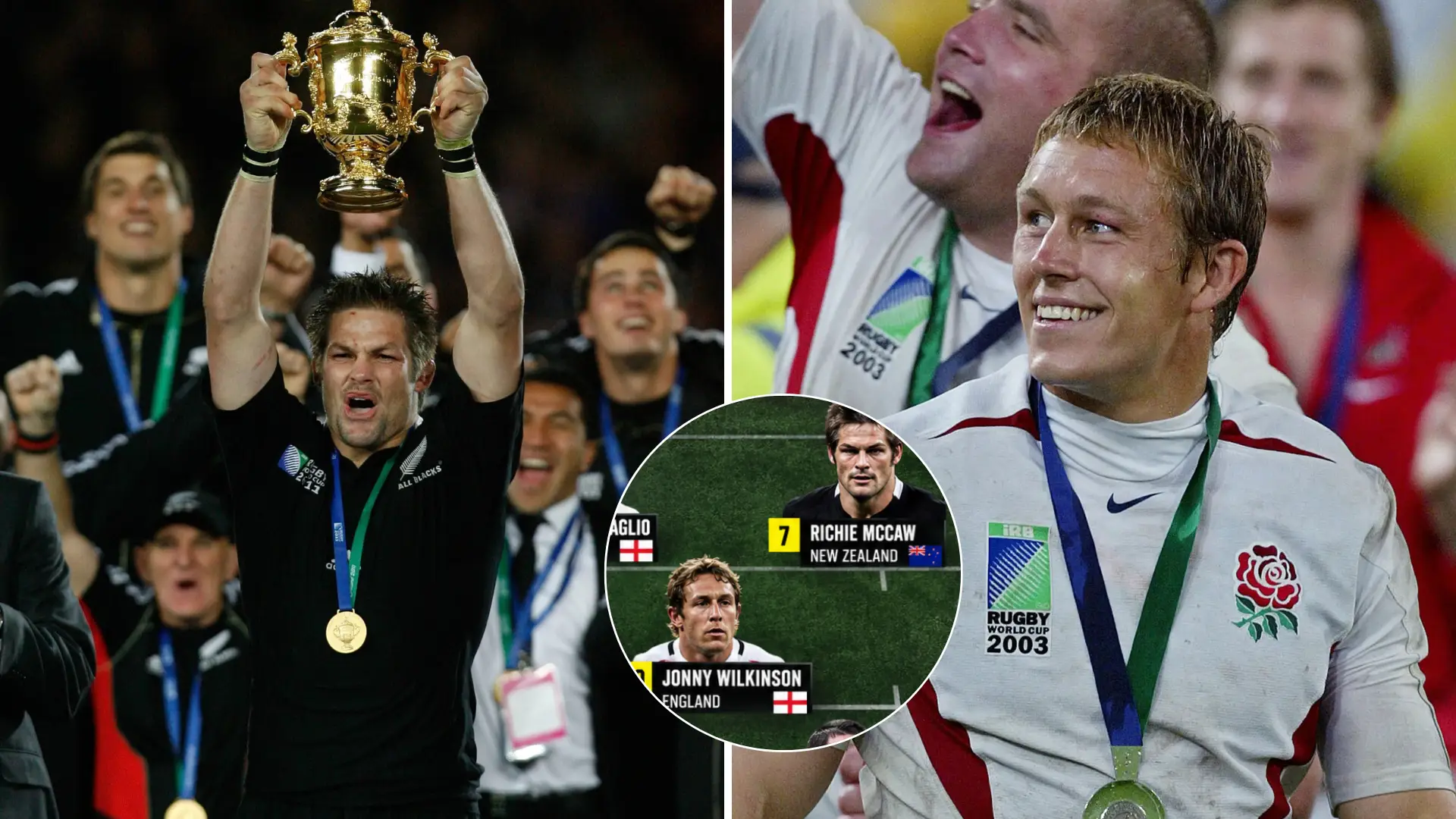
At fly-half, there can only be Jonny Wilkinson.
The ultimate professional's perfectionist, his extra-time drop goal against the Wallabies in Sydney has been hung in the annals of the RFU, as he delivered England the 2003 World Cup title.
Wilkinson is also celebrated for his relentless defensive work rate, as he pioneered the tackling capabilities of a number 10, whilst his unique kicking style brought meticulous accuracy to the tee.
George Gregan provides the tactical authority at scrum-half, as the Wallabies legend retired in 2007 as the most-capped international player in history at the time, with 139 Australia appearances.
Up front, Tony Woodcock takes the loose-head spot, having long spearheaded the All Blacks with scrummaging class.
South Africa’s John Smit brings the leadership of the 2007 World Cup-winning captain in at hooker.
Wales’ resident propping wildman Adam Jones anchors the tight-head, becoming a cornerstone of the Welsh pack and one of the decade’s most formidable scrummagers.
In the row, Victor Matfield is the undisputed lineout king, playing a starring role in South Africa’s 2007 World Cup triumph.
Alongside him, Ireland’s Paul O’Connell supplies relentless physicality and leadership, captaining the British & Irish Lions on their 2009 tour of South Africa.
O'Connell picked up where Martin Johnson left off with the Lions, following the England legend's international retirement in 2004.
The back row is built around three very different forms of excellence. Schalk Burger won World Player of the Year in 2004 and overcame a neck injury to return for South Africa’s 2007 World Cup triumph.
Richie McCaw became the defining openside of the professional era, winning World Player of the Year twice during the 2000s and transforming the breakdown into an art form.
Lawrence Dallaglio completes the trio, playing every minute of England’s 2003 World Cup campaign and setting the standard for number eights across the globe.
HONOURABLE MENTIONS:
TANA UMAGA (NEW ZEALAND), FOURIE DU PREEZ (SOUTH AFRICA), JASON ROBINSON (ENGLAND), THIERRY DUSATOIR (FRANCE), DAN CARTER (NEW ZEALAND), RONAN O'GARA (IRELAND)
15. PERCY MONTGOMERY (SOUTH AFRICA)
14. SHANE WILLIAMS (WALES)
13. BRIAN O'DRISCOLL (IRELAND)
12. WILL GREENWOOD (ENGLAND)
11. BRYAN HABANA (SOUTH AFRICA)
10. JONNY WILKINSON (ENGLAND)
9. GEORGE GREGAN (AUSTRALIA)
1. TONY WOODCOCK (NEW ZEALAND)
2. JOHN SMIT (SOUTH AFRICA)
3. ADAM JONES (WALES)
4. VICTOR MATFIELD (SOUTH AFRICA)
5. PAUL O'CONNELL (IRELAND)
6. SCHALK BURGER (SOUTH AFRICA)
7. RICHIE MCCAW (NEW ZEALAND)
8. LAWRENCE DALLAGLIO (ENGLAND)
2010s: Faster and Stronger: Pro Era Evolves
The 2010s marked rugby’s next great evolutionary leap. The professional game was now fully established, defensive systems were becoming brutally sophisticated and players were expected to be bigger, faster and more complete than ever before.
This XV captures a decade where precision met power, and individual brilliance still found ways through increasingly organised defences.
At full-back is the one and only Beauden Barrett. The All Blacks legend was named World Rugby Player of the Year twice throughout the 2010s, and scored a try in the 2015 Rugby World Cup Final.
Barrett is the only player named in our team of the 2010s who is still playing Test match rugby, which speaks to the career longevity of the superstar.
Barrett is joined by fellow All Black Julian Savea in the back three, who supplied devastating power on the wing. “The Bus” scored 46 tries in 54 Tests, including an incredible hat-trick against France at the 2015 Rugby World Cup.
In midfield, Wales great Jonathan Davies brought defensive intelligence and attacking incision alongside the colossal Ma’a Nonu.
A two-time World Cup winner with 103 All Blacks caps, Nonu evolved from feared wrecking-ball runner into a remarkably complete second five-eighth.
George North completes the back three out on the left wing, with the Wales and Lions icon towering above his opponents with a 6ft 4in frame.
With exceptional speed, he followed Lomu's prototype for a powerhouse winger, and carved his own legacy in two famous red jerseys.
At No. 10 sits Dan Carter, arguably the most complete fly-half rugby has produced.
A two-time World Cup winner and international rugby’s record Test points scorer with 1,598, Carter could run, kick, defend and control a match with extraordinary calm.
Behind him, his fellow countryman and 2015 Rugby World Cup winner Aaron Smith’s lightning service helped drive the All Blacks’ high-tempo game.
Up front, Tendai Mtawarira provides the raw power with the Beast a must-have name coming in from the Springboks.
Ireland stalwart Rory Best the technical precision in at hooker, before Dan Cole too brings the relentless set-piece craft and impressive international longevity.
However, no two men have won more international caps than our selected second row pairing of Alun Wyn Jones and Sam Whitelock.
The Wales and All Blacks great form a colossal engine, combining leadership, lineout expertise and seemingly endless work rates for a total of 323 caps (Jones 170, Whitelock - 153).
The back row is built for war, with All Blacks hard-man Jerome Kaino brings brutal gainline defence to the number six jersey.
Richie McCaw brings the greatest breakdown mastery of his generation, and becomes the first player to be selected in two decades after leading the All Blacks to Rugby World Cup glory in 2011 and 2015.
Italy's all-time greatest rugby contribution Sergio Parisse adds the creative brilliance to No. 8, with the back row icon celebrated for leading his beloved Azzurri single-handedly at times.
HONOURABLE MENTIONS:
KIERAN READ (NEW ZEALAND), OWEN FARRELL (ENGLAND), STUART HOGG (SCOTLAND), MANU TUILAGI (ENGLAND), JOHNNY SEXTON (IRELAND), LEWIS MOODY (ENGLAND), LEIGH HALFPENNY (WALES)
GREATEST MEN'S XV OF THE 2010S
15. BEAUDEN BARRETT (NEW ZEALAND)
14. JULIAN SAVEA (NEW ZEALAND)
13. JONATHAN DAVIES (WALES)
12. MA'A NONU (NEW ZEALAND)
11. GEORGE NORTH (WALES)
10. DAN CARTER (NEW ZEALAND)
9. AARON SMITH (NEW ZEALAND)
1. TENDAI MTAWARIRA (SOUTH AFRICA)
2. RORY BEST (IRELAND)
3. DAN COLE (ENGLAND)
4. ALUN WYN JONES (WALES)
5. SAM WHITELOCK (NEW ZEALAND)
6. JEROME KAINO (NEW ZEALAND)
7. RICHIE MCCAW (NEW ZEALAND)
8. SERGIO PARRISE (ITALY)
2020s: The Stars of Today take the Stage
With the 2020s decade still unfolding, this XV represents the stars who have already defined the modern game over the past six years.
At fullback is once again Beauden Barrett. The ultimate hybrid back who can turn defence into attack from anywhere on the field, Barrett's standard bearing excellence sees him follow Richie McCaw in being named in our selected teams across two decades.
On the wing, the pulsating pace of Cheslin Kolbe brings something entirely different: diminutive, explosive and almost impossible to contain in broken play.
His 2019 World Cup final try remains an enduring image of his brilliance, with Stormers fans excited to have their man back in South Africa.
Louis Bielle-Biarrey represents the new generation on the left wing, combining frightening acceleration with exceptional positioning and finishing.
LBB broke the Six Nations record for tries in a single campaign back in 2025 with eight, before going one better in 2026 and bagging nine tries in five tests.
His emergence as one of France’s most dangerous attacking weapons has made him one of the decade’s defining young stars.
Two Six Nations titles with France and two Champions Cup winners medals with Bordeaux-Begles has defined such dominace.
In the midfield, Jesse Kriel has become the defensive brain of South Africa’s extraordinary backline, while Jordie Barrett brings size, kicking range and playmaking ability to No. 12.
Then comes Finn Russell, rugby’s ultimate maverick in the 10 jersey.
His audacious passing, kicking and willingness to attempt the unexpected make him almost impossible to scheme against. Whilst at scrum-half, Antoine Dupont takes the game to another level entirely.
A World Rugby 15s Player of the Year, European champion and Olympic gold medallist in sevens, Dupont possesses the power of a back-rower, the vision of a fly-half and the instincts of a world-class scrum-half.
Is the Dupont-Russell halfback pairing the greatest possible combination of all time?
Up front, Ox Nché provides explosive scrum power, as a celebrated member of Rassie Erasums' bomb squad who would be delighted to remind you that 'salads don't win scrums.'
Alongside him at hooker is the reigning World Rugby Player of the Year.
Malcolm Marx brings the breakdown threat of modern day Ironman with the masterful scrummaging and line-out work of a grizzled old-school verteran.
Tadhg Furlong rounds of the scrum at tight-head, as the decorated Ireland and Leinster man combines anchor-like strength with remarkable handling ability and the hot-stepping of top-flight winger.
Eben Etzebeth supplies intimidation, physicality and elite lineout work to the second row, and he packs down with England and Lions captain Maro Itoje. The Saracen brings relentless disruption to the locks.
The back row is led by the one and only Siya Kolisi, whose leadership helped South Africa become back-to-back World Cup champions, with Rassie's men now targeting an unprecedented three-peat of Rugby World Cup titles.
Beside him, his fellow countryman and multiple time World Rugby Player of the Year winner Pieter-Steph du Toit takes his dutifully deserved spot in the back row.
Ardie Savea then rounds off the greatest possible men's rugby XV of the past half dozen years. The newly announced Blues man is one of the the most complete packages in modern rugby.
Rightfully the man to lead the All Blacks into Australia for the Rugby World Cup, Savea's explosive carrying, breakdown expertise and relentless work rate knows no bounds in black.
HONOURABLE MENTIONS:
SAM CANE (NEW ZEALAND), TADHG BEIRNE (IRELAND), TOMASSO MENONCELLO (ITALY), ELLIS GENGE (ENGLAND), CAELAN DORIS (IRELAND), JAC MORGAN (WALES) DAMIEN DE ALLENDE (SOUTH AFRICA), SCOTT BARRETT (NEW ZEALAND), BEN EARL (ENGLAND)
15. BEAUDEN BARRETT (NEW ZEALAND)
14. CHESLIN KOLBE (SOUTH AFRICA)
13. JESSE KRIEL (SOUTH AFRICA)
12. JORDIE BARRETT (NEW ZEALAND)
11. LOUIS BIELLE-BIARREY (FRANCE)
10. FINN RUSSELL (SCOTLAND)
9. ANTOINE DUPONT (FRANCE)
1. OX NCHE (SOUTH AFRICA)
2. MALCOLM MARX (SOUTH AFRICA)
3. TADHG FURLONG (IRELAND)
4. EBEN ETZEBETH (SOUTH AFRICA)
5. MARO ITOJE (ENGLAND)
6. SIYA KOLISI (SOUTH AFRICA)
7. PIETER-STEPH DU TOIT (SOUTH AFRICA)
8. ARDIE SAVEA (NEW ZEALAND)