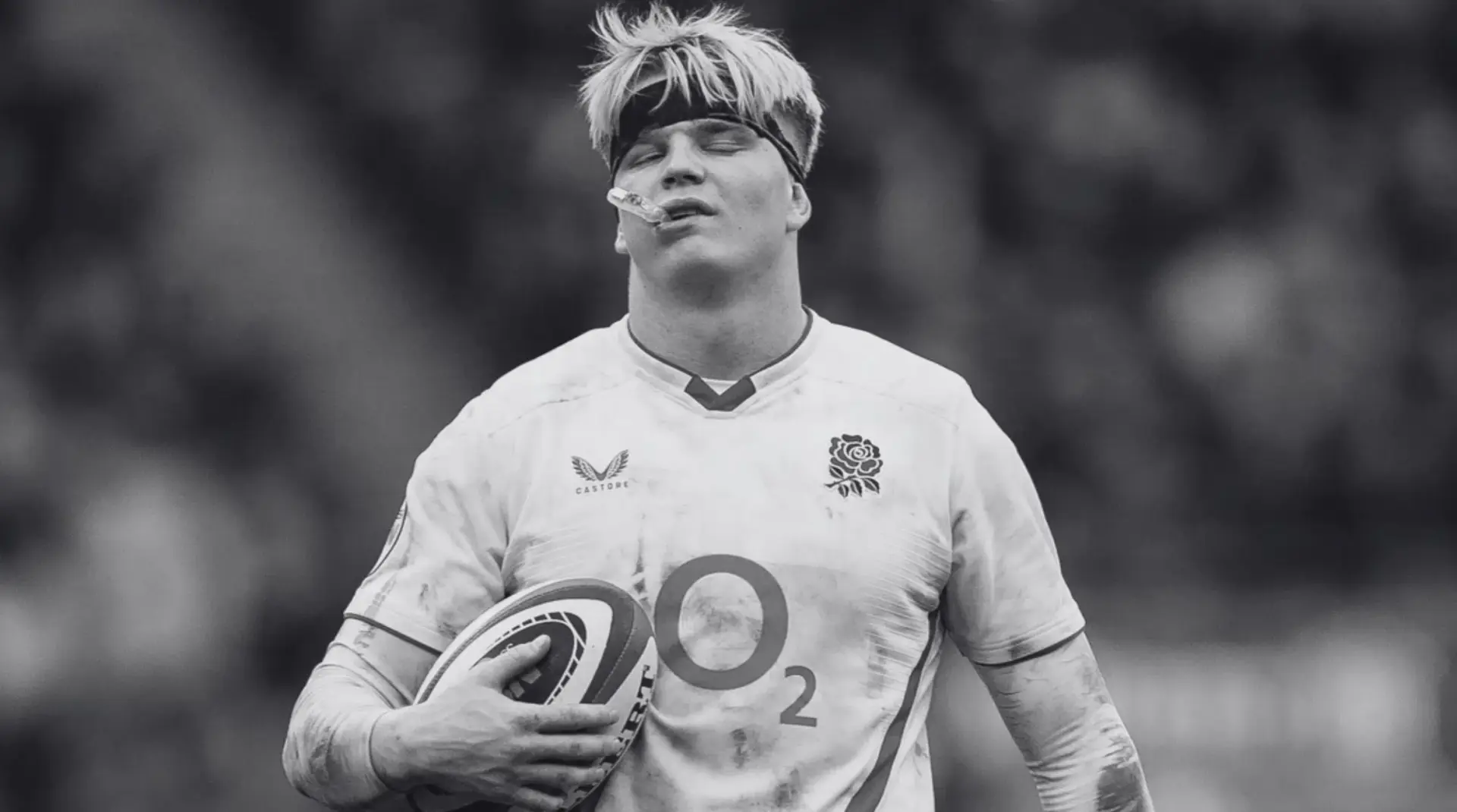

PREM Rugby returns this weekend after the conclusion of the Six Nations — but one of England’s rising stars will not be involved.
⭐ Save us to your Google Favourites for nonstop RUCK content!
Henry Pollock has been stood down from all rugby activity with immediate effect, in line with strict player welfare protocols following the international campaign.
It comes just days after a dramatic Six Nations finale, where Thomas Ramos’ late penalty sealed the title for France, underlining the relentless nature of the modern rugby calendar.
Join RUCK’s Instagram broadcast channel and get the latest rugby news straight to your phone.
Welfare rules force immediate decision
Under World Rugby’s latest welfare framework, elite players are limited to approximately 30 matches per season and no more than six consecutive match weeks. Just as importantly, those involved in Test rugby are required to take a minimum one-week rest period to recover both physically and mentally.
Pollock’s involvement during the Six Nations has pushed him into a position where rest is not optional — it is mandatory.
RFU monitoring triggers stand-down
The decision has been overseen by the Rugby Football Union and PREM Rugby through the Men’s Professional Rugby Board’s Player Load Management Group. This body continuously tracks the workload of England-qualified players and can enforce rest periods where necessary.
In Pollock’s case, his accumulated minutes during the championship have triggered an immediate stand-down, ruling him out of this weekend’s Premiership fixtures.
Teammates already switching off
Pollock is not alone in stepping away following the tournament. Tommy Freeman has already jetted off to New York, while Ben Earl is currently unwinding on the golf course in Spain — clear signs that England’s internationals are taking advantage of their enforced downtime.
Condensed Six Nations a key factor
This year’s Six Nations schedule has only intensified the issue. With just one fallow week instead of the usual two, players have had less recovery time between matches.
As a result, those heavily involved — like Pollock — have faced a more compressed and demanding run of fixtures, increasing the need for enforced rest.
What it means for PREM Rugby
Pollock’s absence highlights the growing influence of player welfare regulations on team selection. Clubs are now required to balance performance with strict workload limits, particularly in the aftermath of international tournaments.
While some England players may return immediately if they featured minimally, those who carried the bulk of the workload — Pollock included — will be carefully managed over the coming weeks.
For now, one thing is clear: Henry Pollock’s Premiership return will have to wait.
EDITORS PICKS:
Mail Online brutally ranks England’s FIVE worst performers in the Six Nations
red plenty of scrutiny as performances fluctuated throughout the tournament.
Following the championship, Mail Online released its player ratings, with only five England players receiving a score below 5/10.
Several of those low ratings were influenced by injuries, limited appearances, or difficult matches against strong opposition. Below is a closer look at those players — alongside RUCK’s own verdict on their tournaments.
⭐ Save us to your Google Favourites for nonstop RUCK content!
Tom Curry – 4/10
Mail Online:
"Played very well on last summer’s Lions tour despite nursing a serious wrist injury. It all caught up with him in this year’s championship. Nowhere near his best, in and out of the side, and then suffered a calf problem in the warm-up to the Italy game. Like Itoje, he also badly, badly needs a rest."
"Played very well on last summer’s Lions tour despite nursing a serious wrist injury. It all caught up with him in this year’s championship. Nowhere near his best, in and out of the side, and then suffered a calf problem in the warm-up to the Italy game. Like Itoje, he also badly, badly needs a rest."
RUCK Verdict:
Curry was injured against Italy and otherwise produced a fairly average tournament by his usual high standards. Fitness issues clearly impacted his ability to influence games consistently.
Curry was injured against Italy and otherwise produced a fairly average tournament by his usual high standards. Fitness issues clearly impacted his ability to influence games consistently.
Ollie Lawrence – 3/10
Mail Online:
"Struggles with a knee injury meant that his only appearance came against Ireland and England were cut to ribbons defensively in the outside channels in that game. He’s far better than he showed in this championship."
"Struggles with a knee injury meant that his only appearance came against Ireland and England were cut to ribbons defensively in the outside channels in that game. He’s far better than he showed in this championship."
RUCK Verdict:
Lawrence appeared only against Ireland. He played tidily but had limited opportunity to make a larger impact on the game.
Lawrence appeared only against Ireland. He played tidily but had limited opportunity to make a larger impact on the game.
Luke Cowan-Dickie – 3/10
Mail Online:
"Replaced after just 29 minutes against Ireland as he couldn’t find a lineout jumper with his throws for love nor money, but he’s the type of character to brush off setbacks. The reality is England don’t have better hooking options than him and George right now, even if Theo Dan must surely come through at some point."
"Replaced after just 29 minutes against Ireland as he couldn’t find a lineout jumper with his throws for love nor money, but he’s the type of character to brush off setbacks. The reality is England don’t have better hooking options than him and George right now, even if Theo Dan must surely come through at some point."
RUCK Verdict:
Cowan-Dickie endured a difficult afternoon against Ireland where England’s lineout malfunctioned early. However, his overall contribution and experience still make him an important part of England’s current hooking options.
Cowan-Dickie endured a difficult afternoon against Ireland where England’s lineout malfunctioned early. However, his overall contribution and experience still make him an important part of England’s current hooking options.
Fraser Dingwall – 4/10
Mail Online:
"The Northampton man had enjoyed a good autumn and deserved to start the campaign as England's No 12.
"The Northampton man had enjoyed a good autumn and deserved to start the campaign as England's No 12.
But Borthwick will finish the tournament with question marks over who should be wearing the shirt. Dingwall is another one who disappeared after Ireland and may struggle to retain his place amid competition from Seb Atkinson and Max Ojomoh."
RUCK Verdict:
Dingwall offers distribution as an additional playmaker in midfield but rarely threatens the gainline consistently. This reflects England’s tactical setup as much as it does individual performance.
Dingwall offers distribution as an additional playmaker in midfield but rarely threatens the gainline consistently. This reflects England’s tactical setup as much as it does individual performance.
Freddie Steward – 4/10
Mail Online:
"Started the tournament but like others, he paid the price for the Scotland and Ireland defeats and was nowhere to be seen in the final two rounds. Substituted before half-time against the Irish as England began woefully again. It was bizarre that George Furbank didn’t get a minute at full-back, as he has to be first choice in that position."
"Started the tournament but like others, he paid the price for the Scotland and Ireland defeats and was nowhere to be seen in the final two rounds. Substituted before half-time against the Irish as England began woefully again. It was bizarre that George Furbank didn’t get a minute at full-back, as he has to be first choice in that position."
RUCK Verdict:
Steward endured one of the tournament’s lowest moments against Ireland, receiving a red card and leaving the field after 30 minutes. While it was a difficult outing, the incident highlighted areas for improvement rather than making him a scapegoat for England’s struggles.
Steward endured one of the tournament’s lowest moments against Ireland, receiving a red card and leaving the field after 30 minutes. While it was a difficult outing, the incident highlighted areas for improvement rather than making him a scapegoat for England’s struggles.
TRENDING


LATEST NEWS


LATEST COMMENTS
- Jordie Barrett over Damian de Allende is far from being correct. The hype around Dupont is also overreaching, he's probably 4th in the world and has been since the 2023 WC. He also avoids certain matchups which is strange. The rest of the list is pretty good apart from minor subjective biases.JasonMarlow16-09-2026
Loading