
Rugby union has 15 players on each team, but what does each position actually do? From the giants in the scrum to the speedsters on the wing, every shirt number has a different job.
If you've ever watched a rugby match and wondered why some players spend their afternoon buried in scrums while others have acres of space, you're in the right place.
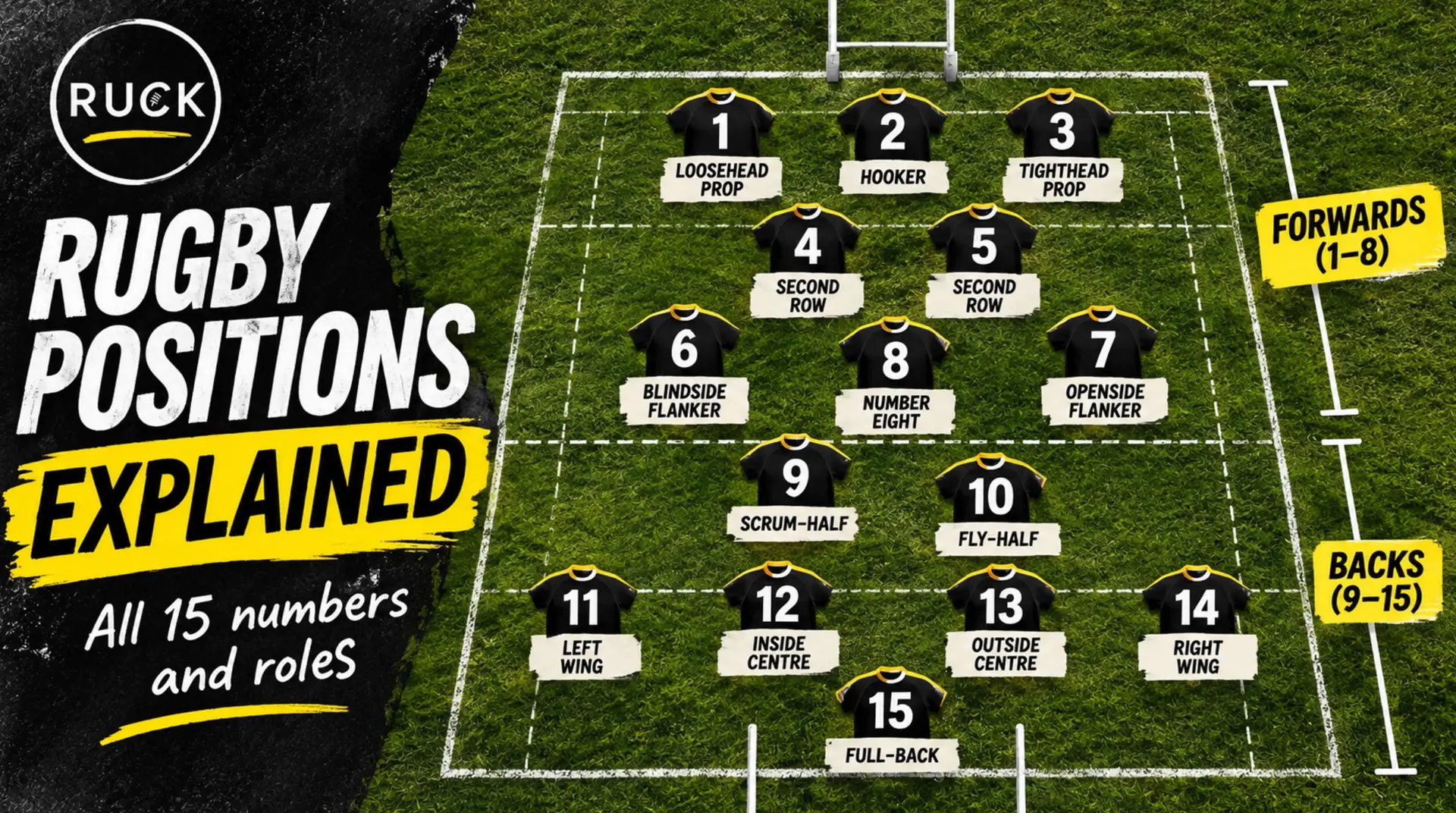
There are 15 positions in rugby union, split into two groups: eight forwards and seven backs.
The forwards generally provide the muscle, winning possession through scrums, lineouts and breakdowns.
The backs usually turn that possession into points through passing, running and kicking.
Of course, modern rugby likes to tear up traditional job descriptions. Props score tries, wingers win turnovers and some forwards have better hands than the backs.
Here's everything you need to know about rugby positions, shirt numbers and what each player does.
Interactive rugby positions: Explore all 15 players
Want to know where each rugby player stands?
Tap any shirt number on our interactive rugby pitch to discover the position, its main responsibilities and a famous international player who plays there.
Widget placement: Mobile-first rugby pitch with clickable shirt numbers 1–15, forwards and backs distinguished by colour, and expandable player descriptions.
Rugby positions and numbers: Complete guide
Every starting player in rugby union traditionally wears a shirt number corresponding to their position.
These are the traditional shirt numbers used in rugby union.
Some teams, particularly South Africa, use different numbering conventions for their flankers.
You can also find a full breakdown in World Rugby's official guide to positions.
- Strong and enjoy physical contact: Prop or back row
- Tall and good at jumping: Second row
- Quick reactions and accurate passing: Scrum-half
- Good vision and tactical kicking: Fly-half
- Fast with good footwork: Wing
- Powerful runner with good handling: Centre
- Confident catching high balls: Full-back
- Enjoy tackling and winning possession: Flanker
Rugby forwards explained: Positions 1–8
The forwards are rugby's engine room.
They're the players who usually do the hard work at scrums, lineouts, mauls and breakdowns.
A forward pack consists of three front-row players, two second rows and three back-row players.
1. Loosehead prop
Shirt number: 1
Famous player: Ox Nche (South Africa)
The loosehead prop plays on the left side of the front row.
Their main responsibility is scrummaging, where strength, technique and balance are essential.
They also carry the ball into contact, make tackles and help secure possession at rucks.
Don't be fooled by the traditional image of props as players who simply push in scrums.
South Africa's Ox Nche has demonstrated just how influential a world-class prop can be.
For anyone unfamiliar with the technical side, World Rugby's scrum guide explains how the front row works.
2. Hooker
Shirt number: 2
Famous player: Malcolm Marx (South Africa)
The hooker lines up between the two props.
Their specialist responsibilities include hooking the ball during scrums and usually throwing it into lineouts.
That means they need strength, accuracy and excellent timing.
Modern hookers are also expected to contribute heavily in open play.
Malcolm Marx is a perfect example. The Springboks star combines powerful carrying with outstanding breakdown skills.
3. Tighthead prop
Shirt number: 3
Famous player: Tadhg Furlong (Ireland)
The tighthead prop plays on the right side of the front row.
It's one of the most technically demanding positions in rugby.
Unlike the loosehead, the tighthead scrummages between two opposition front-row players.
They must withstand enormous pressure while keeping the scrum stable.
Ireland's Tadhg Furlong has become one of the best-known tightheads in the modern game.
Despite his size, he's also remarkably comfortable with the ball in his hands.
4 and 5. Second rows
Shirt numbers: 4 and 5
Famous players: Eben Etzebeth (South Africa) and Maro Itoje (England)
Second rows, also known as locks, are usually among the tallest players on the pitch.
Their height makes them particularly valuable at lineouts, where they compete to catch the ball.
They also provide power behind the front row during scrums.
Away from set pieces, second rows make tackles, carry into contact and compete at the breakdown.
Eben Etzebeth is famous for his physical presence, while England's Maro Itoje is particularly effective at disrupting opposition possession.
Both show why second rows are far more than simply tall players who jump.
6. Blindside flanker
Shirt number: 6
Famous player: Pieter-Steph du Toit (South Africa)
The blindside flanker traditionally operates on the narrower side of the scrum.
They need strength, stamina and an appetite for tackling.
Their responsibilities include carrying the ball, protecting possession and putting pressure on opposition attackers.
Pieter-Steph du Toit is a brilliant example of a powerful, athletic back-row forward.
Worth knowing: South Africa traditionally gives its openside flanker the number six shirt, meaning the Springboks' numbering differs from the convention used by England and several other nations.
7. Openside flanker
Shirt number: 7
Famous player: Josh van der Flier (Ireland)
The openside flanker is often one of the busiest players on the pitch.
They chase the ball, make tackles and compete for turnovers at the breakdown.
Speed, anticipation and stamina are particularly important.
A good openside can ruin an opposition attack before it has even started.
Ireland's Josh van der Flier is an excellent example, combining relentless work rate with intelligent support play.
England youngster Henry Pollock is another exciting back-row talent.
Pollock also caused plenty of amusement when he named what he considers rugby's easiest position.
His answer? Scrum-half. Unsurprisingly, not everyone agreed.
8. Number eight
Shirt number: 8
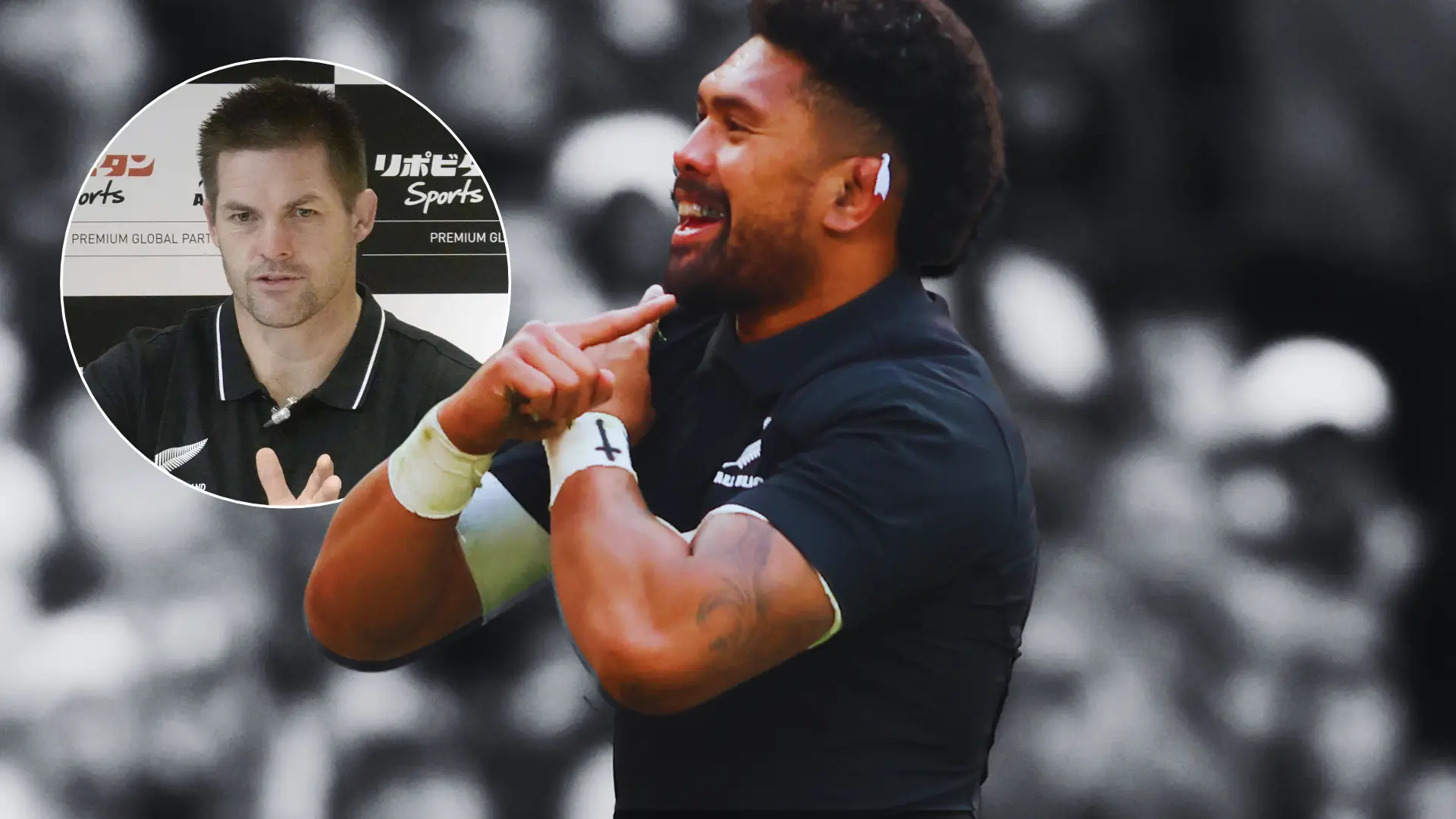
Famous player: Ardie Savea (New Zealand)
The number eight lines up at the back of the scrum.
They can pick up the ball from the scrum base, carry into contact or link up with the scrum-half.
It's a position that demands strength, handling skills and good decision-making.
New Zealand's Ardie Savea shows just how dangerous a number eight can be.
He combines explosive running with exceptional footwork and breakdown ability.
Rugby backs explained: Positions 9–15
The seven backs are usually the team's main attacking players.
They use passing, kicking, movement and speed to create scoring opportunities.
However, they also have important defensive responsibilities, particularly when dealing with opposition kicks.
9. Scrum-half
Shirt number: 9
Famous player: Antoine Dupont (France)
The scrum-half is the link between the forwards and backs.
They usually collect the ball from rucks, scrums and mauls before passing to a teammate.
Quick decisions are essential.
At almost every breakdown, the scrum-half must decide whether to pass, kick or run.
France superstar Antoine Dupont has taken the position to another level with his strength, vision and ability to create something from nothing.
You don't need to be the biggest player on the pitch to be a brilliant scrum-half.
And despite Henry Pollock's cheeky assessment of the position, there's considerably more to the job than passing and kicking.
10. Fly-half
Shirt number: 10
Famous player: Finn Russell (Scotland)
The fly-half is often described as rugby's chief playmaker.
They receive the ball from the scrum-half and decide how the attack should develop.
Passing, tactical kicking, vision and composure are vital.
A good fly-half knows when to attack and when to play for territory.
Scotland's Finn Russell is one of the game's most creative number tens.
He can spot a gap that most spectators haven't even noticed.
11 and 14. Wingers
Shirt numbers: 11 and 14
Famous players: Cheslin Kolbe (South Africa) and Louis Bielle-Biarrey (France)
Wingers traditionally play on the outside edges of the backline.
Their main attacking responsibility is to finish opportunities and score tries.
Pace, acceleration and footwork are huge advantages.
However, modern wingers also need to be excellent under high kicks and reliable in defence.
Cheslin Kolbe proves that you don't need to be enormous to dominate international rugby.
His footwork can leave defenders looking as though they've turned up wearing the wrong boots.
12. Inside centre
Shirt number: 12
Famous player: Bundee Aki (Ireland)
The inside centre plays alongside the fly-half.
They often provide another attacking option, either by carrying directly into contact or distributing the ball.
Some inside centres are powerful runners, while others operate almost like a second fly-half.
Ireland's Bundee Aki is known for his physical carrying and ability to break tackles.
It's a position that requires both attacking intelligence and defensive strength.
13. Outside centre
Shirt number: 13
Famous player: Jesse Kriel (South Africa)
The outside centre plays between the inside centre and the winger.
Their job is to find gaps, create overlaps and help release the wide players.
Defensively, it's one of the trickiest positions on the pitch.
One wrong decision can leave a huge gap for the opposition to exploit.
Springboks centre Jesse Kriel has become particularly respected for his defensive organisation and athleticism.
15. Full-back
Shirt number: 15
Famous player: Hugo Keenan (Ireland)
The full-back usually operates behind the main defensive line.
They need to catch high kicks, cover space and organise teammates.
When their team wins possession, they can launch counter-attacks from deep.
Good positioning is just as important as speed.
Ireland's Hugo Keenan is an excellent example of a reliable, intelligent full-back.
He's often in exactly the right place before the opposition even kicks the ball.
Which rugby position should you play? Take our quiz
Not sure whether you're a future fly-half, flying winger or fearsome front-row forward?
Our rugby positions quiz will help you discover which role might suit your playing style.
Answer five quick questions about your strengths, speed, skills and what you enjoy most on the pitch.
You'll receive a suggested position and learn why it could be a good fit.
Widget placement: Five-question quiz with multiple-choice answers, a personalised position recommendation and an option to try again.
Remember, there's no perfect body type for every rugby position. The quiz is just a bit of fun, not a replacement for advice from a qualified coach.
What is the difference between forwards and backs in rugby?
The simplest way to understand rugby positions is to divide the team into forwards and backs.
Forwards (numbers 1–8) are generally responsible for winning possession, competing at set pieces and providing physical power.
Backs (numbers 9–15) usually focus on moving the ball, creating space and scoring tries.
However, every player must contribute in defence and attack.
The days when a prop could spend 80 minutes doing little more than scrummaging are long gone.
Which rugby position suits your body type?
Choosing a rugby position depends on your skills, physical development and what you enjoy doing.
There's no single body type that guarantees success in a particular role.
However, these general characteristics might help beginners find a starting point.
- Strong and enjoy physical contact: Prop or back row
- Tall and good at jumping: Second row
- Quick reactions and accurate passing: Scrum-half
- Good vision and tactical kicking: Fly-half
- Fast with good footwork: Wing
- Powerful runner with good handling: Centre
- Confident catching high balls: Full-back
- Enjoy tackling and winning possession: Flanker
For younger players, it's particularly important not to specialise too early.
Trying different positions helps develop a wider range of skills.
A qualified coach can also help identify where a player might be most comfortable.
What are the most important positions in rugby?
Every rugby position is important, but some have a particularly large influence on how a team plays.
The scrum-half and fly-half are often central to attacking decisions.
The hooker and props are vital for securing possession at set pieces.
The full-back can also have a major influence through defensive positioning and tactical kicking.
Ultimately, even the best fly-half in the world will struggle if their forwards cannot win the ball.
Rugby is a team sport, and all 15 positions depend on one another.
What is the difference between rugby union and rugby league positions?
Rugby union and rugby league have different numbers of players.
Rugby union uses 15 players per side, while rugby league uses 13.
Both sports feature forwards and backs, but the positions and their responsibilities differ.
For example, rugby league doesn't have flankers or a number eight.
Its forwards include props, a hooker, second-row forwards and a loose forward, while the backs include a full-back, wingers, centres, a stand-off and a scrum-half.
The two codes also have different laws governing tackles, possession and scrums.
For a more detailed explanation of the union game, see World Rugby's official laws.
Rugby positions: Frequently asked questions
How many positions are there in rugby union?
There are 15 starting positions in rugby union: eight forwards and seven backs.
What position is number 10 in rugby?
Number 10 is the fly-half. They usually direct the attack and make important passing and kicking decisions.
What position is number 7 in rugby?
Number 7 is traditionally the openside flanker. Their main responsibilities include tackling, supporting teammates and competing for turnovers.
What position is number 8 in rugby?
Number 8 is the number eight, a back-row forward who controls the ball at the base of the scrum and often makes powerful carries.
What position is number 13 in rugby?
Number 13 is the outside centre. They help create attacking opportunities and have an important defensive role.
What is the easiest position in rugby?
There is no universally easiest position.
Every role requires different skills, and what feels natural to one player might be extremely difficult for another.
That hasn't stopped England star Henry Pollock from having his say on rugby's easiest position.
What is the hardest position in rugby?
That depends on the skills being measured.
Props face enormous technical and physical demands at scrums, while fly-halves must make constant tactical decisions under pressure.
What is the fastest position in rugby?
Wingers are often among the fastest players because they need pace to beat defenders and finish attacking opportunities.
What is the best rugby position for a beginner?
There is no single best position for beginners.
New players should try different roles, develop their basic skills and work with a qualified coach to find what suits them.
Can rugby players change positions?
Yes. Players can switch positions during their careers or matches, provided they meet any applicable requirements.
Some players are particularly versatile and can perform several different roles.
Front-row positions require specialist training because of the safety demands of scrummaging.
Why do rugby players wear numbers 1 to 15?
In rugby union, starting shirt numbers traditionally identify each player's position.
The forwards wear numbers 1–8, while the backs wear numbers 9–15.
Replacements generally wear higher numbers.
Final thoughts
Rugby might look complicated when you're watching your first match, but understanding the shirt numbers makes everything easier.
The forwards win possession, the backs look to use it, and every player has a part to play.
Once you know the difference between a prop and a fly-half, or a flanker and a full-back, you'll start seeing the game differently.
And the next time someone shouts about the number seven winning a turnover, you'll know exactly why they're celebrating.