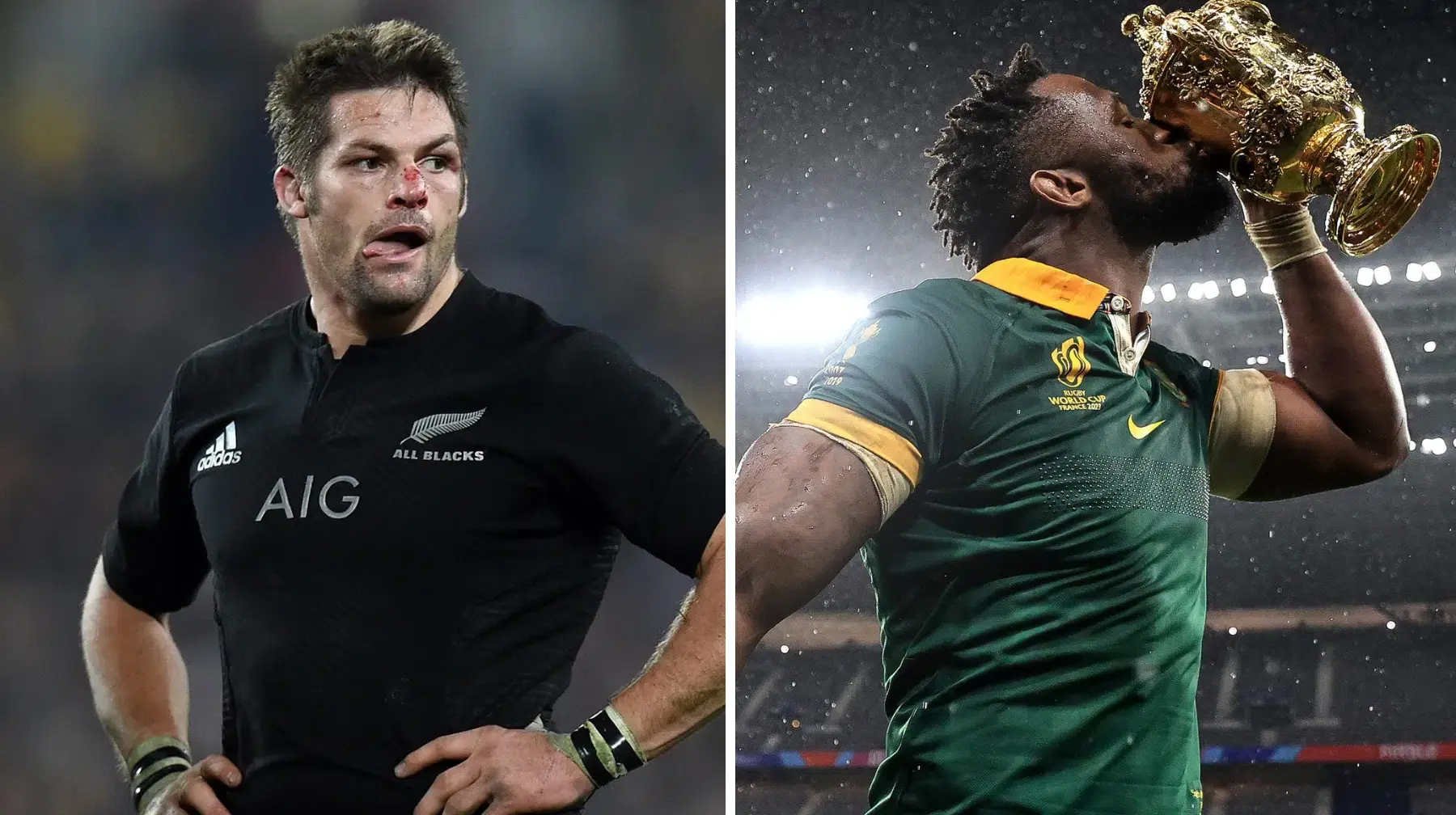

Rugby flankers are the heartbeat of rugby union—relentless, hard-hitting forwards who dominate the breakdown, make crucial tackles, and drive their teams forward.
Known for their work rate, strength, and leadership, the best flankers in rugby history have shaped matches, defined eras, and set the standard for modern forwards.
In this article, we rank the 20 greatest rugby flankers of all time, celebrating the legends who mastered the breakdown, inspired their teams, and left a lasting legacy on the game.
and get the latest rugby news straight to your phone.
20 Michael Leitch
Born in New Zealand but embraced as a Japanese hero, Michael Leitch embodies leadership, resilience, and pride. From his early days with Toshiba Brave Lupus to captaining Japan’s astonishing win over South Africa in 2015, Leitch has been the beating heart of Japanese rugby. His fearless tackling and humility made him a symbol of unity during Japan’s 2019 World Cup run. Beyond the field, his legacy stands immortalised—quite literally—in statue form in Tokyo.
19 Siya Kolisi
Few stories inspire like Siya Kolisi’s. Rising from humble beginnings to become the first black captain of South Africa, he lifted not one but two Rugby World Cups—2019 and 2023. His leadership extends far beyond the pitch, representing hope and equality for millions. Kolisi’s ferocious work rate and emotional intelligence define his game, while his humanity defines his legacy. Twice a world champion, twice a symbol of South Africa’s power to unite through sport.
18 Jerry Collins
Jerry Collins was rugby’s enforcer with a soul—a man who played like thunder but carried himself with quiet humility. Born in Samoa and raised in Porirua, New Zealand, Collins earned 48 All Blacks caps and a fearsome reputation for his bone-crunching tackles. Whether for the Hurricanes, Ospreys, or in Japan, he gave everything to the game. His tragic passing in 2015 only deepened the legend of a player who embodied pure, uncompromising commitment.
17 Ardie Savea
Electric, fearless, and endlessly dynamic, Ardie Savea is redefining what it means to be a modern flanker. His explosive pace, offloading flair, and relentless energy make him a constant menace to opponents. A leader by example, Savea’s performances for the Hurricanes and All Blacks have earned universal admiration—and in 2023, the ultimate recognition: World Rugby Player of the Year. Whether in chaos or control, Savea thrives, turning every breakdown into a battleground he dominates.
16 Michael Hooper
Michael Hooper is a former Australian professional rugby union player, best known as one of the world’s leading openside flankers. Born in Manly, New South Wales, he rose to prominence with the NSW Waratahs and made his Wallabies debut in 2012.
A long-time captain of Australia, Hooper earned over 100 international caps and led the team at multiple Rugby World Cups, including the 2015 final. Renowned for his work rate, leadership, and consistency, he is widely respected for his impact on Australian rugby.
15 Jerome Kaino
Jerome Kaino was the quiet force behind New Zealand’s golden era. Twice a Rugby World Cup winner, he blended power and precision with an unmatched defensive presence. With over 130 appearances for the Blues and countless for the All Blacks, Kaino’s consistency became his signature.
His devastating tackling and composure under pressure made him indispensable. A proud Samoan-American who rose to All Black legend, Kaino’s career is a lesson in loyalty, strength, and humility.
14 David Pocock
Intense, intelligent, and impossibly driven, David Pocock was a breakdown artist of the highest order. His strength over the ball made him a nightmare for opponents, and his leadership off it—especially his environmental and humanitarian activism—made him one of rugby’s most respected figures.
Twice John Eales Medallist and a key force in Australia’s 2015 World Cup run, Pocock proved that courage is as much about conviction as it is about contact.
13 Schalk Burger
Few players have matched Schalk Burger’s ferocity. A wrecking ball in a Springbok jersey, he combined brute force with a heart of gold. Burger’s career—spanning a 2007 World Cup win, 86 Test caps, and countless accolades—was also marked by incredible resilience, overcoming life-threatening illness to return to the game. Always playing on the edge, he embodied South Africa’s uncompromising spirit, leaving behind a legacy of fearless tackling, tireless work, and unrelenting passion.
12 Thierry Dusautoir
Nicknamed the “Dark Destroyer,” Thierry Dusautoir was the embodiment of French grit. Renowned for his defensive brilliance, he famously made 38 tackles against New Zealand in the 2007 World Cup and captained France to within a point of glory in 2011. That night, he was named Man of the Match and later World Player of the Year. Elegant yet unyielding, Dusautoir’s calm leadership and iron will made him one of France’s most admired captains.
11 Juan Smith
Juan Smith’s career reads like a story of quiet greatness and extraordinary comeback. A powerhouse blindside flanker, he helped South Africa win the 2007 World Cup and countless honours with the Cheetahs and Toulon. After a career-threatening Achilles injury forced him into early retirement, he returned miraculously to win European and French titles. Smith’s mix of physicality, humility, and perseverance made him a symbol of what true resilience looks like in rugby.
10 Neil Back
Small in stature but colossal in influence, Neil Back epitomised English tenacity. A key part of England’s 2003 World Cup-winning back row, he thrived on work rate, precision, and guile. Known for his tireless tackling and breakdown mastery, Back was the heartbeat of Leicester’s dominance and a model professional for nearly two decades. His leadership and rugby intellect made him as effective as he was enduring—a true testament to craft over size.
9 Sean O’Brien
Nicknamed the “Tullow Tank,” Sean O’Brien was Ireland’s human sledgehammer—a flanker with the power of a prop and the hands of a fly-half. Over a decade with Leinster and Ireland, he won four European Cups and two Lions tours, blending ferocity with flair. O’Brien’s ability to carry, tackle, and inspire made him a fan favourite. Injuries couldn’t dull his spirit, and he remains one of Ireland’s most loved and respected modern warriors.
8 George Smith
Grace and grit defined George Smith, one of the most naturally gifted flankers ever to pull on a Wallaby jersey. Over 100 Test caps and a career spanning continents, Smith combined silky hands with ferocious defence and turnover mastery. His longevity and consistency were staggering, his dreadlocks iconic. For two decades, Smith was Australia’s engine room, setting standards for openside play that few have matched and inspiring a generation of back-row stars.
7 Sam Warburton
Sam Warburton led with calm authority and ferocious determination. The youngest captain in Welsh history, he inspired his nation and twice led the British & Irish Lions—an honour few achieve. His career, though shortened by injury, burned brightly with leadership and humility. A master of the breakdown, Warburton’s integrity and professionalism made him one of rugby’s most respected figures, proving that true greatness is as much about character as it is about trophies.
6 Francois Pienaar
Francois Pienaar’s impact transcended rugby. As South Africa’s 1995 World Cup-winning captain, he helped unite a divided nation under one flag, sharing that iconic moment with Nelson Mandela.
On the field, Pienaar was a commanding leader and relentless flanker, playing all 29 Tests as captain. His legacy, though, lives far beyond his tackles—it lies in his role as a symbol of reconciliation, leadership, and the enduring power of sport to heal.
5 Pieter Steph Du-Toit
The Springboks’ towering workhorse, Pieter-Steph du Toit, combines relentless effort with rare athletic grace. Twice crowned World Rugby Player of the Year (2019, 2024), his ability to cover ground and hit with precision defines South Africa’s defensive steel. His man-of-the-match performance in the 2023 World Cup final against New Zealand sealed his place among the greats. Tireless and selfless, du Toit represents everything a flanker should be: disciplined, dependable, and devastatingly effective.
4 Jean-Pierre Rives
Flamboyant, fearless, and unmistakable with his blond mane, Jean-Pierre Rives brought artistry to the brutality of flanker play. A talismanic French captain through the 1970s and ’80s, he turned tackling into poetry and leadership into legend.
“Blond Bébé” became a national hero for his courage and passion, later transforming his creativity into sculpture. On and off the field, Rives embodied the soul of French rugby—romantic, rebellious, and utterly unforgettable.
3 Richard Hill
Often called England’s “silent assassin,” Richard Hill was the unsung hero of England’s 2003 World Cup-winning side. Reliable, disciplined, and technically superb, he glued together a back row featuring Neil Back and Lawrence Dallaglio.
Never flashy but always flawless, Hill’s consistency made him indispensable to Clive Woodward’s England. Revered by teammates and respected by rivals, Hill’s understated brilliance proved that the best players don’t always need to shout to be heard.
2 Michael Jones
“The Iceman” played rugby with grace and conviction. Michael Jones was a trailblazer—a devout Christian who refused to play on Sundays, yet still became one of the greatest All Blacks of all time.
The first try-scorer in Rugby World Cup history, he blended athleticism, humility, and intelligence in equal measure. Beyond rugby, Jones inspired Pacific Islander communities through his faith and integrity, earning not just medals, but deep respect across generations.
1 Richie McCaw
Relentless, humble, and indestructible, Richie McCaw stands as the benchmark for every flanker who follows. His leadership drove the All Blacks to back-to-back World Cups and a golden era of dominance. Renowned for his mastery of the breakdown and unparalleled endurance, McCaw turned hard graft into art. Off the field, his humility mirrored his heroics on it. Two World Cups, 148 Tests, countless tackles—and an enduring legacy as rugby’s ultimate warrior.
TRENDING


LATEST NEWS

LATEST COMMENTS
- Jordie Barrett over Damian de Allende is far from being correct. The hype around Dupont is also overreaching, he's probably 4th in the world and has been since the 2023 WC. He also avoids certain matchups which is strange. The rest of the list is pretty good apart from minor subjective biases.JasonMarlow16-09-2026
Loading