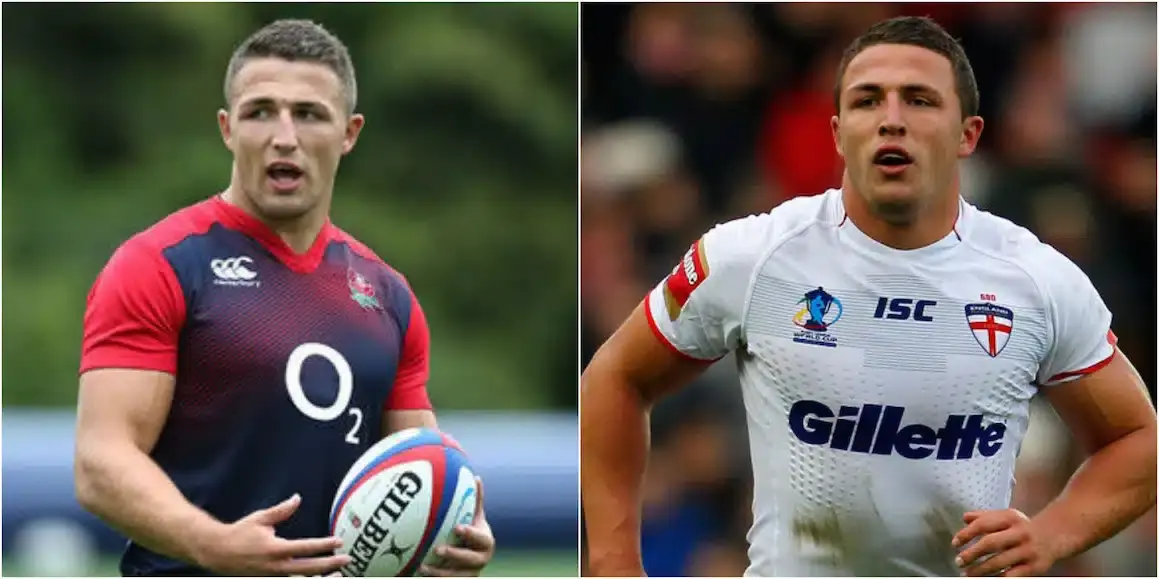

Rugby is divided into two main “codes”; Rugby League and Rugby Union. Although there are many similarities between the two variants of rugby, the differences are pronounced enough that the two codes can be considered to be two different games.
1. In 'Union' sides consist of 15 players, whereas in 'League' sides only have 13.
2. In 'League' there are no line-outs, rucks or mauls.
3. In 'Union' there is no limit to the number of tackles which can be made on each possession. 'Rugby League', however, has a six-tackle rule - similar to the 'downs' rule of American Football.
4. In 'League' a try is worth 4 points, and a conversion worth 2. In 'Union' they are worth 5 and 2 respectively. A drop-goal is also worth 3 points in 'Union', whereas it is only worth 1 in 'League', and a penalty-goal worth 3 in 'Union' and 2 in 'League'.
5. In the UK, Rugby League is more popular in the north of England, whereas Rugby Union is more popular in the South.
To which is the better code of Rugby, that's a matter of taste, which do you prefer?
LIST | 4 rugby league stars who flopped for England
They were built up to be international stars after switching to rugby union, but it simply didn't work out long-term...
1. Sam Burgess
England, who fast-tracked Burgess into their World Cup squad in defiance of logic, Bath and the player himself each shoulder varying degrees of blame for arguably the greatest cross-code flop in history. We're not saying he was an awful player, but the whole thing was a complete disaster.

Sam Burgess of England tackled by Taulupe Faletau of Wales - Photo mandatory by-line: Dean Lancaster/Pinnacle - Tel: +44(0)1363 881025 - Mobile:0797 1270 681 - VAT Reg No: 183700120 - 26/09/2015 - SPORT - RUGBY UNION - RUGBY WORLD CUP 2015 - POOL A Match 16 - England v Wales- Twickenham Stadium, London, England.
2. Barrie-Jon Mather
He became the first player to represent Great Britain in Rugby League and England in Union. His move to union was part funded by the RFU, who were embarking on a strategy of converting some of leagues best talent. However, Mather struggled to make an impact with Sale and moved back to Castleford in 2000. In spite of his poor form with Sale, Clive Woodward gave Mather his debut against Wales in the famous Grand Slam decider in 1999. However, Mather never played for England again after Wales won the game 32-31, following Scott Gibbs’ superb try.

11 Apr 1999: Barrie-Jon Mather of England rises above Brett Sinkinson of Wales to take the high ball in the Five Nations match at Wembley in London. Wales won 32-31 to deny England the championship. \ Mandatory Credit: Gary M Prior/Allsport
3. Lesley Vanikolo
Following his cross-code switch, the Volcano’ stormed onto the scene for Gloucester, doing something ridiculous like scoring five tries on his debut against Leeds, before qualifying for England on residency grounds. International honours followed, with Vainikolo making his England debut against Wales in 2008. However, he failed to bring his try-scoring form to the international scene and was quickly dropped from Martin Johnston’s squad after winning five caps.

4. Joel Tompkins
Tomkins began his League career with Wigan in 2005 and outside of a short stint with the Widnes Vikings in 2007, played with the Warriors until moving to Saracens in 2011. While Tomkins initially struggled to adapt to union, but his form during the beginning of the 2013/14 season saw him earn an England cap against Australia in November 2013. Although he went on to make two further international appearances, he looked completely out of his depth and returned to league soon after.

TRENDING


LATEST NEWS



LATEST COMMENTS
- Jordie Barrett over Damian de Allende is far from being correct. The hype around Dupont is also overreaching, he's probably 4th in the world and has been since the 2023 WC. He also avoids certain matchups which is strange. The rest of the list is pretty good apart from minor subjective biases.JasonMarlow16-09-2026
Loading