2003 England World Cup winner 'too poorly' to speak to former teammates
Rugby NewsTuesday, 04 August 2026 at 09:51
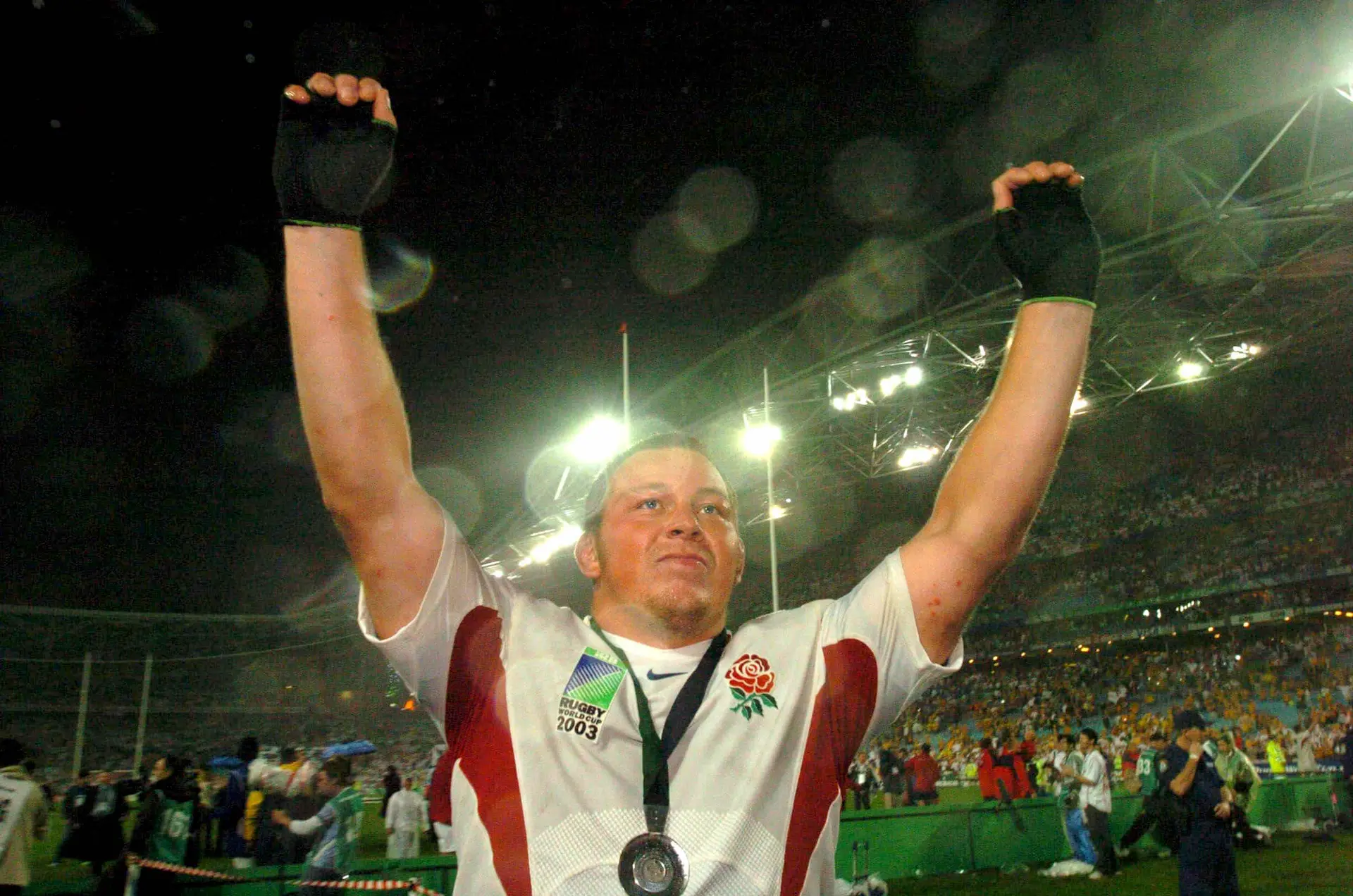
Steve Thompson's former England team-mate Phil Vickery has shared a heartbreaking update on the 2003 Rugby World Cup winner, revealing the former hooker is now "too poorly" to speak to many of the teammates he once called brothers.
The emotional comments came during an in-depth interview with The Observer's Ben Coles, which explores Vickery's own neurological struggles and the devastating impact brain injuries continue to have on former rugby players.
Join RUCK’s Instagram broadcast channel and get the latest rugby news straight to your phone.
'I told him I loved him'
Thompson, who has previously spoken publicly about living with early-onset dementia and probable chronic traumatic encephalopathy (CTE), remains one of rugby's most high-profile concussion cases.
Vickery revealed he has repeatedly tried to make contact with his former front-row partner but has struggled to get through.
"I went to war with him, one of my brothers, and he won't speak to me because he's too f***ing poorly," Vickery told The Observer.
"For his honour and pride, he won't speak to me. I told him I loved him this morning again, you know? And that upsets me because we should be helping him more regardless of whether rugby caused it or not.
"He's suffering, so why are we not helping him?"
The comments offer another sobering reminder of the human cost of rugby's concussion crisis.
Fresh developments in the concussion lawsuit
Thompson and Vickery are among more than 1,100 former players involved in legal action against World Rugby, the RFU, the WRU and the Rugby Football League, alleging the governing bodies failed to adequately protect players from neurological injuries. The organisations continue to deny liability.
The long-running case has taken another twist in recent days after the governing bodies asked the court to strike out the claims, alleging the players' legal team failed to comply with court orders relating to medical records. Several of the leading claimants have also changed legal representation as the case continues.
Read the full interview
Vickery's comments form part of a powerful feature by Ben Coles in The Observer, which also details the former England captain's own battle with probable CTE and the daily challenges he now faces. It is a remarkable and deeply moving read that shines a light on the ongoing struggles faced by many members of England's 2003 World Cup-winning squad.
Editors Picks:
- Eben Etzebeth makes retirement decision after latest concussion scare
- Andy Farrell became Dad at 16 with England legends sister
- Henry Pollock sends clear England World Cup message after ‘buzzing’ draw
- Siya Kolisi makes Springboks retirement decision in fresh statement
2003 Rugby World Cup Team of the Tournament: Where are they now?
From coaching and broadcasting to business and charity work, this is where those World Cup heroes are now.
15 Mils Muliaina (New Zealand)
All Blacks full-back Mils Muliaina finished the 2003 Rugby World Cup as the tournament's joint-leading try scorer, crossing for seven tries alongside team-mate Doug Howlett.
Dangerous whenever he had the ball in hand, he was one of New Zealand's standout performers throughout the competition.
Among his highlights was a stunning individual try against Tonga, while he also ran in four against Canada. His performances suggested he would become New Zealand's long-term solution at full-back, a prediction that proved entirely accurate.
Muliaina represented New Zealand from 2003 until retiring after the 2011 Rugby World Cup. During that tournament, he became only the second All Black to reach 100 Test caps, achieving the milestone in the quarter-final against Argentina.
He scored 33 tries for his country during an illustrious international career. Today, Muliaina works as a mortgage adviser, serves as a panellist on Sky Sport New Zealand's The Breakdown, and is also a public speaker.
14 Rupeni Caucaunibuca (Fiji)
BBC's review of Caucau's performances at the 2003 World Cup were as follows: "Seeing the Fijian flyer in action was strangely reminiscent of Jonah Lomu in his prime. The only caveat to Caucau's World Cup appearance was that it was all too brief, as Fiji failed to qualify from the pool stages.
"He was on fire from the very outset, sprinting in a 70-metre solo spectacular against France before being banned for two games for a punch on Olivier Magne.
"Thankfully, Caucau returned for the final game against Scotland and was at his prolific best once more with a further two tries."
Despite possessing world-class talent, Caucaunibuca never fully fulfilled his immense potential. His career was repeatedly disrupted by disciplinary issues, including a one-year ban from Fiji after missing a match in Samoa. Those off-field problems ultimately overshadowed what could have been one of rugby's greatest careers.
At club level, he enjoyed significant success, finishing as the Top 14's leading scorer with Agen and later winning the prestigious Bouclier de Brennus with Toulouse in 2011 while serving as a medical joker.
However, life after rugby proved difficult. Speaking in the 2019 documentary Oceans Apart, Caucaunibuca revealed he had been living in poverty in his remote village of Nasau since ending his playing career with Agen in 2014.
He admitted that much of his earnings had been spent on alcohol and supporting friends and family, leaving him with, in his own words, 'had nothing left'.
In 2023, RugbyPass reported that he was farming crops and spearfishing to survive. At times, he reportedly struggled to find the ten Fijian dollars (£3.55) needed to fuel his boat.
13 Stirling Mortlock (Australia)
Stirling Mortlock was one of Australia's key figures during their run to the 2003 World Cup final. Returning from shoulder surgery, he delivered a superb display in the semi-final against New Zealand, repeatedly troubling the All Blacks defence and causing England problems whenever the opportunity arose.
His try against New Zealand was a fitting reward after a lengthy rehabilitation process, and he played a major role in Australia's victory. Although he was unable to replicate that level of influence in the final, his tournament remained highly impressive.
Mortlock went on to score more than 1,000 points in Super Rugby and almost 500 Test points for the Wallabies. He also captained Australia, the Brumbies and the Melbourne Rebels during a distinguished career.
Since retiring, Mortlock has moved into the business world and now serves as Capital Lead and Founding Partner of XV, which describes itself as "Australasia's leading sports innovation accelerator."
12 Tony Marsh (France)
Tony Marsh's 2003 World Cup story was one of remarkable determination. Earlier that year, the France centre had been diagnosed with testicular cancer, but after enduring months of chemotherapy he recovered sufficiently to return to international rugby and help France reach the semi-finals.
Marsh played his final Test for France in 2004, while his last appearance for Clermont came in the 2007 French Championship final against Stade Français. Clermont narrowly lost that match, although they did finish the season as European Challenge Cup winners.
Today, Marsh works as a buyers' agent for a company specialising in property investment in Bali.
11 Lote Tuqiri (Australia)
Speaking about his inclusion in their team, the BBC said, "Tuqiri's selection on the left wing was deemed a gamble not worth taking according to many of Australia's critics.
"But the former league star proved his doubters wrong and was in superb form, always looking exciting on the attack as well as enjoying a superb rapport with both Mat Rogers and Wendell Sailor."
Tuqiri went on to enjoy a distinguished dual-code career, representing Australia in both rugby league and rugby union, while also playing rugby league internationally for Fiji. He remains widely regarded as one of the finest code-switchers the sport has produced.
These days, Tuqiri works as an ambassador for Agri Labour Australia and Beach Rugby Australia. He is also a co-founder and board member of Hoozu, an influencer marketing agency that connects brands and talent through technology-driven solutions.
10 Jonny Wilkinson (England)
Few players in rugby history are more closely associated with a single moment than Jonny Wilkinson. It was fitting that England's talisman provided the defining image of the tournament, landing his famous extra-time drop goal with virtually the last kick of the World Cup final.
Throughout the competition, Wilkinson dominated headlines in both England and Australia. Critics questioned England's dependence on him, while supporters marvelled at his consistency and accuracy under pressure.
After 2003, Wilkinson battled numerous injuries but returned to help England reach another World Cup final in 2007. He also toured twice with the British & Irish Lions, visiting Australia in 2001 and New Zealand in 2005, earning six Lions caps.
He retired at the conclusion of the 2013-14 season and was inducted into the World Rugby Hall of Fame in 2016. Wilkinson now works as a studio pundit for ITV Sport, covering events including the Six Nations and Rugby World Cup.
9 Fabien Galthié (France)
Fabien Galthié brought his international career to a close following France's semi-final defeat to England. Throughout the tournament, he was one of the game's most reliable scrum-halves, providing leadership and direction while forming an excellent partnership with fly-half Frédéric Michalak.
His final club match was also one of his most memorable. Galthié won the only major club trophy of his playing career when Stade Français defeated Toulouse in the 2003 Top 14 final.
Since retiring, Galthié has enjoyed a highly successful coaching career with Stade Français, Montpellier and Toulon. He joined the France national setup as an assistant coach in 2019 before taking charge as head coach the following year.
Under his leadership, France secured a Six Nations Grand Slam in 2022. Further success followed with Six Nations titles in both 2025 and 2026.
1 Bill Young (Australia)
The BBC selected Bill Young at loosehead prop after a series of dominant displays against both New Zealand and England.
A cornerstone of Australia's scrum, Young consistently got the better of opposing front rows and helped force numerous penalties, particularly in the World Cup final.
Away from rugby, Young has built one of the most successful business careers of any former international player. His family had longstanding ties to Sydney's hospitality industry through the Friend in Hand Hotel in Glebe, which Young himself owned between 2020 and 2022.
He later sold the venue to help fund the purchase of Sydney's Bar Broadway for $37 million in August 2022.
By that stage, Young's family interests reportedly included six Sydney hotels, making him one of Australian rugby's most successful entrepreneurs.
2 Keith Wood (Ireland)
Like Galthié, Keith Wood had already reached the end of his international career, but his influence at the 2003 World Cup remained immense.
Nicknamed "the raging potato" by some commentators, Wood was central to everything Ireland did throughout the tournament and remained one of the most influential hookers in world rugby.
Widely considered the best hooker of his generation, he won the inaugural World Rugby Player of the Year award and is regularly included in discussions about the greatest players ever to wear the number two jersey.
Since retiring, Wood has established himself as one of rugby's most respected broadcasters, working with both the BBC and The Daily Telegraph. His insight, experience and analysis have made him a hugely popular figure in rugby media.
3 Phil Vickery (England)
England's front five was widely regarded as the strongest unit at the tournament, and Phil Vickery was among its standout performers. The powerful prop delivered influential displays in both the semi-final and final, using his considerable strength to dominate opponents in the scrum.
Vickery ended his club career with London Wasps after joining them in 2006 following an 11-year spell with Gloucester.
Known as the "Raging Bull", he appeared at three Rugby World Cups, captained England at the 2007 tournament and toured with the British & Irish Lions in both Australia and South Africa.
Following retirement, Vickery moved into broadcasting and worked as a co-commentator during ITV's coverage of the 2011 Rugby World Cup. He also won the 2011 series of Celebrity MasterChef.
More recently, he has undergone a dramatic fitness transformation, embracing bodybuilding ahead of the 20th anniversary celebrations of England's World Cup triumph.
4 Martin Johnson (England)
There was never any doubt about who would captain the BBC's Dream XV. Martin Johnson lifted the Webb Ellis Cup after England's dramatic 20-17 victory over Australia and was the tournament's defining leader.
However, his place in the side was secured by more than just his captaincy. Johnson remained one of the finest second rows in the game and brought his international career to a close after his 84th Test in the World Cup final.
He returned to the England setup as team manager in 2008 and guided the side to the 2011 Six Nations title, England's first championship triumph since 2003.
Johnson stepped down following England's quarter-final exit at the 2011 Rugby World Cup and has not returned to a management role since. He now works as a pundit, including regular appearances for the BBC.
5 Paul O'Connell (Ireland)
The second-row competition for places was fierce, with the likes of Victor Matfield and Malcolm O'Kelly producing outstanding performances. However, it was Paul O'Connell who earned his place in the BBC selection.
Ireland's line-out was one of the tournament's great strengths and O'Connell played a crucial role, combining his set-piece excellence with his trademark physicality around the field.
O'Connell went on to captain Munster, Ireland and the British & Irish Lions before moving into coaching.
He currently serves as forwards coach for Ireland and was appointed interim head coach for Ireland's 2025 summer tour while Andy Farrell and Simon Easterby were away with the British & Irish Lions in Australia.
Alongside his coaching work, O'Connell has enjoyed a long media career with both BBC Sport and ITV Sport.
6 George Smith (Australia)
George Smith was one of Australia's most influential performers throughout the tournament and received a standing ovation when substituted during the semi-final victory over New Zealand.
The openside flanker went on to earn 111 caps for Australia, making him one of the country's most decorated forwards. His final international appearance came against the British & Irish Lions in 2013.
Today, Smith remains heavily involved in the game as Head of Rugby at St Andrew's Anglican College on Queensland's Sunshine Coast.
7 Joe van Niekerk (South Africa)
South Africa's campaign may have lacked consistency, but Joe van Niekerk was one of the Springboks' most dependable performers.
Renowned for his defensive work and powerful ball carrying, he consistently impressed despite South Africa's mixed results.
His post-rugby path has been among the most unusual of any former international player. Based in Cape Town, van Niekerk now works as a holistic health mentor, bodywork practitioner and trauma healing coach.
After spending time living in Costa Rica following retirement, he returned to South Africa to raise his son and continues to host wellness and breathwork retreats.
8 Lawrence Dallaglio (England)
Rounding off the side is England number eight Lawrence Dallaglio. His performances against both France and Australia highlighted his importance to England's success, particularly his work protecting scrum-half Matt Dawson and his relentless effectiveness around the breakdown.
Dallaglio won 85 caps for England, helped secure the 2003 World Cup and remains one of the few players to have won both the Rugby World Cup and the Rugby World Cup Sevens. He also represented the British & Irish Lions on three tours, winning three Test caps.
He continues to work in television and radio as a rugby pundit, although recent years have brought significant personal and financial challenges.
Dallaglio is currently dealing with bankruptcy proceedings connected to his former sports business and unpaid tax liabilities. Following those financial difficulties, he divorced his wife Alice after 20 years of marriage and sold his family home for £2.4 million after it had originally been listed at £3.3 million.
Already a Member of the Order of the British Empire (MBE), he was appointed Officer of the Order of the British Empire (OBE) in the 2008 Birthday Honours.
Quiz: Name these 10 retro rugby players
From jaw-dropping tries to unforgettable moments (and yes, some questionable haircuts), these players defined a golden era of the game. If their names don’t instantly come to mind, we suggest a quick trip to YouTube to jog your memory. Trust us, it’s worth it.
Ready to test your knowledge? Let’s see if you’ve still got it. Good luck!
More Quizzes:
TRENDING


LATEST NEWS
LATEST COMMENTS
- Jordie Barrett over Damian de Allende is far from being correct. The hype around Dupont is also overreaching, he's probably 4th in the world and has been since the 2023 WC. He also avoids certain matchups which is strange. The rest of the list is pretty good apart from minor subjective biases.JasonMarlow16-09-2026
Loading