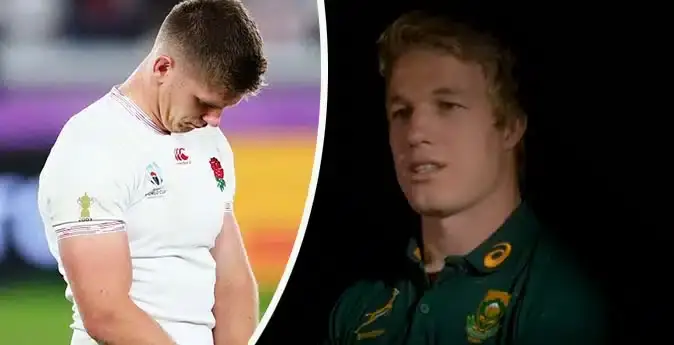

The Springboks’ Pieter-Steph du Toit says that he felt within ten minutes of the Rugby World Cup final that South Africa would be crowned champions.
“The moment in the final I realised ‘look I think we have got them’ was when they started running from behind their own tryline,” said the flanker Du Toit in an interview with the BBC.
“The other was when Vunipola ran into Damian de Allende and Handre Pollard and just threw the ball away.
“I just thought, ‘are you guys crazy? This a World Cup final, you don’t play like this'
“We were quite physical in that game and they were quite afraid of us. That was what the plan was.”
JOIN THE RUCK:
The worst England XV of all-time

Fullback: Mark Van Gisbergen
Yes, he has a cap – only a fleeting one, as a late replacement for Mark Cueto against Australia in 2005 – but he does boast a 100% winning ratio in international colours, so you can’t knock that. His main strengths were dropping the high ball under limited pressure and getting gassed on the outside.
Winger: Barrie-Jon Mather
He became the first player to represent Great Britain in Rugby League and England in Union. His move to union was part funded by the RFU, who were embarking on a strategy of converting some of leagues best talent. However, Mather struggled to make an impact with Sale and moved back to Castleford in 2000. In spite of his poor form with Sale, Clive Woodward gave Mather his debut against Wales in the famous Grand Slam decider in 1999. However, Mather never played for England again after Wales won the game 32-31, following Scott Gibbs’ superb try.
Centre: Joel Tomkins
Tomkins began his League career with Wigan in 2005 and outside of a short stint with the Widnes Vikings in 2007, played with the Warriors until moving to Saracens in 2011. While Tomkins initially struggled to adapt to union, but his form during the beginning of the 2013/14 season saw him earn an England cap against Australia in November 2013. Although he went on to make two further international appearances, he looked completely out of his depth and returned to league soon after.
Centre: Sam Burgess
England, who fast-tracked Burgess into their World Cup squad in defiance of logic, Bath and the player himself each shoulder varying degrees of blame for arguably the greatest cross-code flop in history. We're not saying he was an awful player, but the whole thing was a complete disaster.
Winger: Lesley Vanikolo
The Volcano’ stormed onto the scene for Gloucester, doing something ridiculous like scoring five tries on his debut against Leeds, before qualifying for England on residency grounds. International honours followed, with Vainikolo making his England debut against Wales in 2008. However, he failed to bring his try-scoring form to the international scene and was quickly dropped from Martin Johnston’s squad after winning five caps.
Fly-half: Shane Geraghty
Fly-half Geraghty made his England debut as a replacement against France in the 2007 Six Nations - carving through the French defence to create a crucial try for teammate Mike Tindall and kicking a penalty and a conversion in the 26-18 Twickenham triumph. However, the fact he has fallen into obscurity since, which makes this more of a more disappointed selection rather than poor performances.
Scrum-half: Shaun Perry
Much was made of the fact that Shaun Perry was an ex-welder when he burst into the limelight during an impressive season with Bristol, and it did make a charming rags-to-riches story. But, let’s be honest, he never really looked accomplished in the England shirt. A poor performance against South Africa in the 2007 Rugby World Cup led to Perry being dropped from the 22 by England coach Brian Ashton. He never played again.
Prop: Darren Crompton
The Bristol prop was a solid bloke who anchored the Bristol scrum during that season where they finished 3rd in the Premiership, in 2006-07, and was rewarded with a call-up to the England squad for their tour to South Africa. However, Crompton was never the most mobile and since he was 34 when he made his bow in international colours, he was practically stationary by the time he put on the England shirt.
Hooker: David Paice
Prop: Paul Doran Jones
Despite the good early promise in his career, he spent most of his time in England colours being turned upside down in the set-piece and being battered backwards in contact.
Lock: Mouritz Botha
He packed a punch in the tackle but never really looked comfortable at Test level.
Lock: Louis Deacon
Now Deacon was as tough as nails, but was about as mobile and athletic as the very comfy sofa that I’m currently sat on and offered next to no threat to opponents. Unfortunately, he falls into that category of England players whose best quality was ‘being brave’, which fills you with admiration...but not a whole lot of confidence.
Flanker: Roy Winters
Winters is by all accounts a Bristol legend and an all-around good egg. He was usually a lock but made his international debut on the flank, so that’s where he fits in – and he’s selected for many of the same reasons as his old club-mate Darren Crompton. Solid bloke, yes, but international quality? Not by a long shot.
Flanker: Andy Hazell
Gloucester stalwart Hazell had the unenviable task of filling the retired Neil Back’s shoes. We can assume that Robinson’s thought process was, “He’s small, he’s aggressive, he’s just like Neil Back”, but unfortunately it didn’t really work out like that. Making his international appearances exclusively through 2004-05, Hazell became known as a bit of a penalty machine.
Number 8: Ben Skirving
Skirving travelled to South Africa to take the place of the injured Peter Buxton in the full England squad for their two-test series against the Springboks. The back-rower was not involved in the first test, but won his first England cap starting the second test on 2 June 2007, starting in a comprehensive 55-22 defeat.

VOTE FOR YOUR ALL-TIME SIX NATIONS XV
TRENDING


LATEST NEWS

LATEST COMMENTS
- Jordie Barrett over Damian de Allende is far from being correct. The hype around Dupont is also overreaching, he's probably 4th in the world and has been since the 2023 WC. He also avoids certain matchups which is strange. The rest of the list is pretty good apart from minor subjective biases.JasonMarlow16-09-2026
Loading

