
The fullback has always been one of rugby’s most important positions, combining skill, bravery, vision and a touch of flair.
Over the years, some of the game’s greatest players have made the No.15 shirt their own, producing moments that remain part of rugby folklore.
But who stands above the rest? We rank the greatest fullbacks in rugby union history, from legendary pioneers to modern-day superstars.
10 Gavin Hastings (Scotland)
Widely regarded as one of Scotland’s greatest players, Gavin Hastings was also one of the outstanding fullbacks of his generation.
His international career began in 1986, and the Edinburgh-born star went on to win 61 caps for Scotland, captaining his country on 20 occasions.
One of his biggest achievements came in 1990, when he played a key role in Scotland’s Five Nations Grand Slam.
By the time he finished playing for Scotland, Hastings had scored a then-record 667 points.
His British & Irish Lions career was equally impressive, featuring on the 1989 tour of Australia before taking over as captain for the 1993 tour of New Zealand.
At club level, he represented Watsonians, Edinburgh District and London Scottish before retiring after the 1995 World Cup.
His legacy was later recognised with induction into both the International Rugby Hall of Fame and World Rugby Hall of Fame.
9 Percy Montgomery (South Africa)
Few players were as dependable under pressure as Percy Montgomery. His consistency became one of the defining features of a career in which he established himself as a key figure for the Springboks.
South Africa’s leading points scorer and most-capped player when he retired from international rugby in 2008, Montgomery reached the peak of his career a year earlier.
He helped the Springboks win the 2007 Rugby World Cup and finished the tournament as its leading points scorer.
Rather than relying on spectacular moments, his game was built around positioning, composure and decision-making.
Montgomery always seemed to know where he needed to be, making him an incredibly difficult player to expose.
8 André Joubert (South Africa)
The nickname “Rolls-Royce of Fullbacks” perfectly captured André Joubert’s style. Everything seemed to come naturally, from his smooth running to the effortless way he moved around the pitch.
His finest performances came on the biggest stage. During South Africa’s 1995 World Cup triumph, Joubert was one of the tournament’s standout players and remarkably played in the final against New Zealand despite suffering a broken hand.
Only 34 Test caps ultimately came his way, but that figure hardly reflects his standing in the game. A combination of attacking instinct, defensive awareness and composure made Joubert one of the most gifted fullbacks of his era.
7 John Gallagher (New Zealand)
Not every great international career needs to be long. John Gallagher’s time with the All Blacks was relatively short, but his record remains remarkable.
Every Test Gallagher played for New Zealand ended in victory, while he also featured in every match during the All Blacks’ successful 1987 World Cup campaign. His reliability at the back quickly made him an important part of the side.
International Player of the Year recognition followed in 1990, further underlining his quality.
Gallagher’s route to the top was anything but conventional, having previously played rugby league before later becoming a police officer.
6 Chris Latham (Australia)
More than just a specialist fullback, Chris Latham offered Australia the kind of versatility that made him useful across the backline. His ability to adapt without losing his influence became one of his biggest strengths.
Across his international career, Latham collected 78 caps and scored 40 tries for the Wallabies. Three World Cup appearances followed, including a particularly impressive 2003 campaign in which he crossed the line five times.
There was much more to his game than pace and finishing, too. Latham could kick, organise attacks and create chances for those around him.
Winning the John Eales Medal in 2006 reflected the importance he had gained within the Australian side.
5 Ben Smith (New Zealand)
Reading the game was one of Ben Smith’s greatest qualities. He rarely looked hurried, instead using his understanding of space to make difficult decisions appear almost effortless.
During one of the most successful periods in All Blacks history, that intelligence made Smith one of New Zealand’s most trusted players.
He earned 84 Test caps and was part of the team that lifted the 2015 World Cup.
Although he could play elsewhere in the backline and eventually became vice-captain, it was at fullback where Smith was arguably at his best.
His positioning, timing and finishing made him a remarkably difficult player to replace.
4 J.P.R. Williams (Wales)
Few players have ever been as instantly recognisable as J.P.R. Williams. The famous sideburns, socks around his ankles and fearless approach to the game became part of his identity.
From fullback, Williams played with an attacking mentality that was unusual for the position.
He would throw himself into tackles, chase down opponents and immediately look to launch a counter-attack whenever the opportunity presented itself.
It was a style perfectly suited to Wales’ golden era of the 1970s. A three-time Grand Slam winner, Williams became more than simply an outstanding fullback.
He embodied the confidence, aggression and competitive edge that defined Welsh rugby during that period.
3 Serge Blanco (France)
Entertainment came naturally to Serge Blanco, particularly when he had space in front of him.
Few fullbacks have ever been capable of turning a defensive position into an attacking opportunity quite as spectacularly.
His imagination and flair earned Blanco the nickname the “Pelé of Rugby”, while his record showed he was far more than a showman. He won 93 caps for France, scoring 38 tries and remaining the country’s record international try scorer.
One moment above all others defined his international career.
At the 1987 World Cup, Blanco scored a dramatic late try against Australia to send France into the final.
A Grand Slam winner and former captain, his instinct to attack from anywhere made him one of rugby’s most iconic figures.
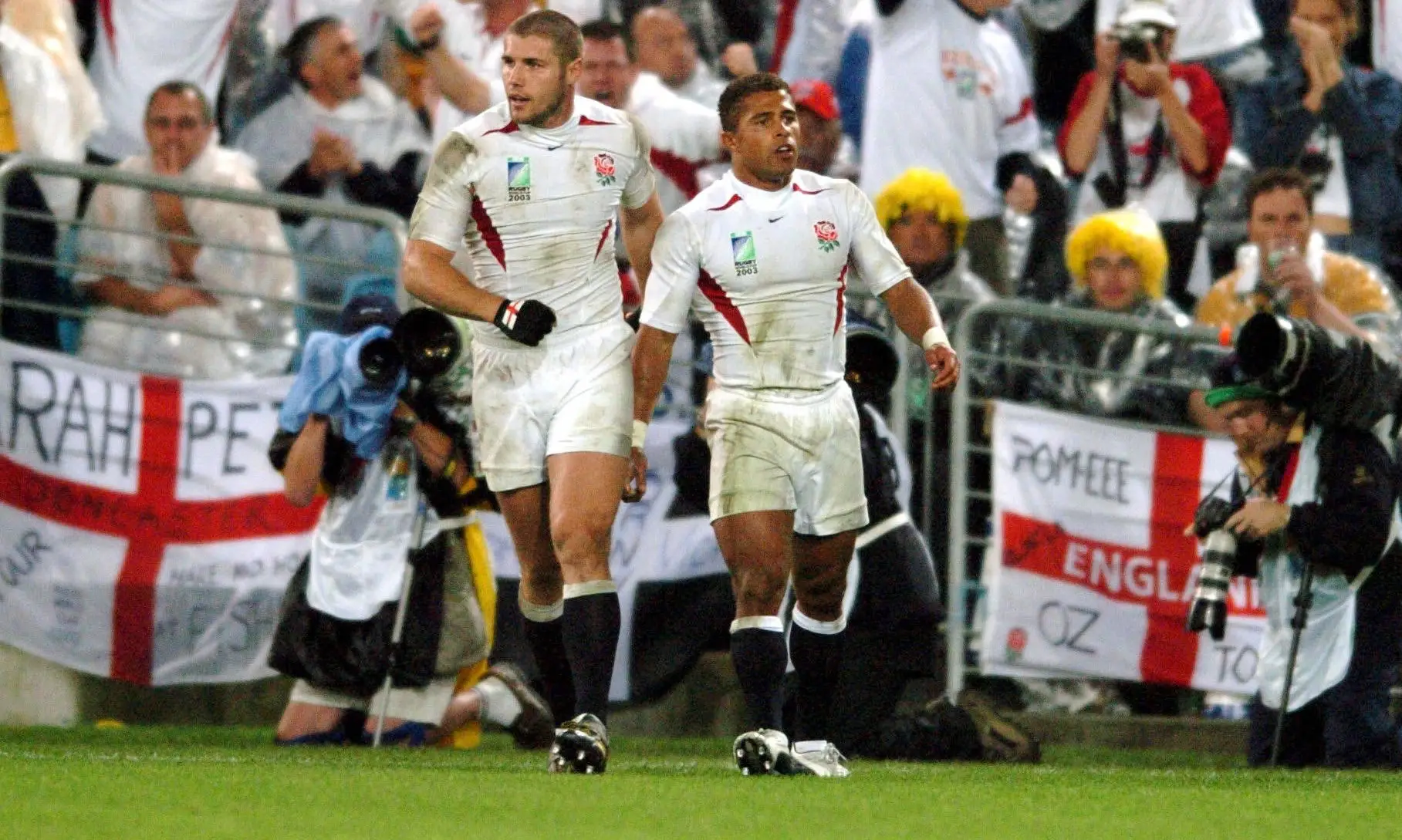
2 Jason Robinson (England)
A switch from rugby league to union could have taken years to master, but Jason Robinson made the transition look remarkably simple. His explosive acceleration and footwork immediately gave England a dangerous attacking weapon.
During a 56-Test career, Robinson scored 30 tries, including a famous effort in the 2003 World Cup final. He was equally effective on the wing or at fullback, particularly when broken-field opportunities opened up.
His influence also extended beyond what he produced with the ball. Robinson became England’s first Black captain and the first former professional rugby league player to lead the national team.
Few defenders could cope with him once he found space. That ability to turn half-chances into genuine scoring opportunities made Robinson one of the most dangerous attacking players of his generation.
RUCK GAMES
CAN YOU BUILD THE ULTIMATE RUGBY XV?
Draft rugby legends, choose their positions and see if you can beat the top score.
15 players. One ultimate team.
PLAY THE ULTIMATE DRAFT →1 Christian Cullen (New Zealand)
Every time Christian Cullen received the ball, there was a sense that something could happen.
Even from deep inside his own half, the New Zealander could accelerate through a gap and leave defenders struggling to keep up.
The numbers were extraordinary. Cullen scored 46 tries in just 58 Tests for New Zealand, an outstanding return for a player who spent much of his international career at fullback.
By the late 1990s, he had become one of the defining faces of New Zealand rugby. His combination of pace, balance and natural attacking instinct made him devastating in open space.
Injuries ultimately limited his international career, but they did little to damage his reputation.
At his best, Cullen made the counter-attack look almost inevitable, which is why he remains one of the finest examples of a truly devastating fullback.