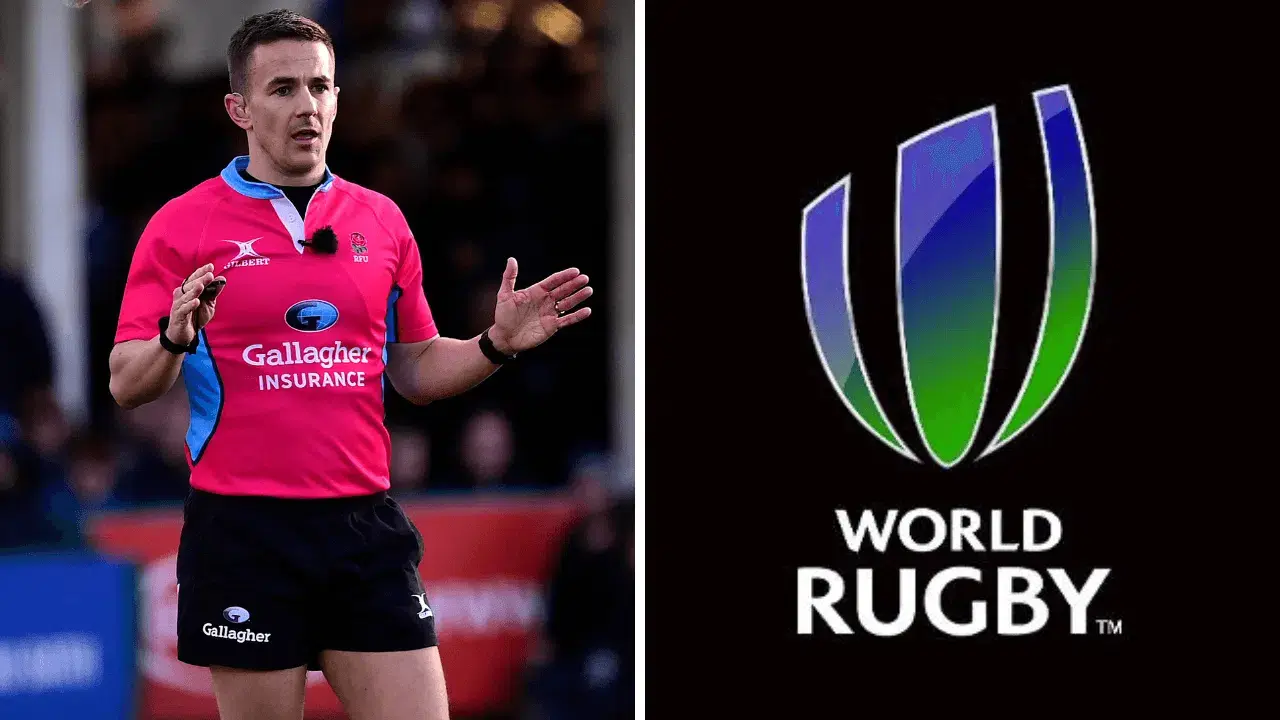

Quicker, accurate decision-making is the rationale behind trial amendments to the Television Match Official (TMO) protocol announced by World Rugby.
Starting for all competitions and stand-alone matches taking place after 1 July, the TMO will be given greater scope, supporting better, quicker decisions.
Formal adoption of the current practice of ‘on the run’ decision-making, where the TMO acts as a ‘sweeper’ on behalf of the referee to examine the following scenarios without stopping play:
- Law 8 Scoring: Incidents relating to whether a player was in touch or touch-in-goal
- Law 9: Dangerous play, specific to where any dangerous play can be immediately determined as a ‘play on’ or a penalty kick only offence
- Law 11: Knock-on or throw forward
- Law 18.2-18.8: All touch/touch-in-goal decisions, including whether a ball was in touch or not, and who took it into touch
In addition, in the event of a try, should the footage relating to an infringement only be made available by the broadcaster after the conversion has taken place, but before the restart, then the referee and TMO may highlight the infringement and deal with it accordingly.
The revised protocol has been designed with input from the world’s top match officials, broadcasters and laws experts, underpinning a collaborative and solution-focused approach.
Nigel Owens wants FOUR law changes to encourage ‘expansive rugby’
Popular referee Nigel Owens says rugby’s new Laws are NOT working to improve the game.
The Welshman, who hung up his whistle two years ago, has come up with four possible changes to encourage expansive rugby.
#1. Scrap the goal-line dropout
Owens wrote: "As for goal-line dropouts, I was a big fan initially because I felt it would prevent attacking teams from numerous pick-and-gos near the try line, with teams instead attempting to move the ball wide to avoid being held up and losing possession. But I'm not sure it has worked as planned. We still see plenty of pick-and-gos until teams get over, we still see plenty of mauls and the number of collisions hasn't decreased.
"We are also seeing fewer scrums near the goal line, and to be honest I'm not sure that is a good thing. The scrum needs to be an important part of the game, and right now we are not seeing the benefits of it. Rugby must continue to be a game for all shapes and sizes, and at all levels, too.
Attacking teams are also kicking longer knowing that if the ball rolls dead, the defending team has to do a goal-line dropout and they can get the ball back. We've also lost the short dropouts we used to see from the 22-metre line where teams would compete to win the ball back, or a quick dropout would be taken, because teams now backed up on their goal line just kick the ball long to escape and what happens? The opposition kick it back.
"From initially believing it would work, I would now like the goal-line dropout law to go to be honest. If anything it is having a negative effect."
#2. Stricter refereeing of RUCK's
Owens wrote: "To make it more effective, we need to be stricter about players staying on their feet at the contact area. Jackallers are going in to win turnovers and just being dragged to the ground by the attacking side, which means the jackaller has to let the ball go.
"The attacking side commits two, sometimes three players to the ruck to secure possession, but the defending side often decide not to continue contesting, and you end up with more defensive players on their feet, fanning out to cover the space, than attackers.
"It's illegal to pull a player down in that contact area, so until the officials deal with that more strictly, we are not going to see the full benefits of the 50:22 in terms of creating more space for attacking rugby. The law should stay, and the ruck law should be refereed."
#3. Less TMO
Owens wrote: "We should aim for good performances that facilitate good games. In my opinion, perfect has become the enemy of the good because people are striving for a standard that is unachievable. A frustrating over-reliance on the TMO is one result of this fear of getting things wrong.
"Pressure is being exerted on referees by spectators, social media users, coaches, players, performance reviewers and referee managers. That is a lot of people scrutinising everything. I think we need to take a step back and make sure we pick up the things that matter."
#4. Less replacements
Owens, who would like to see the number of replacements reduced from eight to four our five, previously said: "This is something I have been saying for a long time.
"Every question and answer session I do I am always asked which law I would like to change and I always say I would like to see the substitution law changed.
"We as referees and referee managers in World Rugby, we're always looking at things that need to be applied firmer, which contributes to the safety of the game and that is an ongoing process
"It is a physical game and unless you change it beyond total recognition of what the sport is, you are going to have to accept that there is going to be a risk of injury, but a minimal risk if you compare it to people that are injured everyday in walking about doing nothing."
#5. Crooked feeds must go
Owens wrote in his column for The Telegraph during the Lions series: "Some of the scrum-feeds from both sides - particularly in the second half by Cobus Reinach - were beyond a joke.

"I must say that I have been as guilty of not giving enough free-kicks for crooked feeds as any referee, but it has to be stopped as soon as possible now. Scrum-halves simply have to put the ball into scrums in an acceptable manner.
"Everyone you speak to about it wants feeds to be straight. Brian Moore has been making the point for years and I agree with him. Everyone comments on it, and there is no excuse. It has been allowed to creep in, after a brief crackdown a couple of years ago."
TRENDING





LATEST NEWS




LATEST COMMENTS
- Jordie Barrett over Damian de Allende is far from being correct. The hype around Dupont is also overreaching, he's probably 4th in the world and has been since the 2023 WC. He also avoids certain matchups which is strange. The rest of the list is pretty good apart from minor subjective biases.JasonMarlow16-09-2026
Loading